

 Vorschau anzeigen
 Versenden
 Teilen
 Details anzeigen

 Herunterladen
 Ähnliche Objekte
 Röntgenaufnahme
 Diashow
untitled (6226)

 Weiterlesen
Giclée / Kunstdruck
Giclée- oder Leinwanddruck in Museumsqualität mit schneller Produktion und flexiblen Veredelungsoptionen. ( Handgemaltes Gemälde kaufen Bild kaufen)




P118B $10

P118H $10

P118W $10

P438Z $10

P508JH $12

P508YH $12

P805H $10

P805Z $10

P919BZ $10

P919G $10

P919XJ $10

P959ZH $10

P968JZ $12

W106C $8

W218G $10

W218JH $8

W218Y $10

W307PJ $10

W316G $10

W316PJ $8

W316Y $10

W398PJ $8

W4111J $10

W500HY $15

W500JH $15

W692G $12

W849H $8

W940BG $15

W953PJ $8




Wählen Sie aus unseren vordefinierten Formaten, die den ursprünglichen Proportionen des Kunstwerks entsprechen.

Sie können Ihre eigenen Maße eingeben, um ein bestimmtes Format oder einen speziellen Platz einzupassen. Wenn das von Ihnen gewählte Format nicht den Proportionen des Originalbildes entspricht, werden wir das Kunstwerk entweder beschneiden oder das Bild mit einem gespiegelten oder einfarbigen Rand erweitern. Ein digitaler Entwurf wird Ihnen zur Genehmigung zugesandt, bevor die Produktion beginnt.
Bitte beachten Sie, dass die Vorschau auf dem Bildschirm nicht den tatsächlichen Zuschnitt oder die Erweiterung widerspiegelt. Nur der Entwurf zeigt die endgültige Komposition präzise an.
Obwohl Sondermaße verfügbar sind, empfehlen wir die Auswahl eines Maßes aus der vordefinierten Liste, um die ursprünglichen Proportionen zu bewahren.
Weltweiter Versand () innerhalb von 2 Wochen statt der üblichen 4/5 Wochen. (12 August)

Kostenloser weltweiter Expressversand

Hochwertige Leinenleinwand

Umfassender Versicherungsschutz beim Versand

Zollgebühren-Rückerstattungsgarantie

Garantie für exakte Farbtreue

60 Tage Rückgaberecht (nur bei Mängeln)

100% Geld-zurück-Garantie

Mengenrabatt verfügbar
 Die Glasoption ist nur für Größen unter 110 cm verfügbar.

untitled (6226)
Giclée / Kunstdruck
Format der Reproduktion
-


Gesamtpreis
$ 62
Sammlerstück-Beschreibung
The Quiet Revolution: Georges Braque and the Genesis of Cubism
Georges Braque's "Untitled (6226)" isn't a painting that shouts; it whispers. Born in Argenteuil, France, in 1882, Braque’s artistic journey began not with grand pronouncements but with the quiet discipline of his father’s trade – house painting and decoration. This foundational experience instilled within him an acute awareness of materials, structure, and the subtle language of form. Initially following a similar path, he soon recognized a deeper calling, enrolling in the École des Beaux-Arts in Le Havre, laying the groundwork for a career that would fundamentally challenge the conventions of Western art. The early 1900s witnessed a seismic shift in artistic thought, fueled by the influence of Paul Cézanne and the vibrant energy of Parisian life. Braque’s engagement with the Fauvist movement – characterized by bold colors and emotional expression – marked an initial departure, but it was his subsequent collaboration with Pablo Picasso that truly ignited the revolutionary spark of Cubism. This wasn't merely a stylistic shift; it represented a profound re-evaluation of how we perceive and represent reality on canvas.

Deconstructing Reality: The Techniques of Analytical Cubism
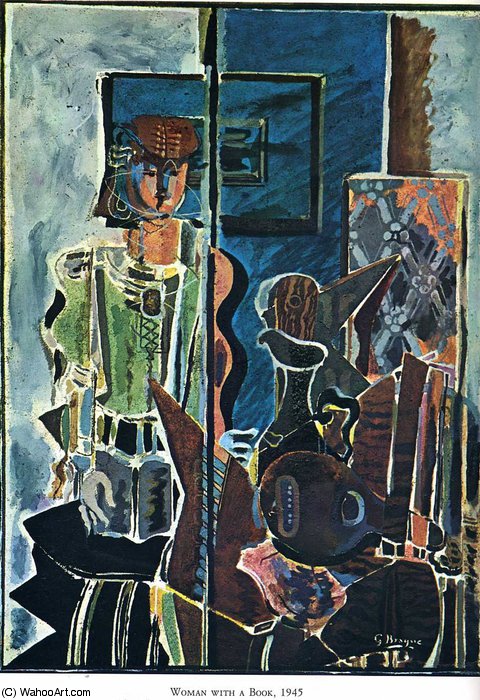
“Untitled (6226)” exemplifies the core tenets of Analytical Cubism, a period in which Braque and Picasso meticulously dismantled familiar objects into their geometric components. The image depicts a man seated, engaged with a guitar – an instrument imbued with both musicality and historical significance. Notice how the figure is fragmented, not rendered as a single, unified form but rather presented as a collection of interlocking planes and angles. This isn’t simply a stylistic choice; it's a deliberate attempt to capture multiple viewpoints simultaneously, reflecting the idea that objects can be understood from any angle. The muted palette – predominantly browns, grays, and ochres – further emphasizes this deconstruction, stripping away superficial color and focusing on the underlying structure of the scene. Braque’s brushwork is precise yet subtly textured, creating a sense of depth and volume despite the flattened perspective. The use of thin layers of paint allows light to penetrate through the forms, adding an ethereal quality to the composition.
Symbolism and Context: A Portrait of Artistic Collaboration
While seemingly straightforward in its subject matter, “Untitled (6226)” carries a deeper resonance. The guitar itself is a potent symbol – representing creativity, expression, and perhaps even contemplation. The man’s posture, seated and engaged with his instrument, suggests a moment of focused concentration, inviting the viewer to share in his artistic process. Considering Braque's close working relationship with Picasso during this period, it’s likely that this piece was conceived as part of a larger dialogue, an exploration of shared ideas and techniques. The painting reflects the spirit of collaboration that defined their Cubist experiments – a constant exchange of inspiration and a willingness to challenge established artistic norms. The inclusion of other figures in the background hints at a social context, suggesting a scene of domestic life or perhaps a gathering of artists.
A Legacy of Innovation: Braque’s Enduring Influence
Georges Braque's contribution to modern art is immeasurable. “Untitled (6226)” stands as a testament to his pioneering spirit and his ability to transform the way we see the world. His work paved the way for Synthetic Cubism, characterized by collage and brighter colors, and profoundly influenced subsequent movements such as Futurism and Constructivism. Today, Braque’s paintings continue to resonate with viewers, offering a glimpse into a pivotal moment in art history – a time of radical experimentation and profound artistic innovation. Reproductions of this piece offer an exceptional opportunity to bring this complex and intellectually stimulating work into your home or studio, allowing you to appreciate the subtle nuances of Braque's genius for years to come.
Ähnliche Kunstwerke


Über den Künstler
**frühes Leben und Ausbildung**
Georges Braque, ein prominenter französischer Maler, Kollagist, Bleistrichzeichner, Grafiker und Bildhauer, wurde am 13. Mai 1882 in Argenteuil, Val-d'oise, geboren. Er wuchs in Le Havre auf und erhielt zunächst eine Ausbildung als Hausmaler und Dekorateur wie sein Vater und Großvater. Braques künstlerische Neigungen führten ihn jedoch dazu, von 1897 bis 1899 an der École des Beaux-Arts in Le Havre Malerei zu studieren.**Künstlerische Entwicklung und Fauvisme**
Im Jahr 1902, nachdem er seine Lehre bei einem Dekorateur in Paris abgeschlossen hatte, besuchte Braque bis 1904 die Académie Humbert. Dieser Zeitraum markierte seine Einführung ins Fauvismus, einen Stil, der durch lebendige Farben und emotionale Reaktionen gekennzeichnet ist. Beeinflusst von den Werken von Henri Matisse und André Derain, übernahm Braque einen fauvistischen Ansatz, wie in seinem Gemälde The Patience (Fauvismus, Öl auf Leinwand).**Beitrag zum Kubismus**
Braques Zusammenarbeit mit Pablo Picasso von 1908 bis 1912 führte zur Entwicklung des Kubismus. Ihre analytischen kubistischen Werke, wie z.B. Georges Braque: The Patience und Pablo Picasso: Clarinet(analytischer Kubismus, Öl auf Leinwand), gelten heute als Meilensteine der Kunstgeschichte.**Erbe und bemerkenswerte Werke**
* Houses at L'Estaques: Ein Zeugnis für Braques innovatives Einsatz von Geometrie und simultaner Perspektive. * The Patience(Fauvismus, Öl auf Leinwand): Demonstriert Braques fauvistischen Stil. * Clarinet(analytischer Kubismus, Öl auf Leinwand): Eine kollaborative kubistische Arbeit mit Picasso.**Museen und Sammlungen**
* Musée d'Orsay: Bietet eine umfangreiche Sammlung impressionistischer und postimpressionistischer Kunst, darunter Werke von Braque. * Musée de l'Orangerie: Zeigt eine breite Palette von Kunstwerken, darunter Werke von Braque und anderen bedeutenden Künstlern.- Erfahren Sie mehr über Georges Braques Leben und Werk auf ArtsDot.com
- Entdecken Sie die Sammlung des Musée d'Orsay, die Werke von Braque und anderen Künstlern umfasst, unter Musée d'Orsay - Wikipedia
- Erfahren Sie mehr über den Fauvismus und seinen Einfluss auf die Entwicklung des Kubismus mit Fauvismus Kunstbewegung auf ArtsDot.com

Georges Braque
1882 - 1963 , Frankreich
Kurzinfos
- Beeinflusste Künstler: ['Pablo Picasso']
- Bemerkenswerte Werke:
- Häuser in L'Estaque
- Die Geduld (Fauvismus)
- Stillleben mit Pfeife
- Mandola
- Einflussreiche Künstler:
- Henri Matisse
- André Derain
- Paul Cézanne
- Geburtsdatum: 13. Mai 1882
- Geburtsort: Argenteuil, Frankreich
- Künstlerischer Stil: Kubismus, Fauvismus
- Nationalität: Französisch
- Sterbedatum: 1963
- Vollständiger Name: Georges Braque
Ähnliche Artikel

Die Kunst der Verschmelzung: Individuelle Kompositionen für bleibende Erinnerungen
ArtsDot verwandelt Ihre Fotos in einzigartige, handgemalte Meisterwerke. Erschaffen Sie bleibende Erinnerungen mit professionellen Künstlern und hochwertigen Materialien – Ihr persönliches Kunstwerk für Generationen.

Deconstructing Reality: Cubism's Revolutionary Impact on 20th-Century Art
Explore the revolutionary world of Cubism with ArtsDot. Discover Picasso & Braque's groundbreaking techniques, its philosophical roots, and lasting impact on modern art. Expert insights for collectors.

Die 10 Meisterwerke des Kubismus: Kunst für Ihr Zuhause | ArtsDot
Entdecken Sie die 10 bedeutendsten Meisterwerke des Kubismus von Picasso, Braque & Gris! Erfahren Sie mehr über Kunstgeschichte, Techniken und Farben. Hochwertige Kunstdrucke auf ArtsDot.com – für stilvolle Wandgestaltung.

The Eloquence of Arrangement: Compositional Strategies in Western Art from the Renaissance to Modernism
Explore the evolution of compositional strategies in Western art! Discover how masters like Raphael & Zurbaran used perspective, proportion, and dynamic arrangement to create timeless masterpieces. Enhance your art appreciation today!

Die 10 Meisterwerke des Kubismus: Kunstgeschichte für Ihr Zuhause |
Entdecken Sie die 10 prägendsten Meisterwerke des Kubismus! Von Picasso bis Braque – erfahren Sie die Geschichten hinter ikonischen Gemälde und lassen Sie sich von moderner Kunst inspirieren. Kunstreproduktionen in Museumsqualiät auf .



