

 Vorschau anzeigen
 Versenden
 Teilen
 Details anzeigen

 Herunterladen
 Ähnliche Objekte
 Röntgenaufnahme
 Diashow
The Three Boats
 Oil On Canvas
- WallArt
- Cubism
 1929
1929 24.0 x 35.0 cm
 Weiterlesen
Giclée / Kunstdruck
Giclée- oder Leinwanddruck in Museumsqualität mit schneller Produktion und flexiblen Veredelungsoptionen. ( Zur handgemalten Reproduktion wechseln Zum Bild wechseln)




P118B $10

P118H $10

P118W $10

P438Z $10

P508JH $12

P508YH $12

P805H $10

P805Z $10

P919BZ $10

P919G $10

P919XJ $10

P959ZH $10

P968JZ $12

W106C $8

W218G $10

W218JH $8

W218Y $10

W307PJ $10

W316G $10

W316PJ $8

W316Y $10

W398PJ $8

W4111J $10

W500HY $15

W500JH $15

W692G $12

W849H $8

W940BG $15

W953PJ $8




Wählen Sie aus unseren vordefinierten Formaten, die den ursprünglichen Proportionen des Kunstwerks entsprechen.

Sie können Ihre eigenen Maße eingeben, um ein bestimmtes Format oder einen speziellen Platz einzupassen. Wenn das von Ihnen gewählte Format nicht den Proportionen des Originalbildes entspricht, werden wir das Kunstwerk entweder beschneiden oder das Bild mit einem gespiegelten oder einfarbigen Rand erweitern. Ein digitaler Entwurf wird Ihnen zur Genehmigung zugesandt, bevor die Produktion beginnt.
Bitte beachten Sie, dass die Vorschau auf dem Bildschirm nicht den tatsächlichen Zuschnitt oder die Erweiterung widerspiegelt. Nur der Entwurf zeigt die endgültige Komposition präzise an.
Obwohl Sondermaße verfügbar sind, empfehlen wir die Auswahl eines Maßes aus der vordefinierten Liste, um die ursprünglichen Proportionen zu bewahren.
Weltweiter Versand () innerhalb von 2 Wochen statt der üblichen 4/5 Wochen. (11 August)

Kostenloser weltweiter Expressversand

Hochwertige Leinenleinwand

Umfassender Versicherungsschutz beim Versand

Zollgebühren-Rückerstattungsgarantie

Garantie für exakte Farbtreue

60 Tage Rückgaberecht (nur bei Mängeln)

100% Geld-zurück-Garantie

Mengenrabatt verfügbar
 Die Glasoption ist nur für Größen unter 110 cm verfügbar.

The Three Boats
Giclée / Kunstdruck
Format der Reproduktion
-


Gesamtpreis
$ 62
Sammlerstück-Beschreibung
A Stormy Vision of the Coastline
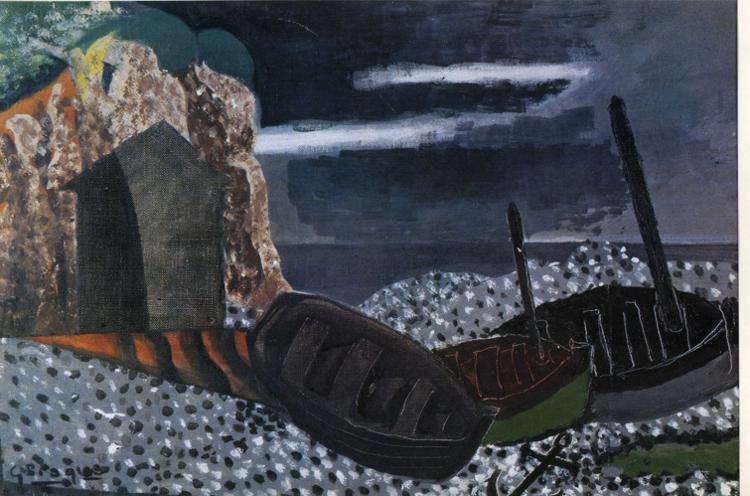
Georges Braque’s “The Three Boats” (1929) isn't merely a depiction of a coastal scene; it’s an immersion into a mood, a palpable sense of drama and isolation. Painted during a pivotal period in his artistic evolution, this oil on canvas captures the raw power of nature against a backdrop of muted blues and greys – colors that speak of impending storm or a lingering twilight. The composition immediately draws the eye to the turbulent sea, dominated by three small boats seemingly adrift amidst the churning waves. These aren’t idyllic vessels; they are humble craft, vulnerable yet resilient, hinting at the lives inextricably linked to this rugged coastline.
The painting's strength lies not in photographic realism but in Braque’s masterful manipulation of form and color. He employs a distinctly Expressionist approach, prioritizing emotional impact over precise detail. The boats themselves are rendered with simplified geometric shapes – rectangles and ovals – that contribute to the overall sense of dynamism and movement. The rocky shoreline is similarly abstracted, its jagged edges defined by bold, assertive lines. This deliberate flattening of perspective creates an almost theatrical stage for the drama unfolding before us.
Cubism’s Echoes and a Shift in Perspective
“The Three Boats” firmly resides within the burgeoning world of Cubism, though it moves beyond its purely analytical roots. Braque, alongside Pablo Picasso, was dismantling traditional notions of representation, fracturing objects into geometric components and presenting them from multiple viewpoints simultaneously. However, unlike some of Picasso’s more overtly intellectual explorations, Braque's work retains a strong connection to the natural world. He doesn’t simply dissect forms; he uses these fragmented shapes to evoke feeling – a sense of unease, perhaps, or the humbling power of the sea.
The painting’s historical context is crucial to understanding its significance. The 1920s were a time of rapid social and artistic change in Europe, marked by disillusionment after World War I and a growing interest in exploring subjective experience. Braque's work reflects this spirit of experimentation, pushing the boundaries of traditional art while retaining a deep appreciation for the beauty and power of the natural world.
Symbolism and Emotional Resonance
Beyond its formal qualities, “The Three Boats” is rich in symbolic meaning. The boats themselves can be interpreted as metaphors for human vulnerability and resilience – small vessels confronting the vastness and unpredictability of life. The stormy sky suggests challenges and uncertainties, while the quiet stillness of the shoreline offers a hint of solace or contemplation. The limited color palette—primarily blues, greys, and browns—reinforces this sense of melancholy and introspection.
Braque’s use of thick impasto – applying paint in heavy layers – adds to the painting's tactile quality and emotional intensity. The visible brushstrokes create a sense of immediacy and energy, as if the artist himself was wrestling with the subject matter. The textured surface invites viewers to engage physically with the artwork, further enhancing its immersive effect.
A Timeless Masterpiece for Art Lovers
“The Three Boats” is more than just a painting; it’s an experience. It's a powerful evocation of coastal drama, rendered with Braque’s signature blend of geometric precision and expressive emotion. Whether you are an art enthusiast, a collector seeking to enrich your collection, or an interior designer searching for a captivating piece to complement your space, this work offers a timeless appeal. Reproductions capture the essence of this dramatic scene, bringing its evocative power into any setting.
Ähnliche Kunstwerke


Über den Künstler
**frühes Leben und Ausbildung**
Georges Braque, ein prominenter französischer Maler, Kollagist, Bleistrichzeichner, Grafiker und Bildhauer, wurde am 13. Mai 1882 in Argenteuil, Val-d'oise, geboren. Er wuchs in Le Havre auf und erhielt zunächst eine Ausbildung als Hausmaler und Dekorateur wie sein Vater und Großvater. Braques künstlerische Neigungen führten ihn jedoch dazu, von 1897 bis 1899 an der École des Beaux-Arts in Le Havre Malerei zu studieren.**Künstlerische Entwicklung und Fauvisme**
Im Jahr 1902, nachdem er seine Lehre bei einem Dekorateur in Paris abgeschlossen hatte, besuchte Braque bis 1904 die Académie Humbert. Dieser Zeitraum markierte seine Einführung ins Fauvismus, einen Stil, der durch lebendige Farben und emotionale Reaktionen gekennzeichnet ist. Beeinflusst von den Werken von Henri Matisse und André Derain, übernahm Braque einen fauvistischen Ansatz, wie in seinem Gemälde The Patience (Fauvismus, Öl auf Leinwand).**Beitrag zum Kubismus**
Braques Zusammenarbeit mit Pablo Picasso von 1908 bis 1912 führte zur Entwicklung des Kubismus. Ihre analytischen kubistischen Werke, wie z.B. Georges Braque: The Patience und Pablo Picasso: Clarinet(analytischer Kubismus, Öl auf Leinwand), gelten heute als Meilensteine der Kunstgeschichte.**Erbe und bemerkenswerte Werke**
* Houses at L'Estaques: Ein Zeugnis für Braques innovatives Einsatz von Geometrie und simultaner Perspektive. * The Patience(Fauvismus, Öl auf Leinwand): Demonstriert Braques fauvistischen Stil. * Clarinet(analytischer Kubismus, Öl auf Leinwand): Eine kollaborative kubistische Arbeit mit Picasso.**Museen und Sammlungen**
* Musée d'Orsay: Bietet eine umfangreiche Sammlung impressionistischer und postimpressionistischer Kunst, darunter Werke von Braque. * Musée de l'Orangerie: Zeigt eine breite Palette von Kunstwerken, darunter Werke von Braque und anderen bedeutenden Künstlern.- Erfahren Sie mehr über Georges Braques Leben und Werk auf ArtsDot.com
- Entdecken Sie die Sammlung des Musée d'Orsay, die Werke von Braque und anderen Künstlern umfasst, unter Musée d'Orsay - Wikipedia
- Erfahren Sie mehr über den Fauvismus und seinen Einfluss auf die Entwicklung des Kubismus mit Fauvismus Kunstbewegung auf ArtsDot.com

Georges Braque
1882 - 1963 , Frankreich
Kurzinfos
- Beeinflusste Künstler: ['Pablo Picasso']
- Bemerkenswerte Werke:
- Häuser in L'Estaque
- Die Geduld (Fauvismus)
- Stillleben mit Pfeife
- Mandola
- Einflussreiche Künstler:
- Henri Matisse
- André Derain
- Paul Cézanne
- Geburtsdatum: 13. Mai 1882
- Geburtsort: Argenteuil, Frankreich
- Künstlerischer Stil: Kubismus, Fauvismus
- Nationalität: Französisch
- Sterbedatum: 1963
- Vollständiger Name: Georges Braque
Ähnliche Artikel

Georges Braque: Die 25 Meisterwerke des Kubismus für Ihr Zuhause | ArtsDot
Entdecken Sie die 25 bedeutendsten Kunstwerke von Georges Braque – vom Kubismus bis zum Fauvismus. Erfahren Sie die Geschichten hinter den Meisterwerken und finden Sie hochwertige Reproduktionen für Ihr Zuhause auf ArtsDot.com.

Georges Seurat: Die 25 Meisterwerke des Pointillismus für Ihr Zuhause | ArtsDot
Entdecken Sie die 25 ikonischsten Meisterwerke von Georges Seurat! Tauchen Sie ein in die Welt des Pointillismus, der Farbtheorie und des Impressionismus. Hochwertige Kunst reproduzieren für Ihr Zuhause – jetzt auf ArtsDot.com!

Die schönsten Landschaftsbilder: 10 Meisterwerke für Ihr Zuhause | ArtsDot.com
Entdecken Sie die 10 schönsten Landschaftsbilder der Kunstgeschichte! Von Monet bis Van Gogh – erfahren Sie die Geschichten hinter Meisterwerken & finden Sie Inspiration für Ihr Zuhause. Hochwertige Kunstdrucke auf ArtsDot.com.

Redefining Nature: A Collector's Guide to the Geometric Beauty of Cubist Landscapes
Explore the revolutionary world of Cubist landscapes. Discover how masters like Picasso and Braque redefined nature through geometric beauty, and learn expert tips for curating these transformative masterpieces in your modern home collection.

Romantische Landschaften: Die 10 Meisterwerke, die eine Epoche prägten | ArtsDot
Entdecken Sie die 10 Meisterwerke der Romantischen Landschaftsmalerei! Von Caspar David Friedrich bis Turner – erleben Sie die Kunst, Emotion & Natur. Hochwertige Reproduktionen auf ArtsDot.com



