


 In echtem Maßstab anzeigen
 Versenden als Grußkarte
 Teilen
 Details anzeigen
 Leitfaden öffnen

 Herunterladen
 Ähnliche Objekte
 Röntgenaufnahme
 Diashow
 Besucherstatistiken
The Pink Napkin


 Mehr anzeigen
Giclée / Kunstdruck
Giclée- oder Leinwanddruck in Museumsqualität mit schneller Produktion und flexiblen Veredelungsoptionen. ( Handgemalte Reproduktion kaufen Zum digitalen Bild wechseln)




P118B $10

P118H $10

P118W $10

P438Z $10

P508JH $12

P508YH $12

P805H $10

P805Z $10

P919BZ $10

P919G $10

P919XJ $10

P959ZH $10

P968JZ $12

W106C $8

W218G $10

W218JH $8

W218Y $10

W307PJ $10

W316G $10

W316PJ $8

W316Y $10

W398PJ $8

W4111J $10

W500HY $15

W500JH $15

W692G $12

W849H $8

W940BG $15

W953PJ $8




Wählen Sie aus unseren vordefinierten Formaten, die den ursprünglichen Proportionen des Kunstwerks entsprechen.

Sie können Ihre eigenen Maße eingeben, um ein bestimmtes Format oder einen speziellen Platz einzupassen. Wenn das von Ihnen gewählte Format nicht den Proportionen des Originalbildes entspricht, werden wir das Kunstwerk entweder beschneiden oder das Bild mit einem gespiegelten oder einfarbigen Rand erweitern. Ein digitaler Entwurf wird Ihnen zur Genehmigung zugesandt, bevor die Produktion beginnt.
Bitte beachten Sie, dass die Vorschau auf dem Bildschirm nicht den tatsächlichen Zuschnitt oder die Erweiterung widerspiegelt. Nur der Entwurf zeigt die endgültige Komposition präzise an.
Obwohl Sondermaße verfügbar sind, empfehlen wir die Auswahl eines Maßes aus der vordefinierten Liste, um die ursprünglichen Proportionen zu bewahren.
Weltweiter Versand () innerhalb von 2 Wochen statt der üblichen 4/5 Wochen. (25 September)

Kostenloser weltweiter Expressversand

Hochwertige Leinenleinwand

Vollständiger Versicherungsschutz beim Versand

Zollgebühren-Rückerstattungsgarantie

Garantie für exakte Farbtreue

100-tägiges Rückgaberecht (nur bei Mängeln)

100% Geld-zurück-Garantie

Angebot für Mengenrabatt
 Die Glasoption ist nur für Größen unter 110 cm verfügbar.

The Pink Napkin
Giclée / Kunstdruck
Format der Reproduktion
-


Gesamtpreis
$ 62
The Enigmatic Charm of "The Pink Napkin": A Glimpse into Braque’s Cubist World
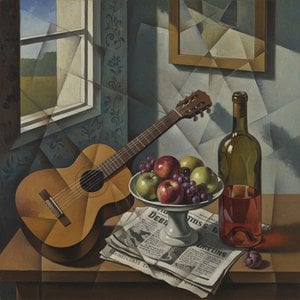
Georges Braque's “The Pink Napkin,” painted in 1933, isn’t merely a still life; it’s a carefully constructed puzzle box inviting the viewer to contemplate the very nature of perception and representation. This vibrant canvas, brimming with familiar objects – fruit, cutlery, and a figure bathed in dappled light – immediately draws us into its world, yet subtly resists easy interpretation. The painting's power lies not just in its visual richness but also in the intellectual challenge it presents, characteristic of Braque’s pivotal role in developing Cubism alongside Pablo Picasso. It’s a testament to his exploration of fractured forms and multiple viewpoints, pushing beyond traditional notions of realistic depiction.A Fusion of Influences: Fauvism and Cézanne's Legacy
“The Pink Napkin” stands as a fascinating bridge between Braque’s early Fauvist period and the more rigorously geometric explorations of Cubism. The initial influence of Fauvism is evident in the bold, unrestrained use of color – the intense pink of the napkin itself, contrasted with the oranges and yellows of the fruit, creates an immediate visual impact. However, unlike the purely emotive approach of the Fauves, Braque’s palette feels more considered, balanced by a growing interest in structure and form. This is where the influence of Paul Cézanne becomes crucial. Cézanne's late works, with their emphasis on geometric simplification and multiple perspectives, provided Braque with a foundational model for deconstructing objects into their essential components. The painting’s fragmented forms and overlapping planes clearly echo Cézanne’s approach to capturing spatial relationships – a key element in the development of Cubism.Deconstructed Reality: The Language of Cubism
At its core, “The Pink Napkin” exemplifies Analytical Cubism. Braque doesn't aim to present a single, unified view of the scene; instead, he breaks down each object – the fruit, the cup, the spoon – into a series of interlocking geometric shapes. These fragments are then rearranged and presented simultaneously on the canvas, forcing the viewer’s eye to actively piece together the image. The figure in the background, partially obscured by the table setting, adds another layer of complexity, further disrupting any sense of conventional spatial relationships. Notice how the light itself seems fractured, cast across the objects in a way that defies easy understanding. This deliberate distortion isn't about inaccuracy; it’s about revealing the underlying structure and principles governing our perception of reality.Symbolism and Emotional Resonance: A Quiet Contemplation
While Cubism is often associated with radical experimentation, “The Pink Napkin” possesses a surprising degree of quiet contemplation. The objects depicted – fruit, tableware – are commonplace, yet their arrangement feels deliberately staged, inviting reflection on themes of abundance, consumption, and perhaps even the fleeting nature of pleasure. The pink napkin itself could be interpreted as a symbol of hospitality or intimacy, while the scattered fruit suggests a moment of shared enjoyment. The presence of the secondary figure adds an element of mystery, hinting at another participant in this intimate scene – someone observing, perhaps contemplating the arrangement itself. Braque’s masterful use of light and shadow further enhances the painting's emotional depth, creating a sense of warmth and serenity despite the fragmented composition. It’s a work that rewards careful observation and invites viewers to project their own interpretations onto its enigmatic surface.ArtsDot Reproduction: Bringing Braque’s Vision to Life
ArtsDot is proud to offer meticulously crafted, hand-painted reproductions of “The Pink Napkin.” Our artists recreate the painting's vibrant colors and complex textures with exceptional detail, ensuring that every nuance of Braque’s original vision is faithfully preserved. Whether you are an art collector, interior designer seeking a striking statement piece, or simply an admirer of this iconic work, our reproductions provide a beautiful and authentic way to experience the power and beauty of Georges Braque's masterpiece. Explore our range of sizes and canvas options to find the perfect addition to your collection – a tangible link to one of the 20th century’s most influential artists.Ähnliche Kunstwerke


Biografie des Künstlers
**frühes Leben und Ausbildung**
Georges Braque, ein prominenter französischer Maler, Kollagist, Bleistrichzeichner, Grafiker und Bildhauer, wurde am 13. Mai 1882 in Argenteuil, Val-d'oise, geboren. Er wuchs in Le Havre auf und erhielt zunächst eine Ausbildung als Hausmaler und Dekorateur wie sein Vater und Großvater. Braques künstlerische Neigungen führten ihn jedoch dazu, von 1897 bis 1899 an der École des Beaux-Arts in Le Havre Malerei zu studieren.**Künstlerische Entwicklung und Fauvisme**
Im Jahr 1902, nachdem er seine Lehre bei einem Dekorateur in Paris abgeschlossen hatte, besuchte Braque bis 1904 die Académie Humbert. Dieser Zeitraum markierte seine Einführung ins Fauvismus, einen Stil, der durch lebendige Farben und emotionale Reaktionen gekennzeichnet ist. Beeinflusst von den Werken von Henri Matisse und André Derain, übernahm Braque einen fauvistischen Ansatz, wie in seinem Gemälde The Patience (Fauvismus, Öl auf Leinwand).**Beitrag zum Kubismus**
Braques Zusammenarbeit mit Pablo Picasso von 1908 bis 1912 führte zur Entwicklung des Kubismus. Ihre analytischen kubistischen Werke, wie z.B. Georges Braque: The Patience und Pablo Picasso: Clarinet(analytischer Kubismus, Öl auf Leinwand), gelten heute als Meilensteine der Kunstgeschichte.**Erbe und bemerkenswerte Werke**
* Houses at L'Estaques: Ein Zeugnis für Braques innovatives Einsatz von Geometrie und simultaner Perspektive. * The Patience(Fauvismus, Öl auf Leinwand): Demonstriert Braques fauvistischen Stil. * Clarinet(analytischer Kubismus, Öl auf Leinwand): Eine kollaborative kubistische Arbeit mit Picasso.**Museen und Sammlungen**
* Musée d'Orsay: Bietet eine umfangreiche Sammlung impressionistischer und postimpressionistischer Kunst, darunter Werke von Braque. * Musée de l'Orangerie: Zeigt eine breite Palette von Kunstwerken, darunter Werke von Braque und anderen bedeutenden Künstlern.- Erfahren Sie mehr über Georges Braques Leben und Werk auf ArtsDot.com
- Entdecken Sie die Sammlung des Musée d'Orsay, die Werke von Braque und anderen Künstlern umfasst, unter Musée d'Orsay - Wikipedia
- Erfahren Sie mehr über den Fauvismus und seinen Einfluss auf die Entwicklung des Kubismus mit Fauvismus Kunstbewegung auf ArtsDot.com

Georges Braque
1882 - 1963 , Frankreich
Eckdaten zum Künstler
- Beeinflusste Künstler: ['Pablo Picasso']
- Bemerkenswerte Werke:
- Häuser in L'Estaque
- Die Geduld (Fauvismus)
- Stillleben mit Pfeife
- Mandola
- Einflussreiche Künstler:
- Henri Matisse
- André Derain
- Paul Cézanne
- Geburtsdatum: 13. Mai 1882
- Geburtsort: Argenteuil, Frankreich
- Künstlerischer Stil: Kubismus, Fauvismus
- Nationalität: Französisch
- Sterbedatum: 1963
- Vollständiger Name: Georges Braque
Verwandte Artikel

Die zartesten Meisterwerke: Top 10 Gemälde in Lichtrosa & ihre Geschichte |
Entdecken Sie die Top 10 berühmter Gemälde in zarten Rosatönen! Von impressionistischen Meisterwerken bis hin zu romantischen Ikonen – erfahren Sie mehr über Künstler, Techniken & Geschichte. Hochwertige Kunstdrucke auf .
Deconstructing Reality: A Comprehensive Exploration of Cubist Still Life
Explore the revolutionary world of Cubist Still Life with ArtsDot. Discover Picasso & Braque's groundbreaking techniques, its philosophical roots, and lasting impact on modern art. Expert insights for collectors.

Georges Braque: Die 25 Meisterwerke des Kubismus für Ihr Zuhause | ArtsDot
Entdecken Sie die 25 bedeutendsten Kunstwerke von Georges Braque – vom Kubismus bis zum Fauvismus. Erfahren Sie die Geschichten hinter den Meisterwerken und finden Sie hochwertige Reproduktionen für Ihr Zuhause auf ArtsDot.com.

Georges Seurat: Die 25 Meisterwerke des Pointillismus für Ihr Zuhause | ArtsDot
Entdecken Sie die 25 ikonischsten Meisterwerke von Georges Seurat! Tauchen Sie ein in die Welt des Pointillismus, der Farbtheorie und des Impressionismus. Hochwertige Kunst reproduzieren für Ihr Zuhause – jetzt auf ArtsDot.com!

Georges Braque: Pionier des Kubismus und die Evolution moderner Formensprache
Entdecken Sie Georges Braques revolutionären Einfluss auf den Kubismus und die moderne Kunstgeschichte. Expertenanalyse seiner Formensprache, Werke & Bedeutung. Jetzt lesen!


