


 In echtem Maßstab anzeigen
 Versenden als Grußkarte
 Teilen
 Details anzeigen
 Leitfaden

 Herunterladen
 Ähnliche Objekte
 Röntgenaufnahme
 Diashow
 Besucherstatistiken
The Fireplace


 Mehr anzeigen
Handgefertigte Ölreproduktion
Handgemaltes Ölgemälde auf Leinwand in Ihrer Wunschgröße und mit Rahmen, auf Bestellung von unseren Künstlern angefertigt. ( Zum Druck wechseln Zum digitalen Bild wechseln)




P118B $10

P118H $10

P118W $10

P438Z $10

P508JH $12

P508YH $12

P805H $10

P805Z $10

P919BZ $10

P919G $10

P919XJ $10

P959ZH $10

P968JZ $12

W106C $8

W218G $10

W218JH $8

W218Y $10

W307PJ $10

W316G $10

W316PJ $8

W316Y $10

W398PJ $8

W4111J $10

W500HY $15

W500JH $15

W692G $12

W849H $8

W940BG $15

W953PJ $8




Wählen Sie aus unseren vordefinierten Formaten, die den ursprünglichen Proportionen des Kunstwerks entsprechen.

Sie können Ihre eigenen Maße eingeben, um einen bestimmten Rahmen oder Platz auszufüllen. Wenn die gewählte Größe nicht den Proportionen des Originalbildes entspricht, werden wir das Kunstwerk entweder beschneiden oder das Gemälde durch zusätzliche, handgemalte Elemente erweitern. Ein digitales Mockup wird Ihnen zur Genehmigung zugesandt, bevor die Produktion beginnt.
Bitte beachten Sie, dass die Bildschirmvorschau nicht die tatsächliche Beschneidung oder Erweiterung widerspiegelt. Nur das Mockup zeigt die endgültige Komposition exakt an.
Obwohl Sondermaße verfügbar sind, empfehlen wir, eine Größe aus der vordefinierten Liste zu wählen, um die ursprünglichen Proportionen beizubehalten.
Nach der Bestellung wird das ArtsDot.com-Team dem Kunden Anweisungen per E-Mail zusenden und eine Mockup-Vorschau bereitstellen.
Weltweiter Versand () in nur 3 bis 4 Wochen statt der üblichen 5 Wochen. (24 September). Keine Kompromisse bei der Qualität.

Kostenloser weltweiter Expressversand

Hochwertige Leinenleinwand

Vollständiger Versicherungsschutz beim Versand

Zollgebühren-Rückerstattungsgarantie

Garantie für exakte Farbtreue

100-tägiges Rückgaberecht (nur bei Mängeln)

100% Geld-zurück-Garantie

Angebot für Mengenrabatt
 Die Glasoption ist nur für Größen unter 110 cm verfügbar.

The Fireplace
Reproduktionsmedium
Format der Reproduktion
-


Gesamtpreis
$ 263
Georges Braque’s ‘The Fireplace’: A Cubist Exploration of Domesticity
The Fireplace, a captivating work by Georges Braque, offers a profound meditation on the everyday rendered through the revolutionary lens of early 20th-century Cubism. Painted around 1910-1914, during Braque’s pivotal collaboration with Pablo Picasso, this piece exemplifies the movement's radical departure from traditional representational art. It isn’t merely a depiction of a room; it’s an intellectual puzzle, a fragmented portrait of domestic life meticulously constructed to challenge our perception of space and form.
- Subject Matter: The scene is deceptively simple – a guitar resting on which a person sits, alongside a bowl, banana, and chair. Yet, Braque elevates these familiar objects into the subject of intense scrutiny.
- Cubist Technique: Braque’s masterful use of fractured planes and multiple perspectives dismantles the illusion of depth, presenting the elements simultaneously from various viewpoints. This technique, central to Cubism, forces the viewer to actively participate in constructing the image.
The Genesis of Fragmentation
Braque's artistic journey was deeply rooted in his upbringing. Born in Argenteuil, France, in 1882, he inherited a practical understanding of materials and form from his father, a house painter and decorator. This early exposure to craftsmanship—the careful layering of paint, the manipulation of textures—informed his later experimentation with abstraction. His formal training at the École des Beaux-Arts in Le Havre provided him with a solid foundation in academic drawing techniques, which he then deliberately subverted through Cubism. The influence of Paul Cézanne, particularly his exploration of geometric forms and multiple viewpoints, is readily apparent in Braque’s work.
Symbolic Layers and Emotional Resonance
While seemingly straightforward, The Fireplace is rich with potential symbolism. The guitar, a recurring motif in Braque's oeuvre, can be interpreted as representing musicality, leisure, or even the artist's own creative process. The bowl and banana introduce an element of still life tradition, but their inclusion within the fractured composition disrupts any sense of serene beauty. The chair suggests occupation, perhaps contemplation or simply the act of existing in a space. The overall effect is one of quiet tension, inviting viewers to consider the complexities of human experience within the confines of domesticity.
A Legacy of Innovation
The Fireplace stands as a testament to Braque’s pivotal role in shaping modern art. His collaboration with Picasso during this period – often referred to as “Analytical Cubism” – fundamentally altered the course of artistic history. This work, like many others from this era, demonstrates Braque's commitment to pushing boundaries and challenging established conventions. A hand-painted reproduction offers a unique opportunity to experience firsthand the power and intellectual depth of this seminal artwork.
Ähnliche Kunstwerke


Biografie des Künstlers
**frühes Leben und Ausbildung**
Georges Braque, ein prominenter französischer Maler, Kollagist, Bleistrichzeichner, Grafiker und Bildhauer, wurde am 13. Mai 1882 in Argenteuil, Val-d'oise, geboren. Er wuchs in Le Havre auf und erhielt zunächst eine Ausbildung als Hausmaler und Dekorateur wie sein Vater und Großvater. Braques künstlerische Neigungen führten ihn jedoch dazu, von 1897 bis 1899 an der École des Beaux-Arts in Le Havre Malerei zu studieren.**Künstlerische Entwicklung und Fauvisme**
Im Jahr 1902, nachdem er seine Lehre bei einem Dekorateur in Paris abgeschlossen hatte, besuchte Braque bis 1904 die Académie Humbert. Dieser Zeitraum markierte seine Einführung ins Fauvismus, einen Stil, der durch lebendige Farben und emotionale Reaktionen gekennzeichnet ist. Beeinflusst von den Werken von Henri Matisse und André Derain, übernahm Braque einen fauvistischen Ansatz, wie in seinem Gemälde The Patience (Fauvismus, Öl auf Leinwand).**Beitrag zum Kubismus**
Braques Zusammenarbeit mit Pablo Picasso von 1908 bis 1912 führte zur Entwicklung des Kubismus. Ihre analytischen kubistischen Werke, wie z.B. Georges Braque: The Patience und Pablo Picasso: Clarinet(analytischer Kubismus, Öl auf Leinwand), gelten heute als Meilensteine der Kunstgeschichte.**Erbe und bemerkenswerte Werke**
* Houses at L'Estaques: Ein Zeugnis für Braques innovatives Einsatz von Geometrie und simultaner Perspektive. * The Patience(Fauvismus, Öl auf Leinwand): Demonstriert Braques fauvistischen Stil. * Clarinet(analytischer Kubismus, Öl auf Leinwand): Eine kollaborative kubistische Arbeit mit Picasso.**Museen und Sammlungen**
* Musée d'Orsay: Bietet eine umfangreiche Sammlung impressionistischer und postimpressionistischer Kunst, darunter Werke von Braque. * Musée de l'Orangerie: Zeigt eine breite Palette von Kunstwerken, darunter Werke von Braque und anderen bedeutenden Künstlern.- Erfahren Sie mehr über Georges Braques Leben und Werk auf ArtsDot.com
- Entdecken Sie die Sammlung des Musée d'Orsay, die Werke von Braque und anderen Künstlern umfasst, unter Musée d'Orsay - Wikipedia
- Erfahren Sie mehr über den Fauvismus und seinen Einfluss auf die Entwicklung des Kubismus mit Fauvismus Kunstbewegung auf ArtsDot.com

Georges Braque
1882 - 1963 , Frankreich
Eckdaten zum Künstler
- Beeinflusste Künstler: ['Pablo Picasso']
- Bemerkenswerte Werke:
- Häuser in L'Estaque
- Die Geduld (Fauvismus)
- Stillleben mit Pfeife
- Mandola
- Einflussreiche Künstler:
- Henri Matisse
- André Derain
- Paul Cézanne
- Geburtsdatum: 13. Mai 1882
- Geburtsort: Argenteuil, Frankreich
- Künstlerischer Stil: Kubismus, Fauvismus
- Nationalität: Französisch
- Sterbedatum: 1963
- Vollständiger Name: Georges Braque
Verwandte Artikel
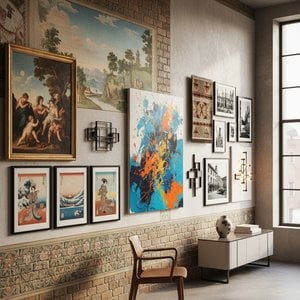
Transforming Spaces: A Comprehensive Exploration of Wall Decor Through Art History & Contemporary Practice
Explore the art of transforming spaces with our comprehensive guide to wall decor. From historical movements to contemporary trends, discover how to curate impactful interiors and commission bespoke artwork for a truly personalized aesthetic.

Harmonie der Epochen: Eine umfassende Anleitung zur Abstimmung von Kunst-Reproduktionen auf verschiedene Einrichtungsstile
Entdecken Sie hochwertige Kunst-Reproduktionen für Ihr Zuhause! Expertenberatung, individuelle Gestaltung & Museumsqualiät bei ArtsDot.com. Finden Sie das perfekte Bild!

Georges Braque: Die 25 Meisterwerke des Kubismus für Ihr Zuhause | ArtsDot
Entdecken Sie die 25 bedeutendsten Kunstwerke von Georges Braque – vom Kubismus bis zum Fauvismus. Erfahren Sie die Geschichten hinter den Meisterwerken und finden Sie hochwertige Reproduktionen für Ihr Zuhause auf ArtsDot.com.

Giclée Prints: Archival Quality & Aesthetic Nuances for the Discerning Collector
Explore the world of giclée prints with ArtsDot. Learn about archival quality, aesthetic nuances & investment potential. Expert guidance for discerning art collectors seeking museum-quality reproductions and lasting value.

Paul Klee: Die 25 Meisterwerke des Abstrakten – Kunst für Ihr Zuhause | ArtsDot
Entdecken Sie die 25 Meisterwerke von Paul Klee! Tauchen Sie ein in seine abstrakte Welt, voller Expressionismus und Bauhaus-Einflüsse. Hochwertige Kunst für Ihr Zuhause – jetzt bei ArtsDot entdecken!


