

 Versenden
 Teilen
 Details anzeigen

 Herunterladen
 Ähnliche Objekte
 Diashow
Untitled


 Weiterlesen
Erwerben Sie ein hochauflösendes, optimiertes digitales Bild, das der Online-Vorschau weit überlegen ist.
Jede Datei wird von unseren hauseigenen Spezialisten mit modernsten Werkzeugen und fachmännischer manueller Retusche sorgfältig vorbereitet. Wir stellen sicher, dass jedes Bild eine außergewöhnliche Klarheit, präzise Farbgenauigkeit und feinste Details aufweist.
Die endgültige Datei wird innerhalb von 72 Stunden per E-Mail zugestellt und ist für den sofortigen Einsatz in professionellen, redaktionellen und Druckumgebungen optimiert. Es handelt sich um dieselbe Qualität, der führende Designstudios, Verlage und Galerien vertrauen.
Digitales Bild
Laden Sie eine hochauflösende Datei für die persönliche Präsentation, den Druck und kreative Projekte herunter. ( Zum Druck wechseln Zur handgemalten Reproduktion wechseln)
In jeder Bestellung digitaler Bilder enthalten
Professionelle digitale Bereitstellung, garantiert
Wenn Sie sich für ArtsDot.com entscheiden, erhalten Sie nicht nur ein Bild – Sie erhalten ein professionell aufbereitetes digitales Kunstwerk, das mit höchster Präzision erstellt und durch eine Zufriedenheitsgarantie abgesichert wird. Hier ist alles, was automatisch mit Ihrer Bestellung geliefert wird:

Schnelle E-Mail-Zustellung
Ihre hochauflösende digitale Bilddatei wird Ihnen innerhalb von 72 Stunden nach der Bestellung per E-Mail zugestellt – bereit zur sofortigen Verwendung.

KI-optimierte digitale Datei
Ihre Kunstwerke werden professionell mithilfe fortschrittlicher KI-Tools und manueller Bearbeitung optimiert, um maximale Detailtreue, Klarheit und Farbgenauigkeit zu gewährleisten.

Lebenslanger kostenloser Neudruckservice
Datei versehentlich gelöscht oder verloren? Keine Sorge – wir senden sie Ihnen jederzeit kostenlos erneut zu.

Keine Einfuhrgebühren – jemals
Genießen Sie Ihr Kunstwerk sofort ohne Zollgebühren, Einfuhrabgaben oder Versandkosten – digitale Downloads sind immer steuerfrei.

Garantierte Farbtreue
Wir garantieren, dass Ihr digitales Bild mithilfe professioneller Werkzeuge und Farbmanagement die Originalfarben so präzise wie möglich wiedergibt.

60-Tage-Zufriedenheitsgarantie
Sollten Sie mit Ihrem digitalen Bild nicht zufrieden sein, werden wir es überarbeiten oder Ihnen innerhalb von 60 Tagen 100% erstatten – ohne Wenn und Aber.

100% Geld-zurück-Garantie
Nicht zufrieden? Erhalten Sie innerhalb von 60 Tagen nach Erhalt Ihrer digitalen Datei eine vollständige Rückerstattung – ohne Angabe von Gründen.

Rabatte bei Großbestellungen
3 Bilder kaufen, 10% sparen – 5 Bilder kaufen, 15% sparen – Ab 10 Bildern 20% sparen. Ideal für kreative Projekte, Galerien und Agenturen.
Details zum Sammlerstück
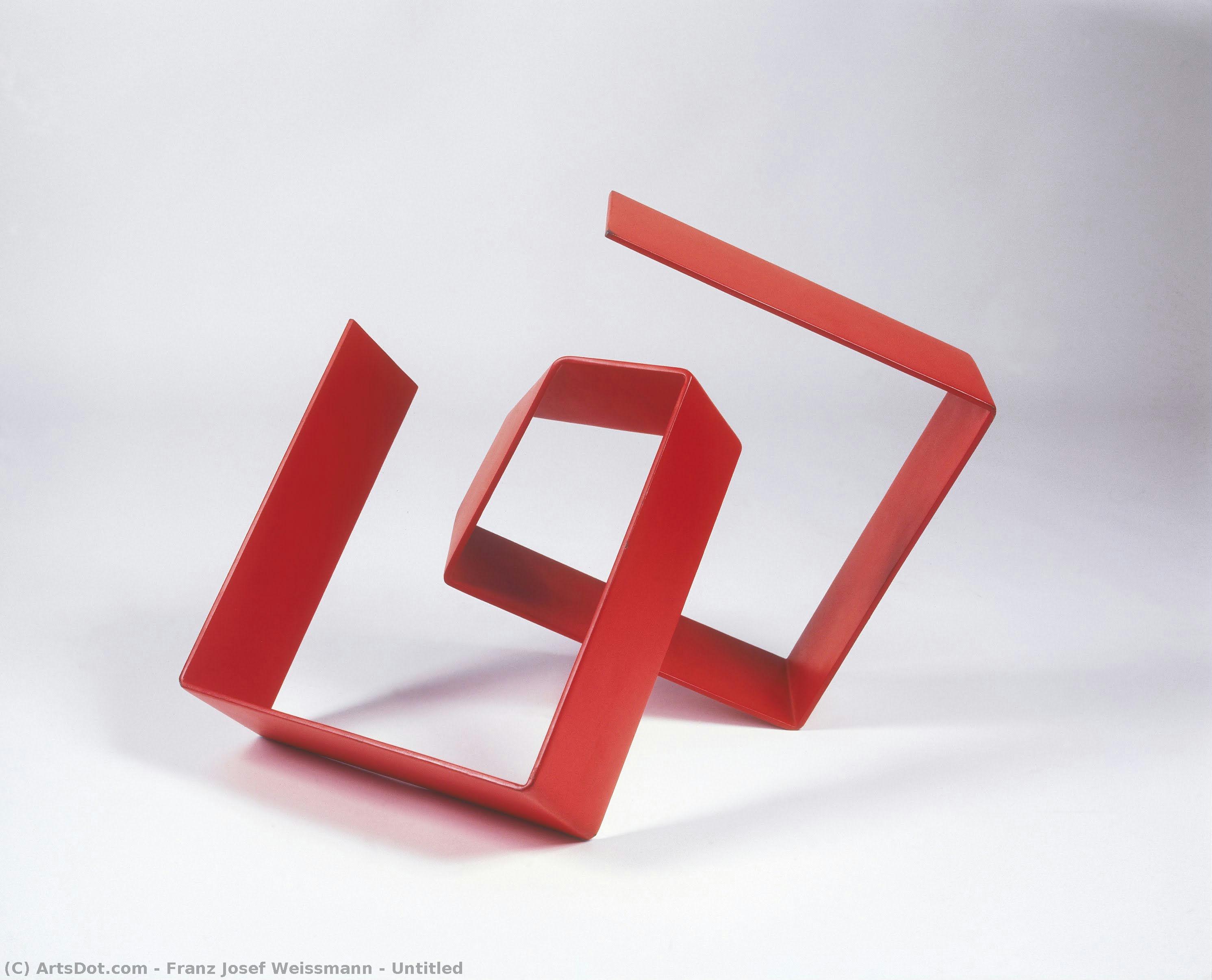
The Geometry of Emotion: A Study in Red
In the realm of geometric abstraction, few works command attention with such visceral intensity as this untitled masterpiece by Franz Josef Weissmann. Created in 1986, this sculpture serves as a profound meditation on form, space, and the rhythmic interplay of angles. At first glance, the eye is immediately arrested by the vibrant, saturated red that defines its surface—a color that pulses with life and energy against a stark, minimalist backdrop. The piece presents an intricate dance of curves and sharp edges, suggesting a deconstructed cube that has been liberated from its rigid, traditional constraints. It is not merely an object to be viewed, but a dynamic presence that seems to shift and evolve as the viewer moves around it.
The sculpture’s power lies in its ability to transform mathematical precision into something deeply organic and emotive. While the structure is rooted in the logic of constructivism, there is a fluid, almost biological quality to its silhouette. The way the light catches the various planes creates a shifting landscape of shadows, adding a layer of depth that invites prolonged contemplation. For the collector or interior designer, this work offers a sophisticated focal point; it possesses the rare ability to anchor a room with its bold color while simultaneously providing an intellectual lightness through its open, airy composition.
A Legacy of Neo-Concrete Innovation
To understand the soul of this work, one must look toward the historical currents that shaped Weissmann’s vision. As a pioneer of the Neo-Concrete movement in Brazil, Weissmann sought to move beyond the cold, purely mathematical nature of traditional abstraction. He aimed to infuse geometric forms with subjectivity and sensory experience. This 1986 creation is a testament to that lifelong pursuit. It reflects his mastery over material and space, demonstrating how a seemingly simple shape can be manipulated to evoke complex psychological responses.
The technique displayed here speaks to a profound command of structural balance. The artist utilizes the interplay of negative and positive space to create a sense of motion within a static medium. Every angle is deliberate, every curve calculated to guide the eye through a continuous loop of discovery. For those seeking to incorporate high-quality reproductions into a curated collection, this piece represents more than just decoration; it is an invitation to engage with the history of Brazilian modernism and the enduring beauty of structural harmony.
Whether placed in a contemporary gallery setting or as a striking centerpiece in a luxury residential interior, this reproduction captures the essence of Weissmann’s genius. It brings the bold, transformative spirit of 20th-century abstraction into the modern home, offering an eternal dialogue between the precision of art and the warmth of human emotion.
Ähnliche Kunstwerke


Biografie des Künstlers
Franz Josef Weissmann: Pioneer of Geometric Abstraction
Franz Josef Weissmann (1911-2005) stands as a pivotal figure in Brazilian art history, recognized primarily for his groundbreaking contributions to Neo-Concrete sculpture and his unwavering dedication to exploring the fundamental principles of geometric abstraction. Born in Austria amidst the Austro-Hungarian Empire, Weissmann’s early life was marked by emigration to Brazil at the age of eleven, shaping his artistic trajectory and fostering a unique perspective on artistic innovation. His formative years instilled within him a profound appreciation for both tradition and experimentation—a duality that would become central to his distinctive style.Early Life & Education
Weissmann’s formal education began in Knittelfeld, Austria, where he honed his skills in architecture, painting, drawing, and sculpture at the National School of Fine Arts in Rio de Janeiro between 1939 and 1941. This formative period exposed him to European artistic currents while simultaneously nurturing a deep connection with Brazilian culture—a synthesis that profoundly influenced his subsequent artistic endeavors. Further refining his craft under August Zamoyski's tutelage from 1942 to 1944—studying drawing, sculpture, modeling, and foundry techniques—established a solid foundation for his artistic pursuits. He mastered the manipulation of materials, particularly zinc and aluminum sheets, recognizing their potential to convey textural nuances and contribute to sculptural depth.The Rise of Neo-Concrete
Weissmann’s involvement with Grupo Frente in 1955 signaled the emergence of Neo-Concrete art in Brazil—a movement that irrevocably altered the course of Brazilian sculpture. Rejecting representational imagery, Grupo Frente championed pure geometric forms—primarily cubes and squares—as vehicles for conveying artistic ideas. Weissmann's leadership within this influential collective solidified his position as one of the foremost proponents of Neo-Concrete’s radical aesthetic. He believed that simplification could illuminate complex concepts, prioritizing clarity and precision in sculptural execution. This conviction drove him to explore repetitive patterns and symmetrical compositions—techniques that became hallmarks of his distinctive style.Notable Works & Exhibitions
Weissmann's sculptural output is characterized by meticulous attention to detail and a masterful manipulation of materials, notably zinc and aluminum sheets hammered into textured surfaces. His seminal piece, “Composition with Semicercles,” currently resides in the Syracuse University Art Collection—a testament to his commitment to exploring spatial relationships and conveying profound emotional resonance through geometric abstraction. Weissmann’s sculptures graced galleries across Europe and Latin America, including São Jorge Gallery in Madrid and Grupo B Gallery in Rio de Janeiro, garnering critical acclaim and cementing his reputation as an internationally respected artist. These exhibitions showcased not only his artistic prowess but also his dedication to engaging with broader cultural dialogues.Influence & Legacy
Franz Josef Weissmann’s enduring impact on Brazilian sculpture is undeniable. His pioneering exploration of geometric abstraction continues to inspire artists today—a legacy rooted in a steadfast belief that art could communicate universal truths through simplified forms. He remains a symbol of artistic courage—a testament to the importance of challenging conventions and pursuing innovative approaches to visual expression. Weissmann’s influence extended beyond his individual artworks; he established Neo-Concrete as an important movement in Brazilian art history, shaping the aesthetic sensibilities of subsequent generations of sculptors. His unwavering commitment to experimentation and innovation cemented his place among Brazil's most significant artistic figures.
Franz Josef Weissmann
1911 - 2005 , Brasil
Kurzinfos
- Artistic Movement Or Style: Neo-Concrete
- Artists Or Movements Influenced By This Artist: ['Expressionismus']
- Artists Who Influenced This Artist: ['August Zamoyski']
- Date Of Birth: 15. September 1911
- Date Of Death: 18. Juli 2005
- Full Name: Franz Josef Weissmann
- Nationality: Brasilianisch
- Notable Artworks: ['Composition mit Halbkreisen']
- Place Of Birth: Brasília, Brasilien

