


Das Bild passt sich Ihren Auswahlmöglichkeiten an: , .
Beschreibung des Sammlerstücks
Two enigmatic faces gaze at each other amidst scattered leaves in this captivating Surrealist oil painting by Francis Picabia, offering a profound way to bring avant-garde mystery into your private art collection.
 Weiterlesen
Künstlerbiografie
Entdecken Sie den Avantgarde-Künstler Francis Picabia (1879–1953). Pionier des Kubismus, Dada & Maschinenästhetik – seine Gemälde verbinden Abstraktion, Kommentar & Farbe. Finden Sie sein Erbe auf ArtsDot!
Handgefertigte Ölreproduktion
Handgemaltes Ölgemälde auf Leinwand in Ihrer Wunschgröße und mit Rahmen, auf Bestellung von unseren Künstlern angefertigt. ( Zum Druck wechseln Zum digitalen Bild wechseln)
Mehr über dieses Gemälde
 Vorschau anzeigen
 Versenden
 Teilen
 Details anzeigen
 Leitfaden

 Herunterladen
 Ähnliche Objekte
 Röntgenaufnahme
 Diashow
 Fragen & Antworten
 Statistiken
Bestellen Sie Ihr Gemälde in vier einfachen Schritten
Lassen Sie sich Zeit. Sie können jede Antwort jederzeit ändern; der Preis in Ihrem Warenkorb passt sich jeder Auswahl automatisch an.
1 Schritt eins von vier
Welche Größe möchten Sie wählen?
Diese Formate bewahren die Proportionen des Originalgemäldes. Die Zeichnung zeigt Ihre Auswahl an einer Wand, oberhalb eines zwei Meter breiten Sofas.
Oder geben Sie Ihre eigenen Maße an
Wählen Sie aus unseren vordefinierten Formaten, die den ursprünglichen Proportionen des Kunstwerks entsprechen.

Geben Sie die Breite und die Höhe an, die Sie für Ihren Rahmen oder Ihre Wand benötigen. Da dieses Werk handgemalt ist, kann der Künstler bei einer anderen Form etwas mehr um das Bild herum malen oder etwas abschneiden – Sie entscheiden. Wir senden Ihnen ein digitales Mockup zur Freigabe, bevor mit dem Malen begonnen wird. Das auf dieser Seite gezeigte Bild stellt nicht das tatsächliche Ergebnis dar – dies tut nur das Mockup.
2 Schritt zwei von vier
Wie soll es vorbereitet werden: gerollt, auf Keilrahmen gespannt oder gerahmt?
Die unten aufgeführten Preise beziehen sich auf die in Schritt eins gewählte Größe.
Wählen Sie die Kanten der Leinwand aus
Wählen Sie Ihren Rahmen

Weißer Rand €1

verlaufende Kanten €1

Umrandung €1

P118B €10

P118H €10

P118W €10

P438Z €10

P508JH €12

P508YH €12

P805H €10

P805Z €10

P919BZ €10

P919G €10

P919XJ €10

P959ZH €10

P968JZ €12

W106C €8

W218G €10

W218JH €8

W218Y €10

W307PJ €10

W316G €10

W316PJ €8

W316Y €10

W398PJ €8

W4111J €10

W500HY €15

W500JH €15

W692G €12

W849H €8

W940BG €15

W953PJ €8

H24-GOLD €30

H24-SILVER €30

H36-GOLD €45

H36-SILVER €45
Gerahmt
Profil: . Gesamtgröße mit Rahmen: .
3 Schritt drei von vier
Möchten Sie am Gemälde noch etwas ändern?
Die meisten Menschen antworten mit Nein. Da jedes Gemälde von Hand gefertigt wird, kann unser Künstler es jedoch auch individuell für Sie anpassen.
Nach der Bestellung wird das Team von ArtsDot.com den Kunden per E-Mail kontaktieren, um Anweisungen einzuholen und eine Vorschau des Entwurfs bereitzustellen
4 Schritt vier von vier
Einige Veredelungsmöglichkeiten
Alle Angaben sind optional. Für bereits ausgewählte Antworten entstehen keine zusätzlichen Kosten.
Wer hat es gemalt?
Weltweiter Versand () in nur 3 bis 4 Wochen statt der üblichen 5 Wochen. (4 November). Keine Kompromisse bei der Qualität.
Ein Namensschild, wie im Museum?
Details der gravierten Bronzetafel
This elegant plaque features the artist's name and the title of the artwork, finely engraved for a timeless presentation.
It is made from bronze with a refined, elegant finish. The text is precisely laser-engraved for a sharp and permanent result. Measuring 9x2 cm, the plaque is compact yet easy to read. It's built to be durable and scratch-resistant, offering a professional, museum-quality look. Mounting is simple thanks to the included adhesive backing.
Details zur Acrylglas-Plakette (transparent)
The plaque includes essential engraved details such as the artist's name, the title of the artwork, the date it was created, the type of media used-like oil on canvas or watercolor-a brief description of the piece, and a QR code that links to the complete artwork information.
It is crafted from clear acrylic, offering a sleek, modern appearance. The text is UV-engraved in black to ensure strong visual contrast. With a size of 10x15 cm, it ensures optimal readability. It comes equipped with two metal hooks for secure wall mounting. The plaque is designed to be weather-resistant, making it suitable for various environments, and it includes interactive features that work seamlessly with smartphone scanning.
Details zur schwarzen Acryltafel
This elegant plaque includes engraved information such as the artist's name, the title of the artwork, the date it was created, the type of media used (like oil on canvas or watercolor), a short description of the artwork, and a QR code for quick access to more information.
The plaque itself is made from refined black acrylic with a premium finish. The text is laser-engraved in white for high contrast and readability. Its size is 10x15 cm, designed to be easy to read. It comes with two metal hooks for professional mounting. The design is sleek and fits any interior style. It is also weather-resistant and durable, with built-in digital integration for mobile compatibility.
Ein Schutzlack?
Bis wann benötigen Sie es?
✓ Prüfen und bestellen
Ihr Gemälde, wie von Ihnen bestellt

Lo
Art der Reproduktion
Format der Reproduktion
-

Erstklassige Meisterkünstler
Mehr Detailtiefe, Raffinesse und zusätzliche Produktionszeit
-

Rahmen für Reproduktionen
-
-
Bei Kunstwerken oder Reproduktionen, die an einer Seite größer als 105 cm (ca. 41 Zoll) sind, wird der Rahmen zerlegt als Bausatz geliefert. Diese Methode gewährleistet eine sichere Zustellung und verhindert Schäden während des Transports.
Professionelle Montage erforderlich – dies ist kein DIY-Produkt.
Der Bausatz muss von einem erfahrenen professionellen Rahmenmacher zusammengebaut und die Leinwand gespannt werden. Hierfür werden Holzleim (nicht im Lieferumfang enthalten), eine Leinwandspannzange sowie Klemmen benötigt, um die Keilleisten während des Trocknungsvorgangs rechtwinklig zu halten. Eine unsachgemäße Montage oder eine ungleichmäßige Spannung der Leinwand kann das Kunstwerk dauerhaft beschädigen und ist nicht durch unsere Garantie abgedeckt.
 Bei Kunstwerken oder Reproduktionen, die an einer Seite größer als 105 cm (ca. 41 Zoll) sind, wird der Rahmen zerlegt als Bausatz geliefert. Diese Methode gewährleistet eine sichere Zustellung und verhindert Schäden während des Transports.
Alle Vollholzkomponenten sind enthalten, präzise auf Maß zugeschnitten.
Der Zusammenbau erfolgt mit den mitgelieferten Schrauben sowie Holzkleber für die Eckverbindungen, der nicht im Lieferumfang enthalten ist und vom Rahmenbauer selbst beschafft werden muss.
Professionelles Werkzeug ist erforderlich und nicht im Lieferumfang enthalten: eine Keilrahmenzange (Spannwerkzeug) sowie Klammern, um die Leisten während der Trocknungszeit des Klebers rechtwinklig zu fixieren.
Wichtiger Hinweis:
Für die Eckverbindungen wird Holzleim benötigt, die Leisten müssen mit Zwingen fixiert werden, bis der Leim vollständig getrocknet ist, und das Spannen der Leinwand auf dem fertigen Rahmen erfordert eine Keilrahmen-Zange. Keines dieser Utensilien ist im Set enthalten. Bitte stellen Sie sicher, dass ein erfahrener Rahmenmacher zur Verfügung steht, bevor Sie diese Größe bestellen.

Beschriftung
-
-

Schutzlackierung
Glanzlack (verstärkt die Farben, schützt vor Licht und Feuchtigkeit)
-

Mein Kunstwerk personalisieren
Beispiele für Anpassungsmöglichkeiten: Gesicht durch Kundenfoto ersetzen; Haustier hinzufügen (z. B. Katze durch Hund ersetzen); Versteckte Nachricht im Hintergrund einfügen; Hintergrundlandschaft oder -elemente ändern.
-

Eilt sehr
Weltweiter Versand () in nur 3 bis 4 Wochen statt der üblichen 5 Wochen. (4 November). Keine Kompromisse bei der Qualität.
-
Expressversand
Weltweiter Versand () innerhalb von 5 Wochen. (11 November).
Inklusive Versand
Endpreis
€ 235
Die Glasoption ist nur für Größen unter 110 cm verfügbar.
In jeder Bestellung enthalten
- Kostenloser weltweiter Expressversand
- Hochwertige Leinenleinwand
- Umfassender Versicherungsschutz beim Versand
- Zollgebühren-Rückerstattungsgarantie
- Garantie für exakte Farbtreue
- 100 Tage Rückgaberecht (nur bei Mängeln)
- 100% Geld-zurück-Garantie
- Mengenrabatt verfügbar


A Surreal Encounter: The Enigmatic World of Picabia's Lo
In the vast, restless landscape of early 20th-century modernism, few works capture the unsettling beauty of the subconscious quite like Francis Picabia’s Lo. This captivating masterpiece serves as a profound window into the Surrealist movement, an era defined by its rejection of logic and its embrace of the dream-state. At first glance, the viewer is met with a striking, minimalist composition: two faces positioned on opposite sides of the canvas, locked in a silent, spectral gaze. There is an undeniable tension in their interaction, a sense of profound connection that exists without the need for physical touch or even complete anatomical detail. By stripping away most facial features and leaving only the haunting presence of eyes and mouths, Picabia invites us to look beyond the surface and into the psychological depths of the human experience.
The technique employed in Lo is a masterclass in the use of oil media to create texture and atmospheric depth. The artist utilizes the richness of the paint to breathe life into an otherwise sparse arrangement, allowing for a subtle interplay of light and shadow that gives the faces a ghostly, three-dimensional quality. Scattered throughout this ethereal space are delicate leaves, drifting across the canvas like fragments of a fading memory. These organic elements introduce a sense of natural chaos to the structured confrontation of the two figures, creating a visual rhythm that guides the eye from the top left corner down through the composition. This juxtaposition of the human form with the random, drifting flora is a hallmark of the Surrealist style, challenging our perceptions of what is permanent and what is transient.
Symbolism and the Avant-Garde Spirit
To understand Lo is to understand the spirit of the avant-garde. Picabia, a provocateur who moved fluidly between Cubism, Dada, and Surrealism, used this work to explore themes of duality and identity. The two faces, mirroring one another yet remaining distinct, can be interpreted as different facets of a single psyche or perhaps as the eternal dialogue between the conscious and the unconscious mind. The absence of traditional features forces the viewer to project their own emotions onto the canvas, making the artwork a deeply personal experience for every observer. The leaves, acting as symbols of growth, decay, and the passage of time, further complicate this narrative, suggesting that even our most profound internal encounters are subject to the whims of nature and fate.
For the discerning collector or interior designer, a high-quality reproduction of Lo offers more than just a decorative element; it provides a focal point of intellectual and emotional intrigue. The painting’s unique ability to command attention through its minimalist yet evocative composition makes it an ideal centerpiece for modern, sophisticated spaces. Whether placed in a gallery-style living room or a curated study, the work brings with it the historical weight of the Dadaist movement and the dreamlike allure of Surrealism. Owning a piece of this caliber allows one to inhabit the same space as Picabia’s revolutionary vision, turning a wall into a portal for contemplation and artistic inspiration.
Fragen & Antworten
Kann ich Augmented Reality nutzen, um "Lo" von Francis Picabia in meinem Raum zu sehen?
"Lo" von Francis Picabia kann mithilfe der AR-Vorschau-Seite des Kunstwerks mit Augmented Reality auf einem kompatiblen Gerät direkt an Ihrer eigenen Wand vorab betrachtet werden.
Wo kann ich eine digitale Abbildung von "Lo" von Francis Picabia kaufen?
"Lo" ist als hochauflösender digitaler Bild-Download direkt über die Seite Digitales Kunstwerk erhältlich.
Welche Motive sind in "Lo" von Francis Picabia zu sehen?
"Lo" von Francis Picabia zeigt: two faces, eyes, mouths, leaves, scattered leaves.
Ähnliche Kunstwerke


![Legende Des Heiligen Franziskus – [24] – Krönung Des Heiligen Franziskus — Giotto Di Bondone, Gothic/proto-renaissance](/media/artworks/images-thumb/81/9b/819b5f0656848eb5cb3fcd40fd5756aa.jpg)
![Leben Des Heiligen Franziskus - [04] - Tod Und Himmelfahrt Des Hl. Franziskus — Giotto Di Bondone, Italienische Renaissance](/media/artworks/images-thumb/08/8b/088b102b13c1a379233690905590f156.jpg)


Francis Picabia
1879 - 1953, Frankreich
Künstlerbiografie
Frühes Leben und künstlerische Anfänge
Francis Picabia, ein französischer Avantgarde-Maler, Dichter und Typograf, wurde am 22. Januar 1879 in Paris geboren. Sein Vater, von kubanisch-spanischer Abstammung, war Attaché an der kubanischen Gesandtschaft in Paris. Diese kulturelle Vielfalt beeinflusste später Picabias künstlerischen Stil. Picabias frühes Leben war von Tragödien geprägt, als seine Mutter an Tuberkulose starb. Er wurde von seinem Vater aufgezogen, der seine künstlerischen Ambitionen förderte. Bereits mit 20 Jahren lebte Picabia von seiner Kunst und wurde nach dem Erhalt einer beträchtlichen Summe von Geld von seiner Mutter zu einem der wohlhabendsten Künstler seiner Zeit.Künstlerische Entwicklung
- Frühe Arbeit (1903-1908): Beeinflusst vom Impressionismus thematisierte Picabias frühe Arbeit Pariser Landschaften und Flussufer. Kritiker stellten seine Originalität in Frage, was ihn dazu veranlasste, einen neuen Ansatz zu suchen.
- Kubistische Periode (1909): Picabia trat der Puteaux-Gruppe bei und freundete sich mit Marcel Duchamp und Guillaume Apollinaire an. Dies markierte einen deutlichen Wandel hin zum Kubismus.
- Proto-Dada (1913): Picabia nahm an der Armory Show in New York teil und stellte seine Werke neben anderen Modernisten aus. In dieser Zeit entstanden seine einzigartigen, abstrakten planaren Kompositionen.
Wichtige Werke und Assoziationen
- Gemälde von 'Francis Picabia': siehe Picabias Werke auf ArtsDot
- Musée des Beaux-Arts de Carcassonne: Entdecken Sie die Sammlung des Museums, die Werke von renommierten Künstlern wie François Perrier und Lanfranco umfasst. Mehr dazu auf ArtsDot
- Postimpressionistische Kunstbewegung: Erfahren Sie mehr über die Bewegung, die Picabias frühe Arbeit prägte und durch ihren Fokus auf subjektiven Ausdruck gekennzeichnet ist. Erforschen Sie den Postimpressionismus auf ArtsDot
Picabias Vermächtnis
Picabias innovativer Stil, der sich durch die Verwendung lebendiger Farben und abstrakter Formen auszeichnet, hat einen bleibenden Eindruck in der modernen Kunst hinterlassen. Seine Proto-Dada-Periode zeigt insbesondere seinen Pioniergeist, der Künstler bis heute inspiriert. Mehr über Francis Picabias Leben und Werk


Ähnliche Artikel

Surrealismus: Die 10 Meisterwerke, die eine Kunstbewegung prägten | ArtsDot
Entdecken Sie die 10 prägendsten Meisterwerke des Surrealismus! Von Dalí bis Magritte – erfahren Sie die Geschichten hinter ikonischen Gemälden und lassen Sie sich von Traumlandschaften & abstrakter Kunst inspirieren. Kunstdrucke in Museumsqualiät auf ArtsDot.com.

Francis Picabia: Dada's Provokateur – Eine Neubewertung mechanischer Formen und mystischer Unterströmungen
Entdecken Sie die faszinierende Welt von Francis Picabia! Unsere Expertenanalyse beleuchtet seine Rolle im Dadaismus, mechanische Formen und mystische Einflüsse. Wertvolle Einblicke für Kunstsammler.
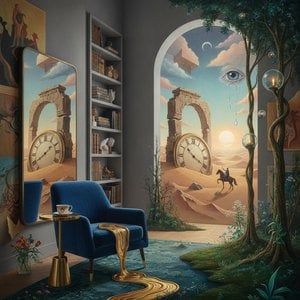
Surrealist Dreamscapes: A Curated Guide to Integrating Breathtaking Surrealism into Sophisticated Home Decor
Transform your home into a breathtaking dreamscape with expert surrealist decor tips. Discover how to curate Salvador Dalí-inspired masterpieces, integrate symbolic textures, and commission bespoke hand-painted oil reproductions that bring the magic of the subconscious to your walls.