


 In echtem Maßstab anzeigen
 Versenden als Grußkarte
 Teilen
 Details anzeigen
 Leitfaden öffnen

 Herunterladen
 Ähnliche Objekte
 Röntgenaufnahme
 Diashow
 Besucherstatistiken
Sketch
 Oil On Canvas
- WallArt
- Early Modern
 1948
1948 132.0 x 99.0 cm
 Walker Art Gallery
 Mehr anzeigen
Die auf dieser Seite dargestellten Kunstwerke sind urheberrechtlich geschützt, was bedeutet, dass wir keine identische Reproduktion rechtmäßig erstellen oder verkaufen dürfen. Dieser Schutz wird durch internationale Abkommen wie die Berner Übereinkunft und durch nationale Gesetze, einschließlich derer, die von den ... festgelegt wurden US-Urheberrecht – Titel 17.
Diese Methode entspricht vollumfänglich den Urheberrechtsbestimmungen, da sie keine Kopie oder Vervielfältigung des geschützten Kunstwerks darstellt. Stattdessen handelt es sich um eine kreative Neuinterpretation – ein neues Gemälde, das vom Original inspiriert, aber nicht identisch mit ihm ist.
Giclée / Kunstdruck
Giclée- oder Leinwanddruck in Museumsqualität mit schneller Produktion und flexiblen Veredelungsoptionen. ( Handgemalte Reproduktion kaufen Zum digitalen Bild wechseln)




P118B €10

P118H €10

P118W €10

P438Z €10

P508JH €12

P508YH €12

P805H €10

P805Z €10

P919BZ €10

P919G €10

P919XJ €10

P959ZH €10

P968JZ €12

W106C €8

W218G €10

W218JH €8

W218Y €10

W307PJ €10

W316G €10

W316PJ €8

W316Y €10

W398PJ €8

W4111J €10

W500HY €15

W500JH €15

W692G €12

W849H €8

W940BG €15

W953PJ €8




Wählen Sie aus unseren vordefinierten Formaten, die den ursprünglichen Proportionen des Kunstwerks entsprechen.

Sie können Ihre eigenen Maße eingeben, um ein bestimmtes Format oder einen speziellen Platz einzupassen. Wenn das von Ihnen gewählte Format nicht den Proportionen des Originalbildes entspricht, werden wir das Kunstwerk entweder beschneiden oder das Bild mit einem gespiegelten oder einfarbigen Rand erweitern. Ein digitaler Entwurf wird Ihnen zur Genehmigung zugesandt, bevor die Produktion beginnt.
Bitte beachten Sie, dass die Vorschau auf dem Bildschirm nicht den tatsächlichen Zuschnitt oder die Erweiterung widerspiegelt. Nur der Entwurf zeigt die endgültige Komposition präzise an.
Obwohl Sondermaße verfügbar sind, empfehlen wir die Auswahl eines Maßes aus der vordefinierten Liste, um die ursprünglichen Proportionen zu bewahren.
Weltweiter Versand () innerhalb von 2 Wochen statt der üblichen 4/5 Wochen. (10 Oktober)

Kostenloser weltweiter Expressversand

Hochwertige Leinenleinwand

Vollständiger Versicherungsschutz beim Versand

Zollgebühren-Rückerstattungsgarantie

Garantie für exakte Farbtreue

100-tägiges Rückgaberecht (nur bei Mängeln)

100% Geld-zurück-Garantie

Angebot für Mengenrabatt
 Die Glasoption ist nur für Größen unter 110 cm verfügbar.

Sketch
Giclée / Kunstdruck
Format der Reproduktion
-


Gesamtpreis
€ 53
The Genesis of a Vision: David Bomberg's 'Sketch'
David Bomberg’s “Sketch,” painted in 1948, isn’t merely a depiction of a scene; it’s an embodiment of the artist’s evolving vision during a pivotal period in British art. Born into a Polish-Jewish family in Birmingham and deeply influenced by the avant-garde movements swirling around London – Cubism, Futurism, and the radical ideas championed by Roger Fry – Bomberg sought to translate these complex influences into a distinctly personal language. This particular work, created shortly after his expulsion from the Slade School of Art for his perceived “audacity,” reflects both a rejection of academic constraints and an embrace of dynamic abstraction. The painting’s raw energy and fragmented forms speak volumes about the anxieties and transformations shaping the post-war artistic landscape.

A Symphony of Color and Geometry
Bomberg’s technique in “Sketch” is immediately arresting. He employs a bold, almost aggressively simplified palette dominated by vibrant reds, oranges, and yellows – colors that evoke both heat and intensity. These hues are layered and blended with remarkable skill, creating a sense of depth and movement despite the painting's predominantly geometric structure. The composition itself is fractured, composed of interlocking planes and angular shapes that seem to vibrate with energy. This deliberate fragmentation isn’t chaotic; rather, it mirrors the artist’s exploration of form and his desire to capture not just what he *saw*, but how he *felt* about what he saw. The use of thick impasto – applying paint in heavy layers – adds a tactile quality to the work, inviting the viewer to engage with its surface.
- Color Palette: Primarily reds, oranges, and yellows; punctuated by blues and greens.
- Technique: Bold impasto, layered application of paint, geometric abstraction.
- Composition: Fragmented planes and angular shapes creating a sense of dynamism.
Roots in the Whitechapel Boys and Beyond
Bomberg was part of the “Whitechapel Boys,” a group of young artists who challenged the established artistic conventions of early 20th-century London. This collective, including Mark Gertler and Stanley Spencer, were deeply influenced by the avant-garde movements emerging from Paris and Italy. His time at the Slade School of Art, under the tutelage of Henry Tonks, provided a crucial foundation, but Bomberg quickly surpassed his teacher’s more traditional approach. His work reflects this trajectory, incorporating elements of Cubism – particularly in its emphasis on multiple perspectives – alongside the dynamism of Futurism and the emotional intensity of Expressionism. Further research reveals that Bomberg's exploration of Jerusalem Church (as documented in a separate ArtsDot article) demonstrates his continued interest in capturing spiritual themes through abstract forms.
Decoding the Emotional Landscape
“Sketch” is more than just a visually striking composition; it's an exploration of emotional states. The intense colors and fragmented forms evoke feelings of both excitement and unease. Some art historians interpret the painting as a reflection of Bomberg’s personal struggles, particularly his experiences in the trenches during World War I. The dynamism of the composition suggests a restless spirit, while the underlying geometric structure hints at an attempt to impose order on chaos. Ultimately, “Sketch” invites viewers to contemplate the complexities of human experience and the power of art to capture the intangible.
Fragen & Antworten
Wer ist der Künstler hinter "Sketch"?
"Sketch" wird David Bomberg zugeschrieben.
In welche Phase von David Bombergs Schaffen lässt sich "Sketch" einordnen?
„Sketch“ entstammt der Early Modern von David Bomberg. Diese Einordnung setzt das Werk in Bezug zur künstlerischen Entwicklung des Künstlers.
In welchem Jahr wurde "Sketch" geschaffen?
"Sketch" stammt aus dem Jahr 1948. Dieses Datum ordnet das Werk in die Schaffensperiode von David Bomberg sowie in dessen Epoche ein.
Wie verbinden sich Kontrast und Harmonie in "Sketch"?
Die Farbkomposition von "Sketch" von David Bomberg vereint einen Serene Kontrast mit einer Unified Palette Harmonie.
Gibt es eine Diashow für "Sketch" von David Bomberg?
Das Diaporama zu „Sketch“ kann auf der Diashow-Seite des Kunstwerks angesehen werden.
Wie kann ich das Bild von "Sketch" von David Bomberg herunterladen?
Für „Sketch“ steht ein Download zur Verfügung: Die Download-Seite des Kunstwerks bietet ein hochauflösender digitaler Bild-Download.
In welchem Alter schuf David Bomberg „Sketch"?
David Bomberg schuf „Sketch“ im Alter von 58. Der Künstler wurde 1890 geboren, und das Werk datiert auf 1948.
Ähnliche Kunstwerke


Biografie des Künstlers
Frühe Jahre und künstlerische Ausbildung
- Geboren: Birmingham, Großbritannien (5. Dezember 1890)
- Gestorben: London, Großbritannien (19. August 1957)
- Einer der 'Whitechapel Boys' – eine Gruppe von Künstlern aus East End, die im frühen 20. Jahrhundert hervortraten.
Geboren als Sohn polnisch-jüdischer Einwanderer, Abraham und Rebecca Bomberg, in Birmingham. Die Familie zog 1895 nach Whitechapel, London.
Zunächst studierte er an der City and Guilds Technical Art School, bevor er sich als Lithograph in Birmingham ausbildete.
Er studierte unter Walter Sickert an der Westminster School of Art (1908-1910), wo er von Sickerts Fokus auf Form und Stadtleben beeinflusst wurde. Erlangte durch die Ausstellung "Manet und die Post-Impressionisten" im Jahr 1910 eine bedeutende Vertrautheit mit Paul Cézanne. Besuchte die Slade School of Art (1911) und gewann den Tonks Prize für seine Zeichnung seines Kommilitonen Isaac Rosenberg.
Die Avantgarde-Jahre: Kubismus, Futurismus und Kontroversen
- An der Slade gehörte Bomberg zu einer bemerkenswerten Generation, darunter Mark Gertler, Stanley Spencer, C.R.W. Nevinson und Dora Carrington.
- Beeinflusst von den Londoner Ausstellungen italienischer Futuristen im Jahr 1912 und Fry's zweiter Post-Impressionisten-Ausstellung (Picasso, Matisse, Fauvisten, Wyndham Lewis).
- Entwickelte einen unverwechselbaren Stil, der Kubismus und Futurismus kombinierte – gekennzeichnet durch geometrische Kompositionen, begrenzte Farbpaletten, eckige Figuren und gitterartige Strukturen.
- Sein radikaler Ansatz führte 1913 zu seinem Ausschluss von der Slade School of Art, da er als zu kühn für die konventionellen Methoden der Institution galt.
- War kurzzeitig mit den Omega Workshops der Bloomsbury Group verbunden und stellte mit der Camden Town Group aus. Zeigte eine Affinität zur Vorticist-Bewegung von Wyndham Lewis, blieb aber unabhängig und beteiligte sich nicht vollständig daran.
Von Krieg zu Landschaft: Ein Wandel im Stil
Die Erfahrungen als Soldat im Ersten Weltkrieg beeinflussten sein künstlerisches Schaffen tiefgreifend und führten zu einem Abschied vom Abstraktionismus.
In den 1920er Jahren übernahm Bomberg einen figurativeren Stil, der sich auf Porträts und Landschaften konzentrierte, die direkt aus der Natur entstanden. Entwickelte eine zunehmend expressionistische Technik, gekennzeichnet durch strukturierte Impastos und emotionale Intensität.
Umfangreiche Reisen durch den Nahen Osten (insbesondere Palästina) und Europa beeinflussten sein späteres Werk maßgeblich. Seine Darstellungen Jerusalems sind besonders bemerkenswert.
Spätere Jahre und Vermächtnis
- Von 1945 bis 1953 unterrichtete er an der Borough Polytechnic (heute London South Bank University) und beeinflusste eine Generation von Künstlern, darunter Frank Auerbach, Leon Kossoff, Philip Holmes, Cliff Holden, Edna Mann, Dorothy Mead, Gustav Metzger, Dennis Creffield, Cecil Bailey und Miles Richmond.
- Verheiratete sich mit der Landschaftsmalerin Lilian Holt.
- Trotz Phasen relativer Obscurität während seines Lebens hat Bombergs Werk in den letzten Jahrzehnten zunehmend an Anerkennung gewonnen und gilt als bedeutender Beitrag zur britischen Moderne.
- Das David Bomberg House an der London South Bank University ist ihm zu Ehren benannt.
- Sein Vermächtnis liegt in seiner einzigartigen Synthese europäischer Avantgarde-Bewegungen und seiner späteren Entwicklung eines kraftvollen, ausdrucksstarken Landschaftsstils, der das Wesen von Ort und menschlicher Erfahrung einfing.

David Bomberg
1890 - 1957 , Vereinigtes Königreich
Eckdaten zum Künstler
- Beeinflusste Künstler:
- Paul Cézanne
- Walter Sickert
- Bemerkenswerte Werke:
- Selbstporträt (1937)
- Jerusalem-Darstellungen
- Geburtsdatum: 5. Dezember 1890
- Geburtsort: Birmingham, Vereinigtes Königreich
- Künstlerische Richtung:
- Kubismus
- Futurismus
- Expressionismus
- Nationalität: Britisch
- Sterbedatum: 19. August 1957
- Vollständiger Name: David Garshen Bomberg
- Von Künstlern Beeinflusst:
- Frank Auerbach
- Leon Kossoff
Verwandte Artikel

Die Top 10 Gemälde in Schattierungen von 'Slate Blue': Kunst für Ihr Zuhause
Entdecken Sie die Top 10 Gemälde in faszinierenden 'Slate Blue' Tönen! Von Monet bis Manet – erleben Sie Kunstgeschichte und lassen Sie sich von Meisterwerken inspirieren. Hochwertige Kunstdrucke auf

The Eloquent Line: Exploring the Artistic Significance of Sketches Across Movements and Media
Explore the profound artistic significance of sketches throughout history. From Renaissance masters to modern innovators like Van Gogh & Guston, discover how these foundational works reveal technique, emotion, and vision. Learn more at ArtsDot.
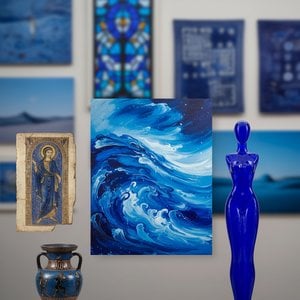
The Allure of Azure: Exploring the Symbolic & Aesthetic Depths of Blue in Art History
Explore the rich history of blue in art! Discover its symbolism, from ancient pigments to modern masterpieces by Kandinsky & Seurat. Uncover the psychological impact and cultural meanings behind this captivating hue.

Crimson Threads of Narrative: Exploring Symbolism & Representation in Artworks Featuring the Red Dress
Explore the rich symbolism of the red dress in art history! From ancient power displays to iconic portraits like Cézanne’s 'Madame Cezanne', discover the cultural and artistic significance behind this captivating color. Expert analysis & insights.

David Bomberg: Reassessing the Pioneering Spirit of Early British Abstraction
Explore the groundbreaking work of David Bomberg, a pivotal figure in British abstraction. Discover his artistic evolution, influences, and lasting legacy through insightful analysis & expert commentary.


