


 Vorschau anzeigen
 Versenden
 Teilen
 Details anzeigen

 Herunterladen
 Ähnliche Objekte
 Röntgenaufnahme
 Diashow
Angler
 Oil On Canvas
- WallArt
- Baroque Detail
 1700
1700 62.0 x 75.0 cm
 Rijksmuseum
 Weiterlesen
Handgefertigte Ölreproduktion
Handgemaltes Ölgemälde auf Leinwand in Ihrer Wunschgröße und mit Rahmen, auf Bestellung von unseren Künstlern angefertigt. ( Druck bestellen Bild kaufen)




P118B $10

P118H $10

P118W $10

P438Z $10

P508JH $12

P508YH $12

P805H $10

P805Z $10

P919BZ $10

P919G $10

P919XJ $10

P959ZH $10

P968JZ $12

W106C $8

W218G $10

W218JH $8

W218Y $10

W307PJ $10

W316G $10

W316PJ $8

W316Y $10

W398PJ $8

W4111J $10

W500HY $15

W500JH $15

W692G $12

W849H $8

W940BG $15

W953PJ $8




Wählen Sie aus unseren vordefinierten Formaten, die den ursprünglichen Proportionen des Kunstwerks entsprechen.

Sie können Ihre eigenen Maße eingeben, um einen bestimmten Rahmen oder Platz auszufüllen. Wenn die gewählte Größe nicht den Proportionen des Originalbildes entspricht, werden wir das Kunstwerk entweder beschneiden oder das Gemälde durch zusätzliche, handgemalte Elemente erweitern. Ein digitales Mockup wird Ihnen zur Genehmigung zugesandt, bevor die Produktion beginnt.
Bitte beachten Sie, dass die Bildschirmvorschau nicht die tatsächliche Beschneidung oder Erweiterung widerspiegelt. Nur das Mockup zeigt die endgültige Komposition exakt an.
Obwohl Sondermaße verfügbar sind, empfehlen wir, eine Größe aus der vordefinierten Liste zu wählen, um die ursprünglichen Proportionen beizubehalten.
Nach der Bestellung wird das ArtsDot.com-Team dem Kunden Anweisungen per E-Mail zusenden und eine Mockup-Vorschau bereitstellen.
Weltweiter Versand () in nur 3 bis 4 Wochen statt der üblichen 5 Wochen. (14 August). Keine Kompromisse bei der Qualität.

Kostenloser weltweiter Expressversand

Hochwertige Leinenleinwand

Umfassender Versicherungsschutz beim Versand

Zollgebühren-Rückerstattungsgarantie

Garantie für exakte Farbtreue

60 Tage Rückgaberecht (nur bei Mängeln)

100% Geld-zurück-Garantie

Mengenrabatt verfügbar
 Die Glasoption ist nur für Größen unter 110 cm verfügbar.

Angler
Art der Reproduktion
Format der Reproduktion
-


Gesamtpreis
$ 313
Beschreibung des Kunstwerks
Angler - A Portrait of Rural Tranquility
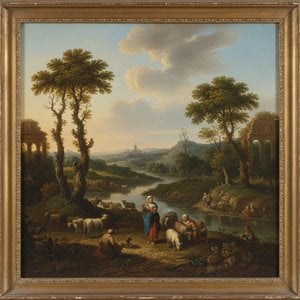
The painting “Angler” by Carel de Moor (1655 – 1738), created around 1700, stands as a quintessential example of Leiden’s Baroque landscape tradition—a genre distinguished by its meticulous realism and profound engagement with the natural world. More than just a depiction of fishing activity, it embodies an idealized vision of rural life, capturing a moment of serene contemplation amidst pastoral beauty.- Subject Matter: The artwork portrays three figures – a young man diligently tending to his fishing line by a pond or canal—a scene rendered with remarkable detail—and two companions observing him from a weathered wooden fence. A milkmaid stands nearby, her gaze directed towards the fisherman’s actions, adding an element of domesticity and quiet observation to the composition.
- Style: De Moor adheres closely to the conventions established by Leiden’s leading artists of his era, notably Gerard Dou and Frans van Mieris. This stylistic lineage emphasizes clarity of form, subtle tonal gradations, and a masterful rendering of textures—characteristics that elevate “Angler” beyond mere representation into an emotionally resonant experience.
- Technique: Executed in oil on canvas using traditional brushwork techniques, the painting showcases De Moor’s exceptional skill in achieving luminous effects and conveying atmospheric depth. Glazes were skillfully employed to subtly modulate color hues and enhance the overall sense of realism—a testament to the artist's dedication to mastering the medium.
Composition & Perspective – A Triangular Harmony
The painting’s compositional structure is notably balanced, utilizing a triangular arrangement that draws the viewer’s eye towards the central figure—the fisherman himself. This deliberate positioning underscores his importance within the scene and establishes a visual hierarchy that guides the gaze across the canvas. Linear perspective contributes to creating depth, subtly diminishing the scale of distant buildings and emphasizing the immediacy of the pond’s surface. Aerial perspective—characterized by muted colors and softened contours—further enhances this illusion of distance, immersing the viewer in the tranquil atmosphere of the countryside.Color Palette & Light – Subtle Nuances of Pastoral Dusk
The color palette is dominated by earthy tones—ochres, browns, and greens—reflecting the natural environment depicted. However, subtle accents of blue—primarily in the sky—introduce a contrasting element that adds visual interest and reinforces the mood of quiet contemplation. Highlights of yellow illuminate the distant buildings and foliage, creating points of warmth against the cooler hues of the landscape. The diffused lighting suggests an overcast day or early morning light—conditions conducive to fostering serenity and enhancing the painting’s emotional impact.Symbolism & Emotional Resonance – Reflections of Inner Peace
Beyond its visual beauty, “Angler” carries symbolic weight. The act of fishing itself can be interpreted as representing patience, perseverance, and a connection to the rhythms of nature—values deeply cherished during the Baroque period. The figures’ postures convey calmness and repose, embodying an idealized vision of human existence harmoniously integrated with the natural world. Ultimately, De Moor's masterpiece invites contemplation on themes of tranquility, simplicity, and the enduring allure of pastoral landscapes.Historical Context – Leiden’s Artistic Legacy
Carel de Moor’s work is firmly rooted in Leiden’s artistic heritage—a tradition characterized by an unwavering commitment to realism and a profound appreciation for observation. Situated within the broader context of the Dutch Golden Age, “Angler” exemplifies the stylistic ideals that prevailed during this era—reflecting a fascination with capturing fleeting moments of beauty and conveying nuanced emotional states through masterful technique. It stands as a lasting testament to Leiden’s enduring contribution to European art history.Ähnliche Kunstwerke


Über den Künstler
Carel de Moor: A Leiden Legacy of Baroque Detail
Carel de Moor (1655 – 1738) stands as a cornerstone of the Dutch Golden Age, an artist whose unwavering dedication to etching and painting secured his indelible mark within the artistic annals of seventeenth-century Holland. Born in Leiden—a city renowned for its artistic patronage and scholarly tradition—he descended from a lineage deeply rooted in visual artistry; his father, himself a painter, consciously cultivated de Moor’s innate talent and fostered an early fascination with capturing the subtle complexities of observation. This formative influence culminated in mentorship under Gerard Dou and Frans van Mieris, shaping his artistic worldview and anchoring him firmly within Leiden's vibrant art circle—a crucible where innovation flourished alongside established conventions.Early Life & Artistic Foundations
De Moor’s upbringing instilled a profound appreciation for meticulous craftsmanship and uncompromising realism – qualities that would permeate every facet of his oeuvre. His education at the St Luke’s Guild wasn’t merely academic; it was transformative, equipping him with mastery over etching techniques alongside mastering other artistic disciplines. This rigorous training ensured he possessed the technical prowess necessary to translate observation into breathtaking visual representations. The Guild's emphasis on anatomical accuracy and tonal gradation undoubtedly influenced his approach to portraying human figures—a characteristic that would become synonymous with Leiden’s artistic excellence during this period.Guild Membership & Patronage: Shaping Artistic Ambition
Becoming deacon multiple times underscored de Moor’s social standing and afforded him access to influential patrons – a crucial element in securing commissions that allowed him to undertake ambitious projects and refine his skills. These connections fostered collaborations with wealthy families and ecclesiastical institutions, propelling him toward artistic heights previously unattainable by many of his contemporaries. The patronage system nurtured creativity and encouraged experimentation—a dynamic that fueled Leiden’s reputation as a hub for artistic innovation during the Golden Age.The Artistry of Detail: Dou & Mieris' Influence
De Moor’s artistic output is distinguished by an unparalleled level of detail, particularly evident in his portraits and genre scenes. He skillfully harnessed chiaroscuro—the dramatic interplay of light and shadow—a technique championed by Gerard Dou and Frans van Mieris—to imbue his subjects with psychological depth and convey emotion through subtle gestures and expressions. This masterful manipulation of tonal gradation wasn’t merely stylistic; it was a deliberate effort to illuminate the inner life of his figures, mirroring Dou's groundbreaking explorations into capturing human emotion with remarkable subtlety. Consider “Portrait of a Gentleman” (1686); de Moor’s meticulous rendering captures not only physical likeness but also an intangible aura—a testament to Mieris’s influence on his artistic sensibilities.Notable Achievements & Legacy
Among his most celebrated works are "Soldier Scene," attributed to Carel de Moor II, showcasing a breathtaking depiction of human anatomy and psychological realism – a direct consequence of Mieris's anatomical studies. This piece exemplifies Leiden’s commitment to scientific observation alongside artistic excellence—a harmonious blend that solidified de Moor’s place in art history. Furthermore, he established a prolific studio, nurturing talent and passing on his skills to pupils like Pieter Lyonet and Andrei Matveev – artists who themselves would contribute significantly to Dutch art history. His son, Carel Isaac de Moor, continued the family tradition, perpetuating Leiden’s artistic heritage for decades to come. De Moor's enduring legacy resides not only in his individual artworks but also in his role as a teacher—a beacon of artistic excellence that illuminated the path for generations of artists following him.
Carel de Moor
1655 - 1738 , Niederlande
Kurzinfos
- Artistic Movement Or Style: Barock
- Artists Or Movements Influenced By This Artist: ['Willem van Mieris']
- Artists Who Influenced This Artist:
- Gerard Dou
- Lucas van Leyden
- Date Of Birth: Leiden, Niederlande (1655)
- Date Of Death: Warmond, Niederlande (1738)
- Full Name: Carel de Moor
- Nationality: Niederlande
- Notable Artworks:
- Soldier Scene
- Das Lobpreisung der Magi
- Place Of Birth: Leiden
Ähnliche Artikel

Handelsanfragen
APS bietet seit 2004 hochwertige Kunst-Reproduktionen und individuelle Auftragsarbeiten an. Unternehmen, Hotels und ausgewählte Sammler vertrauen auf uns für museumsgerechte Kunstwerke, diskreten Service und umfassende künstlerische Lösungen. Kontaktieren Sie uns für ein individuelles Angebot!

Die 10 Meisterwerke des Goldenen Zeitalters der niederländischen Malerei |
Entdecken Sie die 10 Meisterwerke des Niederländischen Goldenen Zeitalters! Von Rembrandt bis Vermeer – erleben Sie Kunstgeschichte, Techniken & Emotionen. Hochwertige Gemäldereproduktionen für Ihr Zuhause auf .

Golden Light & Dutch Skies: Bringing the Magic of Dutch Golden Age Landscapes into Your Home
Transform your home with the breathtaking light of Dutch Golden Age landscapes. Discover how hand-painted oil reproductions of masterworks like Ruisdael and Vermeer bring timeless elegance, atmosphere, and soulful texture to modern interiors. Elevate your space with museum-quality art.
Nicolaes Berchem und das Goldene Zeitalter: Pastoralismus, Idealisierung & Künstlerische Innovation
Entdecken Sie die faszinierende Welt von Nicolaes Berchem und das Goldene Zeitalter der niederländischen Landschaftsmalerei. Expertenanalyse, Hintergrundinformationen & künstlerische Innovationen.

Charles Leickert: Capturing the Dutch Golden Age Light – A Comprehensive Study of Technique, Context, and Legacy
Explore the captivating winter landscapes of Charles Leickert, a master of Dutch Golden Age light & atmosphere. Discover his techniques, symbolism, and lasting legacy – a comprehensive study for art enthusiasts and collectors.

