

- 61.0 x 47.0 cm


Das Bild passt sich Ihren Auswahlmöglichkeiten an: , .
Beschreibung des Sammlerstücks
Explore Mengs' biography, delving into his formative years spent studying ancient masters in Rome and his subsequent career as a painter and director of the Vatican school. Discover related artworks by Israel Rafalsky and explore William Fermor’s role in the Battle of Zorndorf.
 Weiterlesen
Künstlerbiografie
Entdecken Sie Anton Raphael Mengs (1728-1779), Brückenbauer zwischen Barock & Klassizismus! Erleben Sie Fresken, Porträts & seinen Einfluss auf Winckelmanns Wiederbelebung klassischer Ideale.
Handgefertigte Ölreproduktion
Handgemaltes Ölgemälde auf Leinwand in Ihrer Wunschgröße und mit Rahmen, auf Bestellung von unseren Künstlern angefertigt. ( Zum Druck wechseln Zum digitalen Bild wechseln)
Mehr über dieses Gemälde
 Vorschau anzeigen
 Versenden
 Teilen
 Details anzeigen
 Leitfaden

 Herunterladen
 Ähnliche Objekte
 Röntgenaufnahme
 Diashow
 Fragen & Antworten
 Statistiken
Bestellen Sie Ihr Gemälde in vier einfachen Schritten
Lassen Sie sich Zeit. Sie können jede Antwort jederzeit ändern; der Preis in Ihrem Warenkorb passt sich jeder Auswahl automatisch an.
1 Schritt eins von vier
Welche Größe möchten Sie wählen?
Diese Formate bewahren die Proportionen des Originalgemäldes. Die Zeichnung zeigt Ihre Auswahl an einer Wand, oberhalb eines zwei Meter breiten Sofas.
Oder geben Sie Ihre eigenen Maße an
Wählen Sie aus unseren vordefinierten Formaten, die den ursprünglichen Proportionen des Kunstwerks entsprechen.

Geben Sie die Breite und die Höhe an, die Sie für Ihren Rahmen oder Ihre Wand benötigen. Da dieses Werk handgemalt ist, kann der Künstler bei einer anderen Form etwas mehr um das Bild herum malen oder etwas abschneiden – Sie entscheiden. Wir senden Ihnen ein digitales Mockup zur Freigabe, bevor mit dem Malen begonnen wird. Das auf dieser Seite gezeigte Bild stellt nicht das tatsächliche Ergebnis dar – dies tut nur das Mockup.
2 Schritt zwei von vier
Wie soll es vorbereitet werden: gerollt, auf Keilrahmen gespannt oder gerahmt?
Die unten aufgeführten Preise beziehen sich auf die in Schritt eins gewählte Größe.
Wählen Sie die Kanten der Leinwand aus
Wählen Sie Ihren Rahmen

Weißer Rand €1

verlaufende Kanten €1

Umrandung €1

P118B €10

P118H €10

P118W €10

P438Z €10

P508JH €12

P508YH €12

P805H €10

P805Z €10

P919BZ €10

P919G €10

P919XJ €10

P959ZH €10

P968JZ €12

W106C €8

W218G €10

W218JH €8

W218Y €10

W307PJ €10

W316G €10

W316PJ €8

W316Y €10

W398PJ €8

W4111J €10

W500HY €15

W500JH €15

W692G €12

W849H €8

W940BG €15

W953PJ €8

H24-GOLD €30

H24-SILVER €30

H36-GOLD €45

H36-SILVER €45
Gerahmt
Profil: . Gesamtgröße mit Rahmen: .
3 Schritt drei von vier
Möchten Sie am Gemälde noch etwas ändern?
Die meisten Menschen antworten mit Nein. Da jedes Gemälde von Hand gefertigt wird, kann unser Künstler es jedoch auch individuell für Sie anpassen.
Nach der Bestellung wird das Team von ArtsDot.com den Kunden per E-Mail kontaktieren, um Anweisungen einzuholen und eine Vorschau des Entwurfs bereitzustellen
4 Schritt vier von vier
Einige Veredelungsmöglichkeiten
Alle Angaben sind optional. Für bereits ausgewählte Antworten entstehen keine zusätzlichen Kosten.
Wer hat es gemalt?
Weltweiter Versand () in nur 3 bis 4 Wochen statt der üblichen 5 Wochen. (10 November). Keine Kompromisse bei der Qualität.
Ein Namensschild, wie im Museum?
Details der gravierten Bronzetafel
This elegant plaque features the artist's name and the title of the artwork, finely engraved for a timeless presentation.
It is made from bronze with a refined, elegant finish. The text is precisely laser-engraved for a sharp and permanent result. Measuring 9x2 cm, the plaque is compact yet easy to read. It's built to be durable and scratch-resistant, offering a professional, museum-quality look. Mounting is simple thanks to the included adhesive backing.
Details zur Acrylglas-Plakette (transparent)
The plaque includes essential engraved details such as the artist's name, the title of the artwork, the date it was created, the type of media used-like oil on canvas or watercolor-a brief description of the piece, and a QR code that links to the complete artwork information.
It is crafted from clear acrylic, offering a sleek, modern appearance. The text is UV-engraved in black to ensure strong visual contrast. With a size of 10x15 cm, it ensures optimal readability. It comes equipped with two metal hooks for secure wall mounting. The plaque is designed to be weather-resistant, making it suitable for various environments, and it includes interactive features that work seamlessly with smartphone scanning.
Details zur schwarzen Acryltafel
This elegant plaque includes engraved information such as the artist's name, the title of the artwork, the date it was created, the type of media used (like oil on canvas or watercolor), a short description of the artwork, and a QR code for quick access to more information.
The plaque itself is made from refined black acrylic with a premium finish. The text is laser-engraved in white for high contrast and readability. Its size is 10x15 cm, designed to be easy to read. It comes with two metal hooks for professional mounting. The design is sleek and fits any interior style. It is also weather-resistant and durable, with built-in digital integration for mobile compatibility.
Ein Schutzlack?
Bis wann benötigen Sie es?
✓ Prüfen und bestellen
Ihr Gemälde, wie von Ihnen bestellt

William Fermor
Art der Reproduktion
Format der Reproduktion
-

Erstklassige Meisterkünstler
Mehr Detailtiefe, Raffinesse und zusätzliche Produktionszeit
-

Rahmen für Reproduktionen
-
-
Bei Kunstwerken oder Reproduktionen, die an einer Seite größer als 105 cm (ca. 41 Zoll) sind, wird der Rahmen zerlegt als Bausatz geliefert. Diese Methode gewährleistet eine sichere Zustellung und verhindert Schäden während des Transports.
Professionelle Montage erforderlich – dies ist kein DIY-Produkt.
Der Bausatz muss von einem erfahrenen professionellen Rahmenmacher zusammengebaut und die Leinwand gespannt werden. Hierfür werden Holzleim (nicht im Lieferumfang enthalten), eine Leinwandspannzange sowie Klemmen benötigt, um die Keilleisten während des Trocknungsvorgangs rechtwinklig zu halten. Eine unsachgemäße Montage oder eine ungleichmäßige Spannung der Leinwand kann das Kunstwerk dauerhaft beschädigen und ist nicht durch unsere Garantie abgedeckt.
 Bei Kunstwerken oder Reproduktionen, die an einer Seite größer als 105 cm (ca. 41 Zoll) sind, wird der Rahmen zerlegt als Bausatz geliefert. Diese Methode gewährleistet eine sichere Zustellung und verhindert Schäden während des Transports.
Alle Vollholzkomponenten sind enthalten, präzise auf Maß zugeschnitten.
Der Zusammenbau erfolgt mit den mitgelieferten Schrauben sowie Holzkleber für die Eckverbindungen, der nicht im Lieferumfang enthalten ist und vom Rahmenbauer selbst beschafft werden muss.
Professionelles Werkzeug ist erforderlich und nicht im Lieferumfang enthalten: eine Keilrahmenzange (Spannwerkzeug) sowie Klammern, um die Leisten während der Trocknungszeit des Klebers rechtwinklig zu fixieren.
Wichtiger Hinweis:
Für die Eckverbindungen wird Holzleim benötigt, die Leisten müssen mit Zwingen fixiert werden, bis der Leim vollständig getrocknet ist, und das Spannen der Leinwand auf dem fertigen Rahmen erfordert eine Keilrahmen-Zange. Keines dieser Utensilien ist im Set enthalten. Bitte stellen Sie sicher, dass ein erfahrener Rahmenmacher zur Verfügung steht, bevor Sie diese Größe bestellen.

Beschriftung
-
-

Schutzlackierung
Glanzlack (verstärkt die Farben, schützt vor Licht und Feuchtigkeit)
-

Mein Kunstwerk personalisieren
Beispiele für Anpassungsmöglichkeiten: Gesicht durch Kundenfoto ersetzen; Haustier hinzufügen (z. B. Katze durch Hund ersetzen); Versteckte Nachricht im Hintergrund einfügen; Hintergrundlandschaft oder -elemente ändern.
-

Eilt sehr
Weltweiter Versand () in nur 3 bis 4 Wochen statt der üblichen 5 Wochen. (10 November). Keine Kompromisse bei der Qualität.
-
Expressversand
Weltweiter Versand () innerhalb von 5 Wochen. (17 November).
Inklusive Versand
Endpreis
€ 235
Die Glasoption ist nur für Größen unter 110 cm verfügbar.
In jeder Bestellung enthalten
- Kostenloser weltweiter Expressversand
- Hochwertige Leinenleinwand
- Umfassender Versicherungsschutz beim Versand
- Zollgebühren-Rückerstattungsgarantie
- Garantie für exakte Farbtreue
- 100 Tage Rückgaberecht (nur bei Mängeln)
- 100% Geld-zurück-Garantie
- Mengenrabatt verfügbar


A Vision of Neoclassical Grace: The Portrait of William Fermor
In the delicate transition between the exuberant flourishes of the Rococo and the disciplined clarity of Neoclassicism, Anton Raphael Mengs’s 1757 masterpiece, “William Fermor,” emerges as a profound testament to artistic evolution. This striking oil on canvas does more than merely capture the likeness of a Scottish-born officer in the Imperial Russian Army; it serves as a window into an era where the intellectual rigor of the Enlightenment began to reshape the visual language of Europe. As one gazes upon the portrait, there is an immediate sense of dignified resolve, a quality that transcends the sitter's individual identity to touch upon universal ideals of nobility and strength.
The technical execution of the piece reveals Mengs’s unparalleled mastery over light and form. Utilizing a sophisticated application of chiaroscuro, the artist orchestrates a dramatic interplay between shadow and illumination to sculpt Fermor’s features with sculptural precision. The subtle textures of the background wall act as a quiet stage, ensuring that the viewer's focus remains anchored on the subject's commanding presence. Every brushstroke contributes to a sense of tactile reality, from the crispness of the white cravat to the heavy, luxurious weight of the crimson coat, inviting the observer to appreciate the meticulous craftsmanship that defines this pivotal work of the mid-18th century.
Symbolism and the Language of Authority
Beyond its surface beauty, “William Fermor” is rich with symbolic layers that would have been deeply legible to a contemporary audience. The sitter’s attire—a vibrant crimson coat embellished with gleaming gold buttons—is far from a mere fashion statement; it is a deliberate reference to royal heraldry, signaling prestige, authority, and a high social standing. This sartorial grandeur is balanced by the refined elegance of his powdered wig and cravat, elements that evoke the idealized dignity of Roman antiquity. Through these details, Mengs aligns Fermor with the classical virtues of gravitas and decorum, echoing the influential aesthetic theories of Johann Joachim Winckelmann.
The composition itself functions as a visual anchor for the Neoclassical movement. By placing Fermor against a restrained, subtly textured backdrop, Mengs avoids the distracting ornamentation typical of the preceding Rococo style, opting instead for a clarity that mirrors the stability and order sought during the Seven Years’ War era. This deliberate simplicity allows the emotional weight of the portrait to resonate more deeply, making it an ideal centerpiece for those who appreciate art that communicates power through restraint rather than excess.
An Enduring Legacy for the Modern Collector
For the discerning collector or interior designer, a high-quality reproduction of “William Fermor” offers much more than a decorative element; it provides a profound connection to art history. The painting’s palette of deep reds, brilliant golds, and soft neutrals possesses a timeless versatility, capable of anchoring a room with a sense of historical weight and intellectual sophistication. Whether placed in a formal study, a grand library, or a contemporary living space, the portrait introduces an atmosphere of stately composure and refined taste.
Owning a piece that embodies the bridge between two great eras allows for a continuous dialogue with the past. The artwork’s ability to evoke both the warmth of human character and the cold precision of classical ideals makes it a captivating subject for contemplation. It remains an evocative choice for those seeking to surround themselves with art that inspires respect, commands attention, and celebrates the enduring beauty of the human spirit captured through the lens of classical perfection.
Fragen & Antworten
Welche Größe wird für "William Fermor" in einem Living Room empfohlen?
Für einen Living Room ist die empfohlene Druckgröße von "William Fermor" von Anton Raphael Mengs Small.
Sind die Farben in "William Fermor" von Anton Raphael Mengs eher gesättigt oder gedämpft?
Die Farbpalette von "William Fermor" weist eine Sättigung von Subtle Color auf.
Aus welcher Epoche stammt "William Fermor" von Anton Raphael Mengs?
"William Fermor" von Anton Raphael Mengs stammt aus der Epoche der Early Modern. Diese Zeitspanne liefert den historischen Kontext des Werkes.
Ähnliche Kunstwerke


Anton Raphael Mengs
1728 - 1779, Böhmen
Künstlerbiografie
Anton Raphael Mengs: Ein Pionier der Neoklassischen Malerei
- Geboren: 22. März 1728, Ústí nad Labem (Aussig), Böhmen (heute Tschechische Republik)
- Gestorben: 29. Juni 1779, Rom, Italien
Anton Raphael Mengs war ein deutsch-böhmischer Maler, der den Übergang von der Rokoko- zur Neoklassischen Malerei maßgeblich beeinflusste. Er war vor allem in Rom, Madrid und Sachsen tätig, seine Werke verkörpern eine Mischung aus Barockpracht und aufkommenden klassischen Idealen und etablierten ihn als eine zentrale Figur der Kunst des 18. Jahrhunderts.
Frühes Leben und Ausbildung: Im Schatten Ismael Mengs
Mengs’ künstlerische Reise begann unter der Anleitung seines Vaters, Ismael Mengs, einem dänischen Maler, der sich in Dresden niedergelassen hatte. Ismael erkannte sein frühzeitig sein Talent und brachte ihn 1741 nach Rom. Diese prägende Erfahrung umfasste das Kopieren von Werken Raffaels für den Kurfürsten von Sachsen, was Anton Raphaels ästhetische Sensibilität tiefgreifend formte. Die Auseinandersetzung mit Raffaels Meisterschaft weckte in ihm eine tiefe Wertschätzung für klassische Formen und Kompositionen, die zu Kennzeichen seines eigenen Stils werden sollten.
Künstlerisches Schaffen: Fresken, Porträts und Klassische Ideale
Mengs’ Karriere blühte am Hof mehrerer europäischer Höfe auf. 1749 wurde er zum ersten Maler Friedrich Augusts, Kurfürst von Sachsen, ernannt, eine Position, die ihm beträchtliche Förderung ermöglichte, während er seinen römischen Standort beibehielt. Sein bekanntestes Werk ist wohl das Fresko Parnass in der Villa Albani in Rom, das weitreichenden Beifall erhielt und seinen Ruf als führender Künstler festigte. Weitere bedeutende Aufträge umfassten ein hervorragendes Fresko auf der Kuppel der Kirche Sant’Eusebio in Rom, das seine Fähigkeiten bei monumentalen Dekorationen unter Beweis stellte, sowie die Decke des Bankettsaals des Königspalastes von Madrid, der als eine seiner besten Leistungen gilt.
- Bemerkenswerte Werke: Parnass (Villa Albani), Fresken in Sant’Eusebio, Decke des Bankettsaals (Königspalast, Madrid), Johann Joachim Winckelmann (1717–1768)
Obwohl er von der römischen Barocktradition beeinflusst war, nahm Mengs zunehmend die Ideale der klassischen Antike an. Dieser Wandel wurde maßgeblich durch seine enge Zusammenarbeit mit Johann Joachim Winckelmann befördert, einem bedeutenden Kunsthistoriker und Theoretiker, der die Wiederbelebung griechischer und römischer Ästhetik propagierte. Gemeinsam plädierten sie für eine Rückkehr zu Einfachheit, Klarheit und idealisierten Formen in der Kunst und legten damit den Grundstein für die Neoklassizistische Bewegung.
Wichtige Aspekte & Rivalitäten
- Konversion und Rolle an der Vatikanischen Malerschule: Mengs konvertierte 1754 zum Katholizismus und wurde anschließend Direktor der Vatikanischen Malerschule, was seine Position innerhalb der künstlerischen Elite weiter festigte.
- Die Schule der Athener: Er malte "Die Schule der Athener" für den Duke of Northumberland (heute im Victoria and Albert Museum), ein bedeutendes Werk, das seine Beherrschung klassischer Themen und Kompositionen demonstriert.
- Winckelmann-Zusammenarbeit: Seine Partnerschaft mit Winckelmann war maßgeblich an der Gestaltung neoklassizistischer künstlerischer Prinzipien beteiligt.
- Rivalität & Freundschaft: Mengs erlebte sowohl Rivalitäten (insbesondere mit Pompeo Batoni) als auch Freundschaften (mit Giacomo Casanova), was die komplexen Dynamiken der römischen Kunstszene seiner Zeit widerspiegelte.
Vermächtnis und Historische Bedeutung
Anton Raphael Mengs starb 1779 in Rom und hinterließ ein umfangreiches Werk, das die Kluft zwischen Barock- und Neoklassizistischen Stilen überbrückte. Sein Schwerpunkt auf klassischen Idealen, gepaart mit seinem technischen Können, machte ihn zu einer entscheidenden Figur bei der Entwicklung des Neoklassizismus. Er wird nicht nur für seine beeindruckenden Fresken und Porträts erinnert, sondern auch für seine intellektuellen Beiträge zur Kunsttheorie durch seine Zusammenarbeit mit Winckelmann. Sein Einfluss ist in nachfolgenden Generationen von Künstlern sichtbar, die die Klarheit, Ordnung und idealisierten Formen annahmen, die die neoklassische Malerei auszeichneten.


Ähnliche Artikel

Baroque Classicism: Reconciling Drama & Order in 17th-Century Art
Explore the captivating world of Baroque Classicism! Discover its history, key artists like Caravaggio & Rubens, and defining characteristics. Expert insights & high-quality reproductions at ArtsDot.
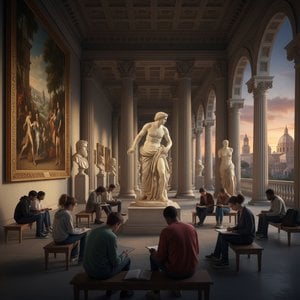
The Enduring Legacy of Classicism: Principles, Evolution & Influence in Western Art
Explore the enduring legacy of Classicism in Western art! Discover its historical context, key principles, iconic masterpieces & lasting influence. Learn about Renaissance and Neoclassical movements with ArtsDot.

Timeless Resonance: Exploring Classic Vibe in Art – A Historical & Aesthetic Analysis
Explore the rich history & enduring aesthetic of Classicism art! Discover key movements, iconic artists like Raphael & David, and its lasting influence on Western art. Deepen your appreciation today.