


 In echtem Maßstab anzeigen
 Versenden als Grußkarte
 Teilen
 Details anzeigen
 Leitfaden

 Herunterladen
 Ähnliche Objekte
 Röntgenaufnahme
 Diashow
 Besucherstatistiken
St.-Lucas-Altarbild


 Mehr anzeigen
Giclée / Kunstdruck
Giclée- oder Leinwanddruck in Museumsqualität mit schneller Produktion und flexiblen Veredelungsoptionen. ( Handgemalte Reproduktion kaufen Zum digitalen Bild wechseln)




P118B $10

P118H $10

P118W $10

P438Z $10

P508JH $12

P508YH $12

P805H $10

P805Z $10

P919BZ $10

P919G $10

P919XJ $10

P959ZH $10

P968JZ $12

W106C $8

W218G $10

W218JH $8

W218Y $10

W307PJ $10

W316G $10

W316PJ $8

W316Y $10

W398PJ $8

W4111J $10

W500HY $15

W500JH $15

W692G $12

W849H $8

W940BG $15

W953PJ $8




Wählen Sie aus unseren vordefinierten Formaten, die den ursprünglichen Proportionen des Kunstwerks entsprechen.

Sie können Ihre eigenen Maße eingeben, um ein bestimmtes Format oder einen speziellen Platz einzupassen. Wenn das von Ihnen gewählte Format nicht den Proportionen des Originalbildes entspricht, werden wir das Kunstwerk entweder beschneiden oder das Bild mit einem gespiegelten oder einfarbigen Rand erweitern. Ein digitaler Entwurf wird Ihnen zur Genehmigung zugesandt, bevor die Produktion beginnt.
Bitte beachten Sie, dass die Vorschau auf dem Bildschirm nicht den tatsächlichen Zuschnitt oder die Erweiterung widerspiegelt. Nur der Entwurf zeigt die endgültige Komposition präzise an.
Obwohl Sondermaße verfügbar sind, empfehlen wir die Auswahl eines Maßes aus der vordefinierten Liste, um die ursprünglichen Proportionen zu bewahren.
Weltweiter Versand () innerhalb von 2 Wochen statt der üblichen 4/5 Wochen. (22 September)

Kostenloser weltweiter Expressversand

Hochwertige Leinenleinwand

Vollständiger Versicherungsschutz beim Versand

Zollgebühren-Rückerstattungsgarantie

Garantie für exakte Farbtreue

100-tägiges Rückgaberecht (nur bei Mängeln)

100% Geld-zurück-Garantie

Angebot für Mengenrabatt
 Die Glasoption ist nur für Größen unter 110 cm verfügbar.

St.-Lucas-Altarbild
Giclée / Kunstdruck
Format der Reproduktion
-


Gesamtpreis
$ 62
A Window Into Renaissance Faith
In the heart of the Early Renaissance, amidst the burgeoning intellectual fervor of Padua, Andrea Mantegna breathed life into the St. Luke Polyptych. Completed between 1453 and 1455, this monumental altarpiece serves as more than a mere religious relic; it is a profound dialogue between the sacred and the classical. As one gazes upon the intricate details of this work, there is an immediate sense of being transported to a time when art sought to resurrect the grandeur of antiquity. The polyptych, originally commissioned for the Benedictine Abbey of Santa Giustina, captures a moment in history where the spiritual devotion of the Middle Ages began to merge with the humanistic precision of the Renaissance.
The composition is a masterclass in spatial illusion and architectural grandeur. Mantegna, having been shaped by the archaeological scholarship of Francesco Squarcione’s workshop, infused the panels with a sculptural weight that feels almost tangible. The central figure of St. Luke is depicted at his desk, deeply immersed in the act of writing his Gospel. This scene is not merely a depiction of a man at work; it is an embodiment of divine inspiration. Surrounded by a celestial assembly of saints—including Jerome, Augustine, and Sebastian—the viewer is invited into a crowded yet harmonious sacred space where every fold of drapery and every column of the Romanesque setting speaks to the artist's obsession with realism and depth.
The Mastery of Light and Form
Technically, the polyptych is a triumph of tempera and distemper on panel. Mantegna’s ability to manipulate light is nothing short of extraordinary; a diffused, ethereal glow illuminates St. Luke, lending his skin and the surrounding parchment an otherworldly quality. This soft illumination contrasts beautifully with the sharp, precise lines of the architectural elements—arches and columns that evoke the lost splendor of Roman temples. For the discerning collector or interior designer, this piece offers a sophisticated interplay of texture and tone. The subtle use of linear perspective creates a window-like effect, pulling the eye into a deep, receding space that adds a sense of monumental scale to any room it inhabes.
The emotional resonance of the work lies in its balance of solemnity and vitality. While the figures possess a heavy, statuesque gravitas, there is an undeniable liveliness in their interactions. The saints are not static icons; they are characters caught in moments of contemplation, reading, or quiet observation. This humanization of the divine was a hallmark of Mantegna’s style, making the sacred narrative accessible and deeply moving. To possess a reproduction of such a work is to bring a piece of history's most profound emotional landscape into one's personal sanctuary.
Symbolism and Timeless Elegance
Every element within this polyptych is laden with symbolic significance, designed to guide the faithful through layers of meaning. St. Luke’s posture represents the quiet strength of contemplation, while his writing serves as a metaphor for the dissemination of truth and the enduring legacy of Christian scripture. The surrounding saints act as pillars of virtue—piety, wisdom, and fortitude—each identified by their unique attributes and expressive countenances. Even the architectural framework, with its heavy moldings and classical motifs, symbolizes the stability of the Church and the continuity of civilization.
For those seeking to decorate a space with art that inspires thought and evokes a sense of heritage, the St. Luke Polyptych offers unparalleled inspiration. Its rich palette of deep blues, earthy ochres, and luminous highlights provides a sophisticated foundation for classical or contemporary interiors alike. A high-quality reproduction of this masterpiece does not merely decorate a wall; it anchors a room with the weight of history, the beauty of Renaissance humanism, and an eternal sense of peace.
Ähnliche Kunstwerke


![Legende Des Heiligen Franziskus - [23] - Der Heilsame Franziskus Wird Von Der Heiligen Klara Beweint — Giotto Di Bondone, Gotik](/media/artworks/images-thumb/17/1c/171c284c41dc3ef8bca83e51c1e1e531.jpg)


Biografie des Künstlers
frühes Leben und Karriere
Andrea Mantegna, ein innovativer italienischer Maler und Gelehrter der römischen Archäologie, wurde 1431 in Italien geboren. Sein Leben ist durch eine bedeutende Abweichung von den weichen Formen seiner Zeit gekennzeichnet, wobei er sich für eine kühne, volumetrische Darstellung von Raum und Form entschied.Beitrag zur Perspektive
Mantegnas Werk war entscheidend bei der Erforschung der Perspektive und nutzte Techniken wie das Anpassen der Horizontlinie, um seinen Werken einen größeren Maßstab und Schwere zu verleihen. Dieser Ansatz stellte eine bedeutende Abweichung von den weichen Formen seiner Zeit dar und zeigte seinen einzigartigen Stil.Bekannte Werke und Verbindungen
* Mantegnas Gemälde sind für ihre robuste, skulpturale Qualität bekannt und zeigen harte, reflektierende Landschaften und Figuren, die seine Bildhauer-Sensibilität für Form und Textur verraten. * Seine Verbindung zur Bellini-Familie durch Heirat ist bemerkenswert, da sie die Vernetzung künstlerischer Familien während der Renaissance widerspiegelt.Vermächtnis in der Kunstgeschichte
Mantegnas Einfluss auf die Entwicklung der Kunst in Italien und darüber hinaus ist unbestreitbar. Sein kühner Ansatz zur Perspektive und Form hat Generationen von Künstlern inspiriert. Wie in seiner Sammlung auf ArtsDot zu sehen ist, fesseln seine Werke die Zuschauer weiterhin mit ihrer Pracht und ihrem innovativen Stil.- Schlüssel künstlerische Bewegungen: Renaissance, frühe Perspektive.
- Bekannte Werke: Umfassen "Die Klage über den toten Christus" und "St. Georg".
- Museen, die seine Werke ausstellen: Die Nationalgalerie in London und die Pinacoteca Brera in Mailand unter anderem.
Weitere Literatur und Erkundung
* Für mehr Informationen über Mantegnas Leben und Werk siehe die Palumbo-Fossati-Sammlung (Venedig, Italien), die einen kurzen Überblick über die Sammlung und ihre bemerkenswerten Stücke bietet. * Erkunden Sie die Geschichte der Kunst in Italien mit der Kultur Italiens auf Wikipedia.
Andrea Mantegna
1431 - 1506 , Italien
Eckdaten zum Künstler
- Beeinflusste Künstler:
- Raphael
- Michelangelo
- Bemerkenswerte Werke:
- Die Klage über den toten Christus
- St. Georg und der Drache
- Camera degli Sposi Fresken
- Die Siege Caesars
- Geburtsdatum: 1431
- Geburtsort: Carturu, Italien
- Künstlerische Bewegung: Renaissance, Frühe Perspektive
- Künstlerische Einflüsse:
- Donatello
- Jacopo Bellini
- Nationalität: Italienisch
- Sterbedatum: 1506
- Vollständiger Name: Andrea Mantegna
Verwandte Artikel

Giotto di Bondone: Die 25 Meisterwerke des Frührenaissance – Kunst für Ihr Zuhause
Entdecken Sie die 25 Meisterwerke von Giotto di Bondone! Erleben Sie die Frührenaissance, religiöse Kunst & ikonische Fresken wie in der Scrovegni Kapelle. Hochwertige Kunstdrucke online bei ArtsDot.com – für zeitlose Eleganz in Ihrem Zuhause.
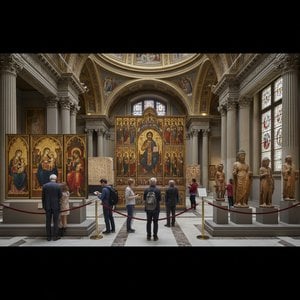
Sacred Narratives Embodied: A Comprehensive Exploration of Religious Iconography in Art History
Explore the rich history of religious iconography in art! Discover symbolism, movements & masterpieces from Byzantine to Renaissance periods. Expert insights for collectors and enthusiasts at ArtsDot.

El Greco: Die 25 Meisterwerke – Kunst für Ihr Zuhause | ArtsDot
Entdecken Sie die 25 bedeutendsten Meisterwerke von El Greco! Erleben Sie die spirituelle Tiefe und den dramatischen Stil des griechischen Malers. Hochwertige Kunstdrucke & Inspiration für Ihr Zuhause auf ArtsDot.com.

Fra Angelico: Die 25 Meisterwerke des italienischen Frührenaissance-Malers | ArtsDot
Entdecken Sie die 25 schönsten Meisterwerke von Fra Angelico! Erleben Sie religiöse Kunst der italienischen Renaissance, himmlische Fresken & Panelgemälde. Finden Sie hochwertige Kunstdrucke und Reproduktionen für Ihr Zuhause auf ArtsDot.com.

Die Wiederbelebung der Polyptychie: Ein zeitgenössisches Design-Statement für Hotels
Entdecken Sie die Wiederbelebung der Polyptychie im Hoteldesign! Expertenwissen & Inspiration für einzigartige Wandgestaltungen. – Ihr Partner für hochwertige Kunst und individuelle Lösungen.


