


 In echtem Maßstab anzeigen
 Versenden als Grußkarte
 Teilen
 Details anzeigen

 Herunterladen
 Ähnliche Objekte
 Röntgenaufnahme
 Diashow
 Besucherstatistiken
Jaroslava and Jiri


 Mehr anzeigen
Giclée / Kunstdruck
Giclée- oder Leinwanddruck in Museumsqualität mit schneller Produktion und flexiblen Veredelungsoptionen. ( Handgemalte Reproduktion kaufen Zum digitalen Bild wechseln)




P118B $10

P118H $10

P118W $10

P438Z $10

P508JH $12

P508YH $12

P805H $10

P805Z $10

P919BZ $10

P919G $10

P919XJ $10

P959ZH $10

P968JZ $12

W106C $8

W218G $10

W218JH $8

W218Y $10

W307PJ $10

W316G $10

W316PJ $8

W316Y $10

W398PJ $8

W4111J $10

W500HY $15

W500JH $15

W692G $12

W849H $8

W940BG $15

W953PJ $8




Wählen Sie aus unseren vordefinierten Formaten, die den ursprünglichen Proportionen des Kunstwerks entsprechen.

Sie können Ihre eigenen Maße eingeben, um ein bestimmtes Format oder einen speziellen Platz einzupassen. Wenn das von Ihnen gewählte Format nicht den Proportionen des Originalbildes entspricht, werden wir das Kunstwerk entweder beschneiden oder das Bild mit einem gespiegelten oder einfarbigen Rand erweitern. Ein digitaler Entwurf wird Ihnen zur Genehmigung zugesandt, bevor die Produktion beginnt.
Bitte beachten Sie, dass die Vorschau auf dem Bildschirm nicht den tatsächlichen Zuschnitt oder die Erweiterung widerspiegelt. Nur der Entwurf zeigt die endgültige Komposition präzise an.
Obwohl Sondermaße verfügbar sind, empfehlen wir die Auswahl eines Maßes aus der vordefinierten Liste, um die ursprünglichen Proportionen zu bewahren.
Weltweiter Versand () innerhalb von 2 Wochen statt der üblichen 4/5 Wochen. (17 September)

Kostenloser weltweiter Expressversand

Hochwertige Leinenleinwand

Vollständiger Versicherungsschutz beim Versand

Zollgebühren-Rückerstattungsgarantie

Garantie für exakte Farbtreue

100-tägiges Rückgaberecht (nur bei Mängeln)

100% Geld-zurück-Garantie

Angebot für Mengenrabatt
 Die Glasoption ist nur für Größen unter 110 cm verfügbar.

Jaroslava and Jiri
Giclée / Kunstdruck
Format der Reproduktion
-


Gesamtpreis
$ 62
A Window Into Victorian Sentiment: Jaroslava and Jiri
Alphonse Mucha’s “Jaroslava and Jiri” is more than simply a depiction of two young children; it's a carefully constructed evocation of late 19th-century sentiment, steeped in the romanticism and nostalgia that defined the era. The painting captures a fleeting moment of innocence – a boy holding an apple, a girl lost in quiet contemplation – within a meticulously crafted still life arrangement. Mucha’s masterful use of light, color, and loose brushwork creates a palpable atmosphere of serene melancholy, inviting the viewer to step into a world both familiar and subtly dreamlike.
Art Nouveau's Embrace: Style & Technique
Rendered in Mucha’s signature Art Nouveau style, “Jaroslava and Jiri” exemplifies the movement’s emphasis on flowing lines, organic forms, and a sense of graceful movement. The composition is dominated by rounded shapes and naturalistic elements, reflecting the influence of Impressionism and the desire to capture fleeting moments of beauty. Mucha's technique is characterized by visible brushstrokes – a deliberate choice that adds texture and depth to the canvas, creating a surface that practically vibrates with life. The impasto application of paint, particularly on the children’s clothing and hair, further enhances this tactile quality, inviting close inspection and appreciation for the artist’s hand.
Symbolic Resonance: Narrative & Detail
Beyond its aesthetic beauty, “Jaroslava and Jiri” is rich in symbolic meaning. The apple held by the boy – a recurring motif in Mucha's work – can be interpreted as representing temptation or knowledge, a subtle nod to classical themes. The presence of the doll suggests playfulness and domesticity, anchoring the scene within a familiar, comforting context. The flattened perspective, typical of portraiture from this period, subtly directs the viewer’s eye towards the central figures, emphasizing their vulnerability and innocence. Notice the careful attention to detail – the texture of the fabric, the sheen on the apple, the delicate expression on the children's faces – all contributing to the painting’s overall sense of realism and emotional depth.
A Legacy of Beauty: Historical Context
Created in 1919, “Jaroslava and Jiri” stands as a testament to Mucha’s enduring influence on art and design. Produced during a period of significant artistic innovation – the rise of Art Nouveau – it reflects the movement's fascination with beauty, nature, and the decorative arts. Much like his other works, this painting speaks to a broader cultural yearning for an idealized past, a time of simpler pleasures and genuine human connection. It’s a poignant reminder of childhood innocence and the enduring power of memory, qualities that continue to resonate with audiences today.
Ähnliche Kunstwerke


Biografie des Künstlers
Frühes Leben und Ausbildung
- Geboren: 15. Juli 1860 in Ivanačice, Mähren (heute Teil der Tschechischen Republik)
- Zeigte schon in jungen Jahren künstlerisches Talent.
- Studierte an der Akademie der Schönen Künste in Prag, war aber von traditionellen Ansätzen enttäuscht.
- Zog 1887 nach Paris, um seinen eigenen Stil zu verfolgen.
Künstlerischer Stil und bemerkenswerte Werke
- Bekannt für seinen unverwechselbaren Jugendstil, der sich durch fließende Linien, organische Formen und eine Bewegungsempfindung auszeichnet.
- Beeinflusst von Künstlern wie Pierre-Auguste Renoir und Gustave Moreau.
- Bemerkenswerte Werke:
- Der slawische Aufstand – Zeigt die Verbindung traditioneller tschechischer Motive mit modernen Jugendstilelementen.
- Salon des Cent
- Gemälde, inspiriert von Werken wie Die Töchter des Tespio von Gustave Moreau und La Ribambelle des Gobelins von Piero Dorazio.
- Illustrationen basierend auf Junge Landwirte ernten Leinen von Sir Hubert von Herkomer.
- Stellte häufig idealisierte Frauen in fließenden Gewändern inmitten üppiger Blumen dar.
Karrierehöhepunkte und wichtige Aufträge
- Zusammenarbeit mit Sarah Bernhardt: Erschuf Plakate und Designs für die Schauspielerin Sarah Bernhardt, beginnend mit dem Plakat für Gismonda (1894), das seine Karriere startete.
- Weltausstellung in Paris (1900): Sein Jugendstil erlangte bei dieser Ausstellung internationale Anerkennung. Er dekorierte den Pavillon von Bosnien und Herzegowina und arbeitete an der Gestaltung des österreichischen Pavillons mit.
- Förderung durch Charles Richard Crane: Erhielt Unterstützung von Charles Richard Crane, die es ihm ermöglichte, die monumentale Serie Der slawische Epos (1912-30) zu schaffen.
- Unabhängiges Tschechoslowakei: Entwarf Briefmarken, Banknoten und Regierungsdokumente für das neu unabhängige Tschechoslowakei.
Einflüsse und Vermächtnis
- Beeinflusst von tschechischen künstlerischen Traditionen und modernen europäischen Kunstbewegungen.
- Sein einzigartiger Stil ebnete den Weg für zukünftige Generationen von Künstlern im Jugendstil und der Sezession.
- Inspirierte andere Künstler wie Eva Prokopcová.
- Sein Vermächtnis erstreckt sich über seine Kunstwerke hinaus und beeinflusst Design und Ästhetik.
Späteres Leben und Tod
- Vermählte sich 1906 mit Maruska (Marie/Maria) Chytilová.
- Besuchte von 1906 bis 1910 die Vereinigten Staaten, wo ihre Tochter Jaroslava geboren wurde.
- Starb am 14. Juli 1939 in Prag, Tschechoslowakei.

Alphonse Maria Mucha
1860 - 1939 , Tschechien
Eckdaten zum Künstler
- Beeinflusste Künstler:
- Pierre-Auguste Renoir
- Gustave Moreau
- Bemerkenswerte Werke:
- Slavonic Uprising
- Salon des Cent
- The Slav Epic
- Geburtsdatum: 15. Juli 1860
- Geburtsort: Brno, Tschechien
- Künstlerische Richtung: Art Nouveau
- Nationalität: Tschechisch
- Todatum: 14. Juli 1939
- Vollständiger Name: Alphonse Maria Mucha
- Von Künstlern Beeinflusst: ['Eva Prokopcová']
Verwandte Artikel

Echoes of Time: Nostalgia, Technique & Cultural Significance in Vintage Paintings
Explore the captivating world of vintage paintings! Discover key styles, cultural significance & collecting tips from art experts at ArtsDot. Find authentic reproductions and elevate your home décor.
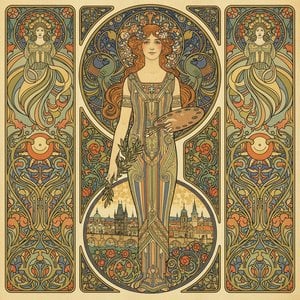
Alphonse Mucha: Meister des Jugendstils und seine zeitlose Ästhetik
Entdecken Sie das Leben und Werk von Alphonse Mucha, dem Meister des Jugendstils! Erfahren Sie mehr über seine ikonischen Plakate, Illustrationen und den bleibenden Einfluss seiner Kunst auf die moderne Welt. Jetzt lesen!

Art Nouveau Meisterwerke: Die 10 prägendsten Kunstwerke für Ihr Zuhause |
Entdecken Sie die 10 prägendsten Art Nouveau Meisterwerke! Von Mucha bis Klimt – erfahren Sie die Geschichten hinter ikonischen Gemälde & dekorativer Kunst. Hochwertige Kunstdrucke online kaufen auf

The Flowing Line & Flourishing Form: Exploring Art Nouveau's Aesthetic Legacy
Explore the captivating world of Art Nouveau! Discover its origins, key artists like Horta & Mucha, regional styles, innovative techniques, and lasting influence on architecture & design. A comprehensive guide for art enthusiasts.

Die Top 10 Gemälde in Sandtönen: Meisterwerke für Ihr Zuhause |
Entdecken Sie die Top 10 Gemälde in faszinierenden Sandtönen! Von Van Gogh bis Monet – erleben Sie Meisterwerke des Impressionismus & mehr. Finden Sie hochwertige Reproduktionen für Ihr Zuhause auf


