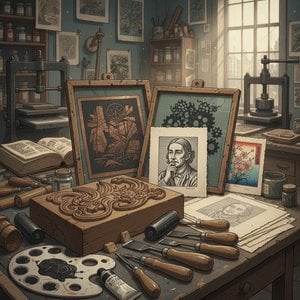
A Master of the Danube School
In the vibrant tapestry of the Northern Renaissance, few threads are as intricately woven as those belonging to Wolf Huber. An Austrian-German painter, printmaker, and architect, Huber emerged as a leading figure of the Danube School, a movement that revolutionized the role of landscape in European art. While much of the Italian Renaissance focused on the perfection of human form and classical idealism, Huber and his contemporaries turned their gaze toward the untamed beauty of the natural world. His work captures the soul of the landscape, transforming dense forests, misty valleys, and dramatic mountain peaks from mere backdrops into profound, living subjects that resonate with spiritual depth.
Born in Feldkirch, Austria, Huber’s early life remains somewhat shrouded in the mists of history, though his presence in the artistic landscape becomes clearly established by the early sixteenth century. By 1515, he was living and working in Passau, Germany, a city that would serve as the primary stage for much of his illustrious career. Though the specifics of his formal training are unknown, it is believed he may have honed his skills within a family workshop. His artistic language suggests a sophisticated understanding of the Italian Renaissance, likely gained through travels to northern Italy, allowing him to blend the meticulous detail of the North with the masterful use of chiaroscuro and atmospheric perspective found in the South.
The Intersection of Spirit and Nature
Huber’s oeuvre is characterized by a remarkable ability to weave human narrative into the very fabric of the earth. In his religious compositions, such as The Flight into Egypt or Christ Taking Leave of His Mother, the landscape does not simply surround the figures; it participates in their emotional journey. He possessed a rare sensitivity to the lyrical qualities of nature, using expansive mountains and verdant trees to act as emotional extensions of his subjects' internal struggles and divine destinies. This technique allowed him to elevate biblical narratives into cosmic events, where the majesty of the terrain mirrors the weight of the spiritual moment.
Beyond his religious works, Huber’s mastery extended to the intimate realm of portraiture. In pieces like the Portrait of Jacob Ziegler, he demonstrates a profound command over light and texture. Through a meticulous layering of pigments, he achieved a velvety depth that brings the sitter to life, capturing the intellectual fervor and introspective thought of his subjects. His portraits often utilize a soft, frontal illumination that lends a sculptural quality to the human face, creating a dialogue between the individual and the atmospheric world unfolding behind them.
Architectural Legacy and Historical Significance
The versatility of Wolf Huber extended far beyond the easel and the printing press. He was a man of multifaceted talent, serving not only as a painter but also as an architect. His architectural contributions are evidenced by his work for local nobility, most notably his commission from Count Niklas II von Salm to rebuild the Neuberg Palace on the Inn River. The surviving fragments of this project reveal his ability to integrate the grander, decorative styles of the Italian Renaissance into the regional landscape, complete with rich, ornamental paintings.
As a court painter to the Duke of Bavaria, Ernst, Huber occupied a position of significant prestige, further cementing his role as a pillar of the German-Austrian artistic community. His legacy lies in his ability to bridge the gap between the human and the divine, the intimate and the expansive. Through his contributions to the Danube School, he helped establish a new way of seeing—one where the landscape is not just a setting for man, but a profound reflection of the eternal.
Spørgsmål & svar
Hvor kommer Wolf Huber fra?
Wolf Huber blev født i Austria.
Findes der en kronologisk gennemgang af Wolf Huber?
En kronologisk gennemgang af Wolf Hubers værker er tilgængelig på kunstnerens Kronologi-side, hvor kunstværkerne præsenteres i rækkefølge efter deres skabelse, kapitel for kapitel.
Hvor er Wolf Hubers værker grupperet efter teknik?
Wolf Hubers værker kan gennemses efter medie på kunstnerens Alle medier side.