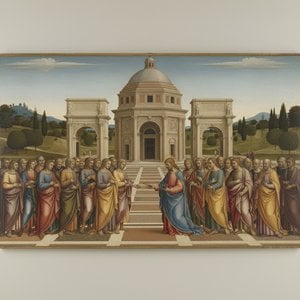
The Sculptor Who Shaped Venetian Renaissance
Pietro Lombardo (1435–1515) stands as a pivotal figure in the artistic landscape of Renaissance Italy, particularly within the vibrant cultural milieu of Venice. Born in Carona, Switzerland—a region steeped in medieval traditions yet embracing burgeoning humanist ideals—Lombardo’s life coincided with an era of unprecedented creative ferment. He emerged not merely as a craftsman, but as one of the most distinguished architects and sculptors of his age, profoundly influencing the artistic sensibilities of his time and cementing Venice's position as a beacon of international innovation.
Little is definitively known about Lombardo’s formative years, yet biographical accounts suggest an education rooted in both Swiss craftsmanship and humanist scholarship. His father, Giovanni Lombadillo, was a stonemason and architect, a lineage that instilled in Pietro a deep, tactile understanding of material and form. This foundational knowledge proved invaluable as he honed his skills under the tutelage of Cristoforo Solari, a prominent Venetian sculptor who championed classical ideals. Through this mentorship, Lombardo adopted an aesthetic centered on balance, proportion, and meticulous detail—characteristics that would become the hallmark of his enduring legacy.
Architectural Mastery and the Venetian Spirit
Lombardo’s architectural prowess reached its zenith with the ambitious undertaking of Santa Maria dei Miracoli (1481–1489). Commissioned by Doge Pasquale Malipiero and financed by Pietro Mocenigo, this monumental edifice represents an extraordinary fusion of Gothic and Renaissance styles. The church's soaring nave, adorned with stunning marble columns and intricate carvings, embodies a masterful assimilation of diverse artistic traditions. In this work, Lombardo demonstrated his ability to translate the grandeur of classical antiquity into the unique, water-bound context of Venice, creating a space that feels both ethereal and structurally grounded.
Beyond architecture, his sculptural contributions redefined the funerary landscape of the Venetian Republic. His works often served as much more than mere memorials; they were profound statements of status, piety, and classical revival. Notable achievements include:
- The Monument to Jacopo Marcello: An exquisite Renaissance relief that depicts a classical nude set against a delicate landscape, showcasing his ability to blend human anatomy with naturalistic beauty.
- The Monument of Pietro Mocenigo: Created around 1476, this stunning marble relief utilizes dramatic lighting and grandeur to celebrate the deceased through a lens of classical detail.
A Legacy Carved in Marble
The historical significance of Pietro Lombardo lies in his role as a bridge between the medieval past and the humanist future. His ability to weave together the intricate, decorative impulses of the Gothic period with the structured, rational beauty of the Renaissance allowed Venice to develop a distinct visual language—one that was neither purely Roman nor strictly Northern. His influence can be felt in the way subsequent generations of Venetian artists approached the interplay of light, shadow, and stone.
Even centuries later, his work continues to captivate the imagination. The intricate details of his reliefs and the structural elegance of his churches remain a testament to a man who understood that true art is found in the harmony of opposites: strength and delicacy, tradition and innovation, the earthly weight of marble and the spiritual lightness of the divine. Through his hands, the stone of the Venetian landscape was transformed into a permanent dialogue with classical antiquity.
Spørgsmål og svar
Hvor kommer Pietro Lombardo fra?
Pietro Lombardo blev født i Switzerland.
Kan jeg gennemse Pietro Lombardos værker efter kunstretning?
Siden Alle kunstretninger grupperer Pietro Lombardos værker efter kunstretning.
Hvordan finder jeg værker af Pietro Lombardo i en specifik farvepalette?
Se Pietro Lombardos værker sorteret efter farvepalette på kunstnerens Efter farvepalet side.