A Pioneer of Lithuanian Silkscreen: The Life and Art of Mikalojus Povilas Vilutis
Mikalojus Povilas Vilutis, born in Vilnius in 1944, stands as a pivotal figure in the development of contemporary graphic art in Lithuania. He isn’t merely an artist; he is a cultural instigator, a printmaking innovator, and a voice that dared to challenge conventions during a period of significant political and artistic constraint. Vilutis's journey began with architectural aspirations at the Vilnius State Art Institute in 1963, but his creative spirit quickly gravitated towards graphic art, recognizing its potent capacity for expression. This shift proved foundational, setting him on a path that would redefine the landscape of Lithuanian printmaking.
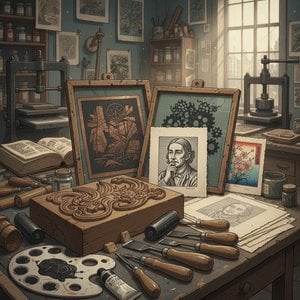
The early years following his graduation in 1970 were marked by a pursuit of technical mastery. Vilutis sought specialized training in serigraphy – silkscreen printing – at an experimental institute in Kiev. This wasn’t simply about acquiring a skill; it was about embracing a medium largely unexplored within the Lithuanian art scene, one that offered a unique texture and immediacy absent from traditional methods. While silkscreen enjoyed popularity in the West as a tool for mass production and pop art aesthetics, Vilutis envisioned something different. He saw its potential to transcend those boundaries, becoming a vehicle for personal narrative and critical commentary.
Breaking with Tradition: An Avant-Garde Aesthetic
Vilutis’s work emerged during a time when Lithuanian art was often steeped in romanticized depictions of folk traditions. He deliberately diverged from this path, instead drawing inspiration from international currents and the realities of everyday life. His early prints possessed an unsettling energy – sharp silhouettes, bold contrasting colors, and unrefined forms that challenged the prevailing aesthetic norms. This boldness wasn’t immediately embraced; for several years after graduating, Vilutis faced obstacles in exhibiting his work due to its perceived modernity and even aggression. This period of relative isolation, however, proved crucial in solidifying his unique artistic voice.
His style is characterized by a playful yet incisive approach. There’s often a subtle humor woven into the compositions, a self-awareness that prevents them from becoming overly didactic. He wasn't afraid to incorporate irony and even self-mockery, creating works that invite contemplation rather than offering easy answers. A prime example of this is his piece “Centre of the Universe No 34405030014,” a self-portrait incorporating his personal identification number – a wry commentary on individuality within a bureaucratic system and the vastness of existence.
Beyond Prints: A Multifaceted Creative Life
While celebrated for his silkscreen prints, Vilutis’s creative output extends far beyond this medium. He has designed striking posters for exhibitions and theatrical productions, created evocative book illustrations – notably collaborating with prominent Lithuanian poets like Sigitas Geda and Marcelijus Martinaitis – and penned insightful essays exploring themes of culture, society, and philosophy. This multifaceted approach underscores his belief in the interconnectedness of art forms and his commitment to engaging with a broad range of intellectual and aesthetic concerns.
His writings, published in various cultural periodicals and collected in volumes like Cake and Soup, reveal a sharp wit and a keen observational eye. They are not merely reflections on art but explorations of the human condition, often delivered with a playful skepticism that challenges conventional wisdom. This literary dimension adds another layer to his artistic persona, positioning him as a thinker and commentator alongside being a visual artist.
Legacy and Historical Significance
Mikalojus Povilas Vilutis’s impact on Lithuanian art is undeniable. He is rightfully regarded as the pioneer of silkscreen printing in the country, introducing a technique that expanded the possibilities for artistic expression. His work broke with established traditions, paving the way for subsequent generations of artists to explore new forms and challenge societal norms. In 2004, he was honored with the Lithuanian National Culture and Arts Prize, a testament to his enduring contribution.
Today, Vilutis’s prints are held in museum collections and private holdings both within Lithuania and abroad. His retrospective exhibition at the Titanikas showrooms of Vilnius Art Academy in 2014 provided a comprehensive overview of his life and work, solidifying his place as a central figure in Lithuanian avant-garde art. He continues to inspire with his unwavering commitment to artistic integrity, his innovative spirit, and his ability to find beauty and meaning in the unexpected corners of everyday life.