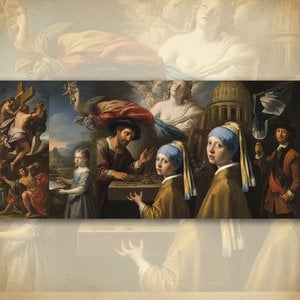
1629 - 1675

Hurtige fakta

  • Nationality: Spain
  • Typical colors: earthy
  • Died: 1675
  • Top 3 works:
    • The Birth of the Virgin
    • The Marriage of the Virgin
    • The Adoration of the Shepherds
  • Also known as:
    • Matheo Gilarte
    • Mateo Gilart
    • Matheo Gilart
    • Mateo Gilarte y Villacís
    • Francisco Gilarte
  • Top-ranked work: The Birth of the Virgin
  • Born: 1629, Orihuela, Spain

The Shadow of the Workshop

The air in Valencia carries the weight of tradition as a young Mateo Gilarte begins his training. He moves through the workshop of Jerónimo Jacinto de Espinosa, absorbing the technical rigor of the era. His early brushwork reveals the unmistakable influence of Pedro de Orrente, a stylistic imprint that marks his formative years. By 1651, the focus shifts away from the Valencian coast toward Murcia, where he settles to establish a permanent presence in the Spanish Baroque landscape.

Life in Murcia is defined by collaboration. He works alongside his brother Francisco, a cathedral painter, to bring a series of paintings devoted to the life of the Virgin to fruition. Their partnership transforms religious spaces through shared vision and technical skill. In 1658, a royal concession grants him the title of "Master of the Royal Gunpowder Factories." It remains an enigma whether he ever practiced his father's trade of gunpowder manufacturing or if the title was merely an honorary distinction bestowed upon a man of growing reputation.

The Chapel and the Battle

Between 1663 and 1667, the focus turns to the Convent of Santo Domingo. Within the chapel of the Brotherhood of the Rosary, Gilarte and his brother execute a series of oil paintings and frescoes. These works demand a command of both scale and light. During this period, his reputation reaches a peak of social and professional recognition. He is said to have received a tribute for his depiction of the Battle of Lepanto, a moment that placed him in the social orbit of figures like Juan de Toledo.

The end of his life is marked by a quiet, personal austerity. In his final will, Gilarte declared himself to be poor. He was buried in the very chapel where he had spent his final years working—the chapel of the Brotherhood of the Rosary. He leaves behind a legacy tied to the sacred spaces of Murcia, a painter whose life was deeply intertwined with the religious and social structures of the seventeenth century.

Kort quiz

Der er kun ét korrekt svar på hvert spørgsmål.

Spørgsmål 1:
In which city did Mateo Gilarte receive his training as a painter?
Spørgsmål 2:
What was the profession of Mateo Gilarte's father, Francisco?
Spørgsmål 3:
By 1658, what title was Mateo Gilarte given by royal concession?
Spørgsmål 4:
With whom did Mateo Gilarte collaborate on paintings devoted to the life of the Virgin?
Spørgsmål 5:
According to Antonio Palomino, what event did Gilarte depict for which he received a tribute?

Spørgsmål og svar

Hvilken farvepalette kendetegner Mateo Gilarte's værker?

earthy

By 1658, what title was Mateo Gilarte given by royal concession?

Master of the Royal Gunpowder Factories

Hvad er andre navne, som Mateo Gilarte er kendt under?

Matheo Gilarte, Mateo Gilart, Matheo Gilart, Mateo Gilarte y Villacís, Francisco Gilarte, Mateo Gilarte Villacís

In which city did Mateo Gilarte receive his training as a painter?

Valencia

Hvor kommer Mateo Gilarte fra?

Spain

Hvornår døde Mateo Gilarte?

1675

Hvor intens er farvebrugen i Mateo Gilarte's værker?

balanced

Hvilken kunstperiode tilhørte Mateo Gilarte?

Early Modern

Hvem er Mateo Gilarte?

The Shadow of the Workshop The air in Valencia carries the weight of tradition as a young Mateo Gilarte begins his training. He moves through the workshop of Jerónimo Jacinto de Espinosa, absorbing the technical rigor of the era. His early brushwork reveals the unmistakable influence of Pedro de Orrente, a stylistic imprint that marks his formative years. By 1651, the focus shifts away from the Valencian coast toward Murcia, where he settles to establish a permanent presence in the Spanish Baroq

With whom did Mateo Gilarte collaborate on paintings devoted to the life of the Virgin?

His brother Francisco