A Master of Flemish Genre
Jan Jozef II Horemans stands as a distinguished figure within the rich tapestry of eighteenth-century Flemish painting. Born in Antwerp, Belgium, he emerged from a lineage deeply rooted in the artistic traditions of his homeland. As the son of Jan Josef Horemans the Elder, a prolific genre painter, the younger Horemans was likely shaped by the intimate lessons of his father's workshop. His journey through the art world was marked by a profound connection to the Guild of St. Luke in Antwerp, where he achieved the prestigious status of master and even served as dean on two separate occasions. This deep involvement with the local artistic community underscores his significance within the cultural fabric of Antwerp during his lifetime.
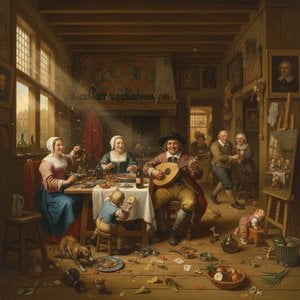
The artistry of Horemans is most vibrantly expressed through his mastery of genre scenes, a style that allowed him to capture the nuanced rhythms of daily life. His works often transport the viewer into intimate, domestic settings, where the quiet joys of social interaction and intellectual pursuit are rendered with exquisite care. In masterpieces such as Concert in an Interior, one can observe the elegance of the Rococo period, characterized by a harmonious balance and an opulent attention to detail. Through his brush, scenes of musical performance, reading, and shared learning become much more than mere depictions; they become windows into the burgeoning culture of enlightenment, reflecting the grace and refinement of the era.
Versatility and Artistic Legacy
While genre painting remains his most celebrated contribution, Horemans possessed a remarkable versatility that expanded his repertoire far beyond domestic interiors. His talent extended to the depiction of harbor views, equestrian paintings, portraits, and still lifes, demonstrating a technical range that appealed to a variety of patrons. This breadth of subject matter allowed him to engage with different facets of the eighteenth-century experience, from the bustling activity of maritime life to the dignified stillness of portraiture. His ability to manipulate light and composition is particularly evident in works like Lesson of Singing, where he captures a moment of profound resonance and shared intellectual joy.
Beyond his individual canvases, Horemans played a pivotal role in the institutional development of the arts in his home city. He was a co-founder of the Genootschap ter aanmoediging der Schoone Kunsten, also known as the Konstmaatschappij, an art society dedicated to the encouragement of fine arts. This endeavor, alongside other notable contemporaries, highlights his commitment to fostering a lasting artistic legacy in Antwerp. Through his diverse body of work and his leadership within the guild and academy, Jan Jozef II Horemans left an indelible mark on the Flemish tradition, ensuring that the elegance and observational brilliance of his era would be preserved for future generations.
Spørgsmål & svar
I hvilke kunstretninger arbejdede Jan Jozef Ii Horemans?
Jan Jozef Ii Horemanss værker kan gennemses efter stilart på kunstnerens Alle ismer side.
Hvor populære er Jan Jozef Ii Horemanss kunstværker?
Statistikker om Jan Jozef Ii Horemanss værker er tilgængelige på kunstnerens Statistikker side.
Hvordan kan jeg se alle værker skabt af Jan Jozef Ii Horemans?
Alle værker af Jan Jozef Ii Horemans på denne hjemmeside kan gennemses via kunstnerens Alle kunstværker-side.