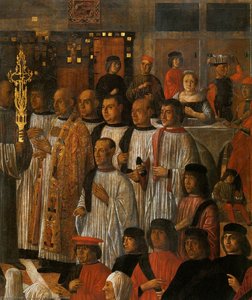
The Enigmatic Legacy of Giovanni di Niccolò Mansueti
Within the golden age of the Venetian Renaissance, certain names flicker like candlelight in a vast cathedral—present, profound, yet partially obscured by the shadows of time. Giovanni di Niccolò Mansueti (c. 1465 – 1527) is precisely such a figure. A master whose brush captured the spiritual essence of Venice, Mansueti operated in an era of immense transition, where the rigid structures of the Middle Ages were yielding to the luminous humanism of the Renaissance. While biographical details regarding his early life remain sparse, his artistic identity is indelibly linked to the Venetian tradition, a lineage defined by color, light, and a profound devotion to sacred narrative.
The foundations of Mansueti’s artistry were laid under the watchful eye of Gentile Bellini, the titan of Venetian painting. From Bellini, Mansueti inherited more than just technical proficiency; he absorbed a specific way of seeing the world—a commitment to disegno and a mastery of glazing techniques that allowed light to permeate the layers of oil paint. This training instilled in him a reverence for classical ideals and an ability to render the divine through meticulous observation. While his contemporaries in Florence were racing toward a bold, muscular naturalism, Mansueti remained a steadfast guardian of the antique style, favoring a serene, idealized beauty that echoed the works of earlier masters like Cimabue and Carpaccio.
A Mastery of Sacred Narrative and Symbolism
To encounter a work by Mansueti is to enter a space of quiet contemplation. His compositions are rarely mere illustrations of scripture; rather, they are carefully constructed theological meditations. He possessed a singular ability to weave complex religious symbolism into the very fabric of his landscapes and figures. In his celebrated depictions of miracles, such as the Miracle of the Relic of the Holy Cross in Campo San Lio, the artist utilizes subtle tonal gradations to elevate the mundane into the miraculous, guiding the viewer's eye through a landscape of profound spiritual significance.
His technical repertoire was characterized by several defining elements:
- Luminous Glazing: The use of thin, transparent layers of pigment to create an ethereal glow that seems to emanate from within the canvas.
- Devotional Precision: A meticulous approach to detail in religious iconography, ensuring that every saintly attribute and sacred object was rendered with clarity and reverence.
- Classical Serenity: An aesthetic preference for balanced, harmonious compositions that evoke a sense of eternal peace rather than dramatic tension.
In masterpieces such as the Adoration of the Kings, Mansueti captures moments of profound human devotion, blending the majesty of the royal visitors with a tender, intimate atmosphere. His work often serves as a bridge between the monumental scale of the High Renaissance and the delicate, ornamental beauty of the Venetian Quattrocento.
Historical Significance and Artistic Resonance
Though the passage of centuries has rendered much of his personal history lost to us, the historical significance of Giovanni di Niccolò Mansueti remains undeniable. He represents a vital link in the evolution of Venetian art, embodying the transition from the decorative traditions of the late 15th century to the more complex, atmospheric explorations of the 16th century. His refusal to abandon the antique style in favor of fleeting trends allowed him to create works that possess a timeless, almost otherworldly quality.
Today, Mansueti’s oeuvre stands as a testament to the enduring power of the Venetian school. His ability to evoke the divine through symbolic representation—as seen in his powerful interpretations of the Crucifixion—continues to captivate scholars and art lovers alike. He remains a master of the sacred, an artist who found the infinite within the details of the finite, leaving behind a legacy of light, faith, and unparalleled Venetian grace.