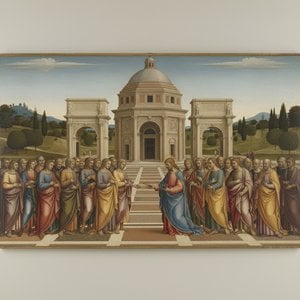
Cosimo Rosselli (1439–1507): A Florentine Hand in Rome
Cosimo Rosselli, born around 1439 in the vibrant heart of Florence, emerged from a family of established merchants—a background that afforded him a stable upbringing and access to the burgeoning cultural life of the Renaissance. Unlike many artists who began their training in youth, Rosselli’s artistic journey commenced relatively late, around the age of twenty. He entered the workshop of Domenico Ghirlandaio, a leading figure in Florentine painting renowned for his masterful frescoes and exquisitely detailed altarpieces. This environment was not merely an apprenticeship; it was immersion into a bustling hub of creativity where numerous assistants contributed to a constant stream of commissions. Here, Rosselli absorbed the fundamentals of drawing, composition, and the meticulous techniques that would define his early style. Ghirlandaio’s influence was profound, instilling in him a linear precision, a vibrant palette, and a narrative clarity that characterized much of his work. Yet, even within this formative period, Rosselli began to demonstrate an individual sensibility, subtly absorbing elements from earlier masters like Masaccio and Fra Angelico—artists who had already revolutionized the depiction of space, light, and emotion in painting.- Early Foundations: Domenico Ghirlandaio’s workshop provided Rosselli with a crucial foundation in painting techniques and compositional principles, shaping his early aesthetic sensibilities. He learned from Ghirlandaio's mastery of perspective and draughtsmanship, establishing a stylistic bedrock that would inform his subsequent endeavors.
- Roman Experience: A pivotal moment arrived in 1481 when Rosselli received an invitation to participate in the monumental fresco cycle decorating the walls of the Sistine Chapel in Rome. This commission, alongside such luminaries as Pietro Perugino and Sandro Botticelli, marked a significant turning point in his career, catapulting him onto an international stage. The overarching theme of these frescoes was a carefully constructed parallel between the stories of Moses and Christ—a deliberate attempt to legitimize papal authority and underscore the continuity of divine law. Rosselli’s contributions focused on scenes from the Life of Jesus, showcasing his ability to translate complex narratives into visually compelling compositions.
Florentine Commissions and a Developing Style
Upon returning to Florence from Rome, Rosselli continued to receive a steady flow of commissions for altarpieces, frescoes, and panel paintings. His mature style blossomed during this period, characterized by refined compositions, elegant figures, and increasingly detailed landscapes. He retained the linear precision and vibrant colors he had learned from Ghirlandaio but began to incorporate elements of Perugino’s more graceful and harmonious aesthetic. Notable works from this time include frescoes for the Santissima Annunziata church—a significant commission that allowed him to showcase his evolving style on a grand scale—and numerous altarpieces adorning chapels throughout Florence. Rosselli possessed a talent for portraying the psychological states of his figures, imbuing them with a sense of inner life that resonated with contemporary audiences. He developed a distinctive approach to depicting religious scenes, emphasizing human emotions and interactions while maintaining an atmosphere of reverence and piety.Influences and Artistic Development
Rosselli’s artistic journey is a compelling example of how Renaissance artists navigated the complex interplay between tradition, innovation, and patronage, leaving behind a legacy that continues to inspire and captivate audiences today. He absorbed elements from earlier masters like Masaccio and Fra Angelico, incorporating their innovations—such as realistic depictions of space and emotional expression—into his own distinctive style. This demonstrates a deep understanding of art history and a willingness to learn from those who came before him. His early training under Ghirlandaio instilled in him a meticulous attention to detail and a mastery of linear perspective, shaping the foundational principles of his artistic practice.Legacy and Historical Significance
Cosimo Rosselli continued working diligently throughout the early 16th century, securing commissions from prominent Florentine families and religious institutions. However, as new artistic stars rose—Raphael and Michelangelo foremost among them—his prominence gradually diminished. He passed away in Florence around 1520, leaving behind a body of work that reflects his skill as a painter and his dedication to depicting religious themes with clarity and elegance. Today, Rosselli is remembered as a skilled Florentine artist who played an important role in the development of Renaissance art. His participation in the Sistine Chapel frescoes helped solidify Florence’s position as a leading center of artistic innovation, and his own works demonstrate his ability to synthesize diverse influences into a distinctive and refined style. While perhaps not achieving the same level of fame as some of his contemporaries, Cosimo Rosselli's contributions remain significant—a testament to his talent, dedication, and enduring legacy within the rich tapestry of Renaissance art.Spørgsmål og svar
Hvilke andre navne eller pseudonymer bruger Cosimo Rosselli?
Cosimo Rosselli optræder under de alternative navne Cosimo di Lorenzo Filippi Rosselli.
Kan jeg gennemse Cosimo Rossellis værker efter stemning?
Stemningsfulde rum for Cosimo Rosselli er en side, hvor kunstnerens værker er organiseret efter stemning.
Hvor og hvornår er Cosimo Rosselli født?
Cosimo Rosselli blev født i Firenze i 1439.