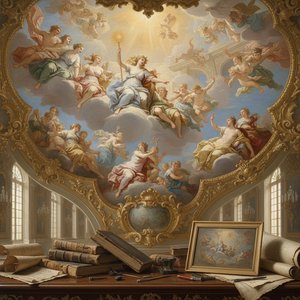
The Reign of Rococo: Anton Pössenbacher and the Bavarian Court
Anton Pössenbacher, born in Munich in 1842 and passing away in 1920, wasn’t merely a furniture maker; he was an architect of atmosphere, a sculptor of interiors who defined the opulent aesthetic of late 19th-century Bavaria. He inherited his father's workshop in 1866, but quickly transcended the established business, transforming it into a large-scale *Hofmöbelfabrik* – a royal furniture factory – by 1873. This wasn’t simply an expansion of scale; it was a declaration of ambition, a commitment to providing complete interior schemes that enveloped patrons in a world of lavish detail and historical allusion. Pössenbacher didn't just craft pieces; he conceived environments, becoming synonymous with the Neo-Rococo style favored by King Ludwig II and the Bavarian aristocracy.A Master of Historicism
Pössenbacher’s work is deeply rooted in *Historicism*, a 19th-century movement that sought inspiration from past styles, particularly those of the Rococo period. However, he wasn't simply copying historical forms. He possessed an exceptional ability to reinterpret and adapt these motifs for contemporary tastes, creating furniture that felt both authentically antique and strikingly modern. His workshop became renowned for its meticulous craftsmanship, employing skilled artisans who excelled in carving, gilding, marquetry, and upholstery. The quality of materials was paramount – rich woods, luxurious fabrics, and shimmering gilt were hallmarks of his creations. He understood the power of illusion, using paint and ornamentation to create a sense of depth and grandeur.Royal Commissions and Lasting Legacy
The defining characteristic of Pössenbacher’s career was his association with King Ludwig II. He became one of the most important suppliers of furniture for the royal palaces of Linderhof, Herrenchiemsee, and Neuschwanstein – castles that stand as monuments to the king's romantic vision. The interiors of these palaces, brimming with Pössenbacher’s designs, are a testament to his skill and artistry. At Linderhof, he furnished the opulent state bedroom and other lavish spaces, creating an atmosphere of regal splendor. Herrenchiemsee, Ludwig’s attempt to recreate Versailles, saw Pössenbacher crafting furniture that rivaled the originals in its extravagance. Perhaps most famously, Neuschwanstein – the fairytale castle itself – featured numerous pieces designed by Pössenbacher, contributing significantly to its romantic and theatrical ambiance. These commissions weren't merely about providing furnishings; they were about realizing a king’s dream, translating his fantasies into tangible reality.Beyond the Palaces: A European Reputation
While inextricably linked with Ludwig II, Pössenbacher’s influence extended far beyond Bavaria. He became a prominent designer and manufacturer of luxury furniture throughout Europe, catering to discerning collectors and aristocratic clients. His workshop developed a reputation for exceptional quality and innovative design, attracting commissions from across the continent. The demand for his work led to an expansion of production capabilities and a refinement of techniques. Pössenbacher wasn’t simply fulfilling orders; he was shaping tastes, setting standards for luxury furniture making, and establishing himself as a leading figure in the European decorative arts scene. His ability to blend historical inspiration with contemporary sensibilities ensured that his designs remained relevant and sought after even after Ludwig II's death.A Lasting Symbol of Bavarian Opulence
Anton Pössenbacher’s legacy endures not only through the surviving furniture in the royal palaces but also through the enduring appeal of the Neo-Rococo style he so masterfully embodied. He represents a pivotal moment in the history of decorative arts, bridging the gap between traditional craftsmanship and industrial production. His workshop's commitment to quality and detail set a new standard for luxury furniture making, influencing generations of artisans and designers. Today, his pieces are highly prized by collectors and museums worldwide, serving as tangible reminders of a bygone era – an era defined by opulence, romanticism, and the artistic vision of a Bavarian master craftsman. His work continues to evoke a sense of wonder and enchantment, transporting viewers back to the gilded age of Ludwig II and the reign of Rococo.Spørgsmål og svar
Hvilken by og hvilket land er Anton Pössenbacher Hofmöbelfabrik født i?
Anton Pössenbacher Hofmöbelfabrik blev født i Munich, i Germany.
Hvordan finder jeg værker af Anton Pössenbacher Hofmöbelfabrik i en specifik farvepalette?
Siden Efter farvepalet grupperer Anton Pössenbacher Hofmöbelfabriks kunstværker efter deres farvepaletter.
Hvor mange kunstværker af Anton Pössenbacher Hofmöbelfabrik er tilgængelige at gennemse?
Du kan gennemse 1 kunstværker værker af Anton Pössenbacher Hofmöbelfabrik på siden Alle kunstværker.