The Luminous Legacy of Abraham Jansz Begeyn
In the vibrant tapestry of the Dutch Golden Age, few threads shimmer with as much versatility and grace as those woven by Abraham Jansz Begeyn. Born in the scholarly atmosphere of Leiden around 1637, Begeyn emerged during an era of unprecedented artistic flourishing, a time when the Netherlands was redefining the boundaries of visual storytelling. His journey from a promising student in the Guild of St Luke to a prestigious court painter in Berlin is a testament to a talent that refused to be confined by borders or genres. While many of his contemporaries found solace in the singular pursuit of portraiture or maritime scenes, Begeyn embraced a much broader canvas, masterfully navigating the delicate realms of Italianate landscapes, intricate still lifes, and evocative hunting scenes.
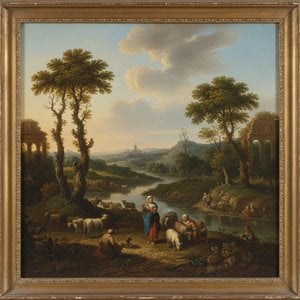
The soul of Begeyn’s work is deeply rooted in his formative travels, most notably his transformative sojourn through Italy between 1659 and 1660. Immersing himself in the artistic currents of Rome and Naples, he absorbed the warmth and classical grandeur of the Mediterranean, which would forever alter his compositional sensibilities. This exposure to Italianate aesthetics allowed him to infuse his Dutch landscapes with a unique atmospheric perspective, blending the meticulous, grounded detail characteristic of his homeland with a sun-drenched, idealized light. Influenced heavily by the works of Nicolaes Pietersz Berchem, Begeyn developed a way of painting that felt both intimately observed and poetically imagined, creating vistas that invited the viewer to wander through worlds of quiet splendor.
Mastery of Detail and the Art of Stillness
Beyond the sweeping horizons of his landscapes, Begeyn possessed an extraordinary ability to command the intimate space of the still life. His floral compositions, such as the exquisite Flowers In A Stone Vase, serve as profound meditations on beauty and transience. In these works, every petal, dewdrop, and insect is rendered with a precision that borders on the miraculous, yet they never feel static. Instead, there is a breathing vitality to his botanical studies, where the play of light across organic textures evokes a sense of temporal presence. This mastery of detail was not merely a technical feat but a way to engage the viewer in a sensory experience, celebrating the fleeting glory of the natural world.
His versatility extended into the more rugged and dynamic genres as well. Whether capturing the pastoral charm of peasants or the structured tension of hunting scenes, Begeyn maintained a consistent standard of excellence. His ability to adapt his style—moving from the delicate textures of a flower petal to the robust presence of cattle or the atmospheric depth of a distant forest—demonstrates a profound understanding of light and form. This adaptability was particularly evident during his time in Amsterdam following the Rampjaar of 1672, where his collaborations with other masters like Willem van de Verlde the Younger showcased his ability to contribute to large-scale, ambitious artistic projects.
A Courtly End and Lasting Significance
The latter part of Begeyn’s life saw him ascending to the highest echelons of European patronage. His appointment as a court painter for Frederick III of Brandenburg, who would later become the King of Prussia, solidified his status as an artist of international importance. Settling in Berlin, he became a vital figure in the burgeoning Prussian cultural landscape, bringing with him the sophisticated techniques and aesthetic sensibilities of the Dutch and Italian traditions. His presence in Berlin was not merely decorative; he was a cornerstone of a movement that sought to establish a new era of artistic excellence in the region.
Though his life came to an untimely end in 1697, leaving behind a legacy marked by both professional triumph and the intense rivalries of the Berlin academy, Begeyn’s impact remains indelible. He stands as a bridge between the grounded realism of the Dutch tradition and the idealized elegance of the Italianate style. To look upon a Begeyn painting is to witness a master at work, balancing the weight of reality with the lightness of beauty, ensuring that his name remains etched in the annals of Baroque greatness.
Spørgsmål og svar
Hvilke andre navne er Abraham Begeyn kendt under?
Abraham Begeyn er også kendt som Abraham Jansz. Begeyn, Jansz. Begeijn, Abraham Bagijn, Abraham Beguyne, Abraham Cornelisz. Begeyn.
Kan jeg udforske Abraham Begeyns værker efter farvespektrum?
Siden Farveindeks organiserer Abraham Begeyns værker efter farve.
Hvilke stemninger udtrykker Abraham Begeyns kunstværker?
Stemningsfulde rum for Abraham Begeyn er en side, hvor kunstnerens værker er organiseret efter stemning.