

The Flourishing Canvas: A Historical Journey Through Botanical Illustration

Indholdsfortegnelse
The Roots of Observation: Early Botanical Depictions
 Wikipedia: Illustration
An illustration is a decoration, interpretation, or visual explanation of a text, concept, or process, designed for integration in print and digitally published media, such as posters, flyers, magazines, books, teaching materials, animations, video g...
Before the advent of photography, the faithful rendering of plant life was not merely a pursuit of aesthetic beauty; it was an essential act of scientific documentation and, often, survival. The earliest botanical illustrations weren’t born in artist studios but within the practical needs of herbalism and medicine. Ancient civilizations – Egyptians, Greeks, Romans – meticulously recorded plants for their healing properties, culinary uses, and even ritualistic significance. These early depictions, found adorning papyrus scrolls and illuminated manuscripts, often prioritized clarity over artistic finesse. The Vienna Dioscurides, a stunningly preserved 6th-century copy of the Greek pharmacopoeia, exemplifies this focus; while beautiful in its own right, its illustrations served primarily as identification guides for apothecaries. The stylized forms and limited color palettes reflect a desire to convey essential characteristics rather than photorealistic detail. Similarly, medieval herbals, painstakingly crafted by monks within cloistered gardens, reveal a deep connection between observation, faith, and the natural world. These early works laid the foundation for a tradition where art and science were inextricably linked.
The Golden Age of Floral Art: 17th & 18th Century Masters
 Jan van Kessel the Elder
Jan van Kessel the Elder (1626-1679) was a versatile Flemish painter known for detailed floral still lifes, insect studies, animal allegories & landscapes. A Brueghel family descendant, his meticulous work reflects 17th-century scientific observation
The Renaissance sparked a renewed interest in classical learning, which extended to the study of botany. However, it was during the 17th and 18th centuries that botanical illustration truly blossomed into an art form. Flemish painter Jan van Kessel the Elder, descended from the renowned Brueghel family, epitomized this era’s meticulous approach. His floral still lifes weren't simply decorative; they were exercises in precise observation, capturing the delicate textures of petals, the intricate patterns of leaves, and even the subtle imperfections of insects that inhabited these botanical worlds. Van Kessel’s work reflects a growing scientific curiosity – an attempt to categorize and understand the natural world through detailed visual representation. This period also saw the rise of elaborate flower paintings commissioned by wealthy patrons, often imbued with symbolic meaning. Each bloom carried a specific connotation—roses for love, lilies for purity—transforming bouquets into coded messages. The demand for accuracy fueled the development of new techniques in watercolor painting and engraving, allowing artists to reproduce botanical specimens with unprecedented fidelity.
Scientific Precision Meets Artistic Beauty: The Rise of Modern Botanical Illustration
 Lilium candidum
Admire Robert Havell's 'Lilium candidum,' a stunning botanical illustration showcasing delicate white lilies with meticulous detail. A classic of 19th-century scientific art.
The 19th century witnessed a shift towards even greater scientific rigor in botanical illustration. Artists were increasingly employed by botanists and explorers to document newly discovered plant species from around the globe. Robert Havell Jr., renowned for his exquisite illustrations of North American wildflowers, exemplifies this trend. His work on John Torrey’s *Flora of North America* set a new standard for botanical accuracy and artistic quality. Havell's watercolors weren’t merely copies of nature; they were interpretations informed by careful study of plant morphology—the structure and form of plants. The precision extended to the composition itself, often showcasing multiple stages of a plant’s life cycle or highlighting key identifying features. This era also saw the emergence of botanical illustration as a distinct profession, with artists undergoing formal training in both art and botany. The goal was no longer simply to create beautiful images but to produce scientifically valuable records that could be used for taxonomic classification.
Women Pioneers in the Field: Mary Morris Vaux Walcott and Marianne North
 Mary Morris Vaux Walcott
Discover Mary Morris Vaux Walcott (1860-1940), the 'Audubon of Botany,' renowned for her exquisite watercolor wildflower paintings documenting North American flora for the Smithsonian.
While historically dominated by men, the field of botanical illustration also saw remarkable contributions from women artists. Mary Morris Vaux Walcott, often dubbed the “Audubon of Botany,” dedicated her life to documenting the wildflowers of North America for the Smithsonian Institution. Her watercolors are celebrated not only for their exquisite detail but also for their vibrant color and dynamic compositions. Walcott’s work was groundbreaking in its scope and ambition—she painted over 800 species, meticulously recording their habitats and growth patterns. Simultaneously, Marianne North challenged artistic conventions with her bold and independent spirit. Traveling extensively throughout the world, she painted exotic plants from life, creating a vast collection of over 800 paintings that now reside in the Marianne North Gallery at Kew Gardens. North’s work is notable for its directness and immediacy—she eschewed traditional studio techniques, preferring to paint outdoors, capturing the essence of each plant in its natural environment. Both Walcott and North defied societal expectations, establishing themselves as leading botanical artists through their talent, dedication, and unwavering passion.
Techniques and Materials: A Closer Look at the Illustrator’s Craft
The creation of a botanical illustration is a painstaking process that requires both artistic skill and scientific knowledge. Traditionally, illustrators begin with careful observation of live specimens, often dissecting plants to understand their internal structure. Graphite sketches are used to establish the basic form and proportions, followed by layers of watercolor washes to build up color and texture. The choice of paper is crucial—a high-quality watercolor paper that can withstand multiple washes without buckling or fading. Pigments are carefully selected for their lightfastness and vibrancy, ensuring that the colors remain true over time. Illustrators often employ techniques such as stippling (creating dots to build up tone) and glazing (applying thin layers of color to create depth and luminosity). The use of a magnifying glass is essential for capturing minute details—the intricate patterns of veins on leaves, the delicate hairs on stems, or the subtle variations in petal shape. Accuracy of scale is paramount; illustrations are often accompanied by precise measurements to aid in identification.
Botanical Illustration Today: Legacy, Conservation & Contemporary Practice
Today, botanical illustration continues to thrive as both an art form and a valuable scientific tool. While digital techniques have emerged, the traditional methods—watercolor painting, graphite drawing, meticulous observation—remain central to the practice. Contemporary illustrators are using their skills to support conservation efforts, documenting endangered plant species and raising awareness about biodiversity loss. The legacy of artists like Robert Havell and Mary Walcott continues to inspire new generations of botanical artists, who strive to combine scientific accuracy with artistic beauty. Museums such as Kew Gardens, home to the Marianne North Gallery, play a vital role in preserving and showcasing these remarkable works. The enduring appeal of botanical illustration lies in its ability to connect us to the natural world—to appreciate the intricate details of plant life and to understand our place within the larger ecosystem. At ArtsDot.com, we celebrate this rich artistic tradition by offering high-quality reproductions of classic botanical illustrations, allowing you to bring the beauty and wonder of nature into your home.
Relaterede artikler
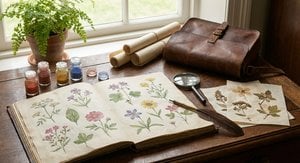
The Flourishing Canvas: A Historical Journey Through Botanical Illustration
Explore the captivating history of botanical illustration! Discover renowned artists like Robert Havell & Mary Walcott, learn about techniques, and find museum-quality art at ArtsDot.com.


