

Sir Lawrence Alma-Tadema: A Study in Victorian Aestheticism & Classical Antiquity
Indholdsfortegnelse
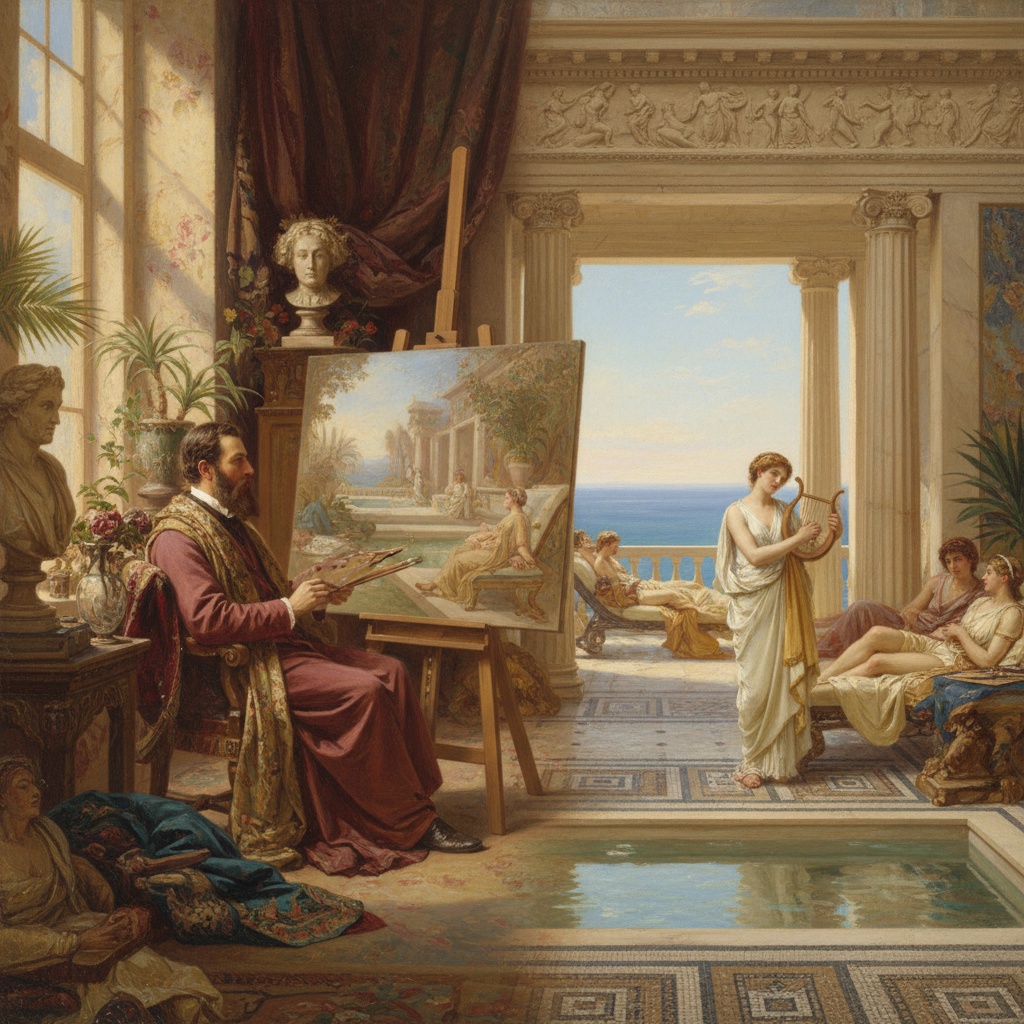
Alma-Tadema’s technique was equally meticulous. He employed a smooth, polished brushstroke, creating surfaces that shimmer with light and texture. His use of color is particularly noteworthy—a palette dominated by whites, creams, and blues evokes the Mediterranean sun and the cool marble interiors of Roman villas. He often built elaborate architectural models to ensure accurate perspective and lighting effects, further enhancing the realism of his compositions.
Depicting Daily Life in Ancient Rome: Beyond Historical Recreation
 The Flower Market
Experience the vibrant bustle of ancient Rome in Sir Lawrence Alma-Tadema's 'The Flower Market.' This 1868 oil painting captures daily life with exquisite detail at Manchester Art Gallery.
While many Victorian artists focused on grand historical narratives—battles, triumphs, and mythological scenes—Alma-Tadema chose a different path. He turned his attention to the everyday lives of ordinary Romans, depicting scenes of leisure, domesticity, and social interaction. Paintings like The Flower Market (1868) capture the bustling energy of a Roman marketplace, while Dolce far niente (1869) portrays a serene woman enjoying a moment of quiet contemplation by the sea. These weren’t scenes of heroic deeds or dramatic events; they were glimpses into the private worlds of individuals, offering a more intimate and relatable vision of antiquity.
However, it's crucial to understand that Alma-Tadema’s depictions weren’t simply objective representations of Roman life. They were infused with his own Victorian sensibilities and aesthetic preferences. His figures often possess a languid grace and elegance that reflects the refined tastes of his time. He also tended to emphasize the luxury and decadence of Roman society, creating scenes that are more akin to idealized fantasies than accurate historical reconstructions. Portrait of Aime-Jules Dalou, His Wife and Daughter (1876) exemplifies this blend of Victorian elegance and classical subject matter.
Even in works with a seemingly straightforward narrative—such as A Reading from Homer (1885)—Alma-Tadema subverts expectations. The scene doesn’t depict an actual reading, but rather a moment of quiet contemplation and social interaction. The storyteller is not actively engaged in reciting poetry; he's lost in his own thoughts, while the audience appears more interested in conversation than in listening to the epic tale.
Aestheticism and the 'Art for Art’s Sake' Philosophy in Alma-Tadema’s Work
Aestheticism (also known as the aesthetic movement) was an art movement in the late 19th century that valued the appearance of literature, music, fonts, and the arts over their functions. According to Aestheticism, art should be produced to be beauti...
Alma-Tadema’s work is inextricably linked to the Aesthetic movement, which flourished in Britain during the late 19th century. This movement championed the idea of “art for art’s sake,” rejecting the notion that art should serve a moral or didactic purpose. Instead, Aesthetes believed that beauty was its own justification—that art should be created solely for aesthetic pleasure.
Alma-Tadema embodied this philosophy in his paintings. He wasn't interested in conveying historical lessons or promoting social commentary; he simply wanted to create beautiful and evocative images. His meticulous attention to detail, his harmonious color palettes, and his elegant compositions were all designed to appeal to the senses—to provide a purely aesthetic experience for the viewer. The emphasis on sensory delight is particularly evident in paintings like Dolce far niente, where the soft light, shimmering water, and luxurious surroundings create an atmosphere of pure indulgence.
This focus on aesthetics also led Alma-Tadema to prioritize visual harmony over historical accuracy. He often sacrificed realism for the sake of beauty, creating scenes that are more concerned with form and color than with factual representation. This approach was controversial at the time, but it ultimately contributed to his enduring appeal.
The Decline and Rediscovery of a Victorian Master
Despite his immense popularity during his lifetime—he counted the Prince of Wales among his admirers—Alma-Tadema’s reputation waned in the decades following his death in 1912. His work was dismissed as overly sentimental, lacking in intellectual depth, and out of step with the modernist trends that were gaining prominence. The rise of abstract art and other avant-garde movements relegated Victorian painting to the margins of art history.
However, beginning in the 1960s, Alma-Tadema’s work began to experience a revival. Scholars and critics started to re-evaluate his paintings, recognizing their technical brilliance, historical accuracy, and unique aesthetic sensibility. The rediscovery was fueled by several factors, including a growing interest in Victorian culture and a renewed appreciation for representational art.
Furthermore, the influence of Alma-Tadema on popular culture—particularly Hollywood cinema—played a significant role in his rehabilitation. Films like Gladiator (2000) drew heavily on his paintings for inspiration, recreating scenes and costumes that were directly inspired by his work. This exposure brought Alma-Tadema’s art to a wider audience, sparking renewed interest in his life and legacy.
Alma-Tadema's Enduring Legacy & Influence on Modern Visual Culture
Today, Sir Lawrence Alma-Tadema is recognized as one of the most important Victorian painters. His work continues to captivate audiences with its beauty, detail, and evocative power. His influence can be seen in a wide range of modern visual culture—from film and television to fashion and interior design.
Alma-Tadema’s meticulous research and dedication to historical accuracy set a new standard for classical painting. His emphasis on sensory delight and aesthetic pleasure continues to inspire artists today. His paintings offer a unique glimpse into the Victorian imagination—a vision of antiquity that is both idealized and deeply personal.
At WahooArt.com, we are proud to offer high-quality reproductions of Alma-Tadema’s masterpieces, allowing you to experience the beauty and elegance of his work in your own home. Explore our collection today and discover the enduring legacy of this Victorian master.
Relaterede artikler

Sir Frederic Leighton: Aestheticism, Academic Mastery & Victorian Masculinity
Explore the life & art of Sir Frederic Leighton, a master of Victorian Aestheticism. Discover his academic training, sculptural innovations, and captivating depictions of beauty. Expert insights for collectors.


R.B.A. John William Godward: A Study in Neoclassical Sensibility & Decadence
Explore the captivating Neo-Classical world of John William Godward. Discover his exquisite paintings, artistic influences, and investment potential. Expert analysis for discerning collectors.

James Abbott McNeill Whistler: Top 25 Kunstværker – Skønhed, Harmoni & Historie | WahooArt
Oplev James Abbott McNeill Whistlers 25 mest ikoniske kunstværker. Fordyb dig i æstetismens verden, tonale malerier & harmoniske kompositioner. Find reproduktioner af højeste kvalitet og inspiration til din indretning på WahooArt.com.

Hans Makart: Opulence, Symbolism & the Viennese Aesthetic Movement
Explore the opulent world of Hans Makart, a pivotal figure in Austrian art history. Discover his influence on Klimt & the Vienna Secession, signature style, and investment potential. Expert insights for collectors.

