
- Forside

- Artikler
- Johan Hendrik Weissenbruch: Capturing Dutch Light & Atmosphere – A Master of Realism
Johan Hendrik Weissenbruch: Capturing Dutch Light & Atmosphere – A Master of Realism
Indholdsfortegnelse
Early Life & Artistic Foundations: A Family Legacy
Jan Hendrik Weissenbruch, also known as Hendrik Johannes Weissenbruch (born 19 June 1824 in The Hague – died 24 March 1903 in The Hague) was a Dutch painter of the Hague School. He is noted especially for his watercolours. == Biography == Hendrik ...
Johan Hendrik Weissenbruch, born in The Hague in 1824, wasn’t simply a painter who emerged from the Dutch landscape; he was cultivated by it – and by a family deeply entwined with artistic expression. His father, Johannes Weissenbruch, though primarily a chef and restaurateur, possessed a keen eye for beauty and nurtured a small but significant collection of Romantic School paintings. This early exposure to art wasn’t merely passive; Johannes himself painted in his leisure time, instilling in his son an appreciation for the visual world and the possibilities it held. The family’s artistic lineage extended further, with cousins also pursuing various forms of printmaking and painting, creating a supportive environment where creativity flourished. This familial encouragement proved pivotal, laying the groundwork for Weissenbruch's lifelong dedication to capturing the nuances of light and atmosphere.
The influence wasn’t limited to amateur practice. His cousin Jan (1822-1880) was already establishing himself as a painter of townscapes, offering a tangible example of artistic success. More importantly, the collection assembled by his father included works by Andreas Schelfhout and Bartholomeus van Hove – artists who would significantly shape Weissenbruch’s early development. These weren't just paintings to admire; they were lessons in technique, composition, and the very *spirit* of Dutch landscape painting.
The Hague School & The Pursuit of Naturalism
Johan Hendrik Weissenbruch lived in the XIX – XX cent., a remarkable figure of Dutch Realism. Find more works of this artist at Wikiart.org – best visual ...
Weissenbruch is inextricably linked with the Hague School, a collective of artists who revolutionized Dutch art in the 19th century. Emerging as a reaction against the idealized historical and mythological scenes favored by academic tradition, the Hague School painters turned their attention to the everyday realities of life – the polders, the dunes, the skies above their homeland. They sought not to recreate perfect forms but to faithfully represent the world *as it was*, with all its imperfections and subtle beauties. This pursuit of naturalism wasn’t simply about accurate depiction; it was a philosophical stance, an embrace of authenticity in a rapidly changing world.
However, defining “naturalism” within the Hague School is nuanced. While sharing a commitment to realism, artists like Weissenbruch moved beyond mere imitation. They weren't striving for photographic accuracy but rather sought to convey the *feeling* of a place – the dampness of the air, the shifting light, the vastness of the sky. This required a deep understanding of atmospheric perspective and a willingness to experiment with brushwork and color to evoke emotional responses in the viewer. Weissenbruch’s early training at the Hague Academy under Bartholomeus van Hove provided a solid foundation, but it was his independent study and relentless observation of nature that truly set him apart.
Mastering Light and Atmosphere: Key Characteristics of Weissenbruch’s Style
 Ships on canal
Admire Johan Hendrik Weissenbruch’s ‘Ships on Canal,’ a serene Hague School landscape painting. Experience atmospheric realism & muted tones of this 19th-century Dutch masterpiece.
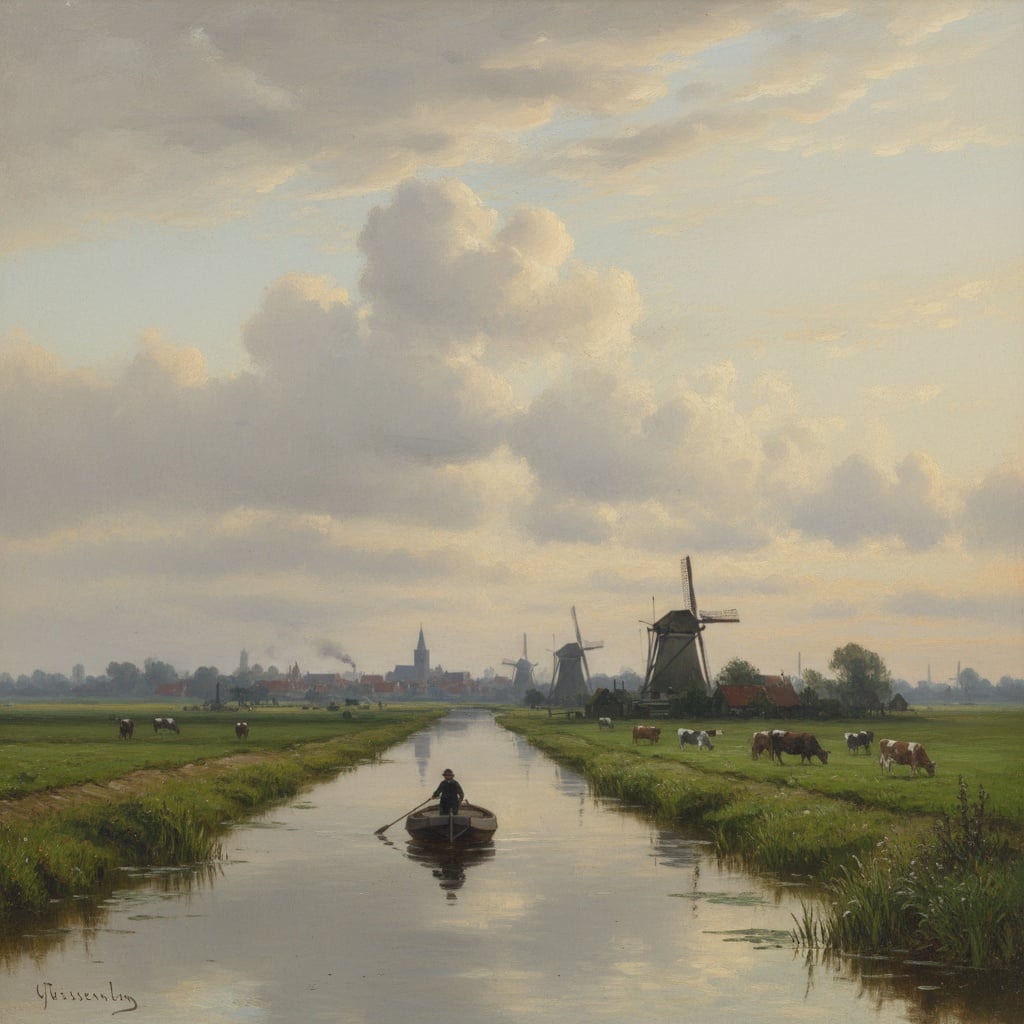
At the heart of Weissenbruch's artistry lies an unparalleled mastery of light and atmosphere. He famously described his constant “battle” to capture “nature itself on the canvas,” a testament to his unwavering dedication. This wasn’t about simply reproducing colors; it was about understanding how light interacted with different surfaces, how clouds shifted and changed, and how these elements combined to create a specific mood or feeling.
His technique is characterized by visible brushstrokes – not haphazardly applied but carefully considered marks that build up texture and depth. He favored a muted color palette, often employing subtle gradations of gray, blue, and brown to convey the atmospheric conditions he observed. This restraint wasn’t a lack of skill; it was a deliberate choice, allowing him to focus on the interplay of light and shadow. The skies in his paintings are particularly remarkable – vast, dynamic expanses filled with swirling clouds and shifting patterns of light. He stressed the importance of both these elements, stating that “The sky in a painting, that is what is most important! Sky and light are the great magicians.”
Iconic Works: Exploring 'View of Haarlem' and 'Ships on Canal'
 View of Haarlem
Experience the tranquility of rural life with Johan Hendrik Weissenbruch's 'View of Haarlem.' This serene landscape captures Dutch countryside beauty & masterful detail.
Two paintings exemplify Weissenbruch’s signature style beautifully: ‘View of Haarlem’ (1848) and ‘Ships on Canal.’ ‘View of Haarlem’ is a serene landscape that captures the tranquility of rural life. The composition is deceptively simple – a quiet countryside scene with fields, trees, and distant buildings – but it's the masterful detail and atmospheric perspective that truly captivate the viewer. The light is soft and diffused, creating a sense of peace and harmony.
‘Ships on Canal’ similarly showcases his ability to evoke atmosphere. The painting depicts a serene Hague School landscape with ships gently gliding along a canal. Muted tones dominate, reflecting the calm waters and overcast sky. The brushwork is loose and expressive, conveying the subtle movement of water and air. Both paintings demonstrate Weissenbruch's commitment to realism – not in the sense of photographic accuracy but in his ability to capture the *essence* of a place and time.
Weissenbruch’s Later Years & Enduring Influence
While Weissenbruch achieved some early recognition, his fame truly blossomed in the late 1880s. He became a respected figure within the Dutch art community, admired by his peers for his technical skill and unwavering dedication to naturalism. He joined the Société Belge des Aquarellistes in Brussels in 1866, further expanding his network and influence.
His later works are characterized by an even greater emphasis on atmospheric effects and a looser application of paint. He increasingly focused on the polder landscapes around Noorden, drawn to their remote beauty and undisturbed tranquility. Critics often point to these later paintings as representing the culmination of his artistic development. His influence extended beyond his immediate circle, inspiring generations of Dutch landscape painters with his commitment to capturing the subtle nuances of light and atmosphere.
Collecting Weissenbruch Today: A Guide for Enthusiasts
For collectors seeking a connection to the heart of Dutch Realism, Johan Hendrik Weissenbruch offers a compelling opportunity. His works are not merely decorative; they are windows into a specific time and place, imbued with a sense of peace and tranquility. Prices vary depending on size, subject matter, and condition, ranging from modest investments for smaller watercolors to significant acquisitions for larger oil paintings.
When considering a purchase, pay attention to the atmospheric quality of the painting – does it evoke a sense of depth and light? Examine the brushwork – is it loose and expressive or tight and controlled? Authenticity is crucial; consult with reputable art dealers and auction houses. ArtsDot.com offers high-quality reproductions of Weissenbruch’s iconic works, allowing enthusiasts to experience his artistry firsthand. Whether you're a seasoned collector or simply appreciate the beauty of Dutch landscape painting, Johan Hendrik Weissenbruch’s legacy continues to inspire and captivate.
Relaterede artikler

Evoking Nature's Sublime: A Comprehensive Exploration of 19th-Century Landscape Painting
Explore the captivating world of 19th-century landscape painting! Discover renowned artists like Friedrich & Monet, key movements, and find the perfect artwork to bring nature's serenity into your home. Expert insights at ArtsDot.


The Evocative Embrace of Reality: Exploring Romantic Realism in 19th-Century Painting
Explore the captivating world of Romantic Realism! Discover key artists like Courbet & Millet, masterpieces, and the social context behind this influential art movement. Expert insights for collectors at ArtsDot.

Thomas George Webster: Navigating Genre Boundaries & American Identity in 19th-Century Landscape Painting
Explore the captivating genre scenes of Thomas George Webster, a Victorian painter bridging British traditions with American themes. Discover his style, influences & legacy in 19th-century art history.

Ephemeral Visions: Exploring the History & Emotional Resonance of Watercolor Painting
Explore the captivating history of watercolor painting, from ancient techniques to modern masters like Kandinsky & Blake. Discover essential artists, collecting tips & the emotional power of this luminous medium. Expert insights for art enthusiasts.

Paul Huet: Capturing the Essence of French Romanticism Through Light and Landscape
Explore the captivating world of Paul Huet (1803-1869), a master of French Romantic landscape painting. Discover his influence on Barbizon & Impressionism, and browse high-quality reproductions at ArtsDot.

