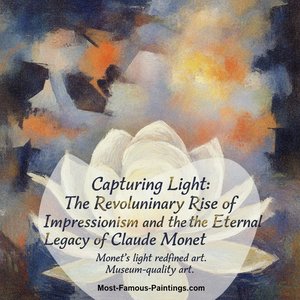
Monet's Serial Vision: How Capturing Light Changed Art Forever
Explore the revolutionary world of Claude Monet. Discover how his obsession with light, color, and serial vision transformed Impressionism forever. An expert journey through art history, from Haystacks to Water Lilies, perfect for every classic art enthusiast.
The First Impressionist Exhibition was an art exhibition held by the Société anonyme des artistes peintres, sculpteurs, graveurs, etc., a group of nineteenth-century artists who had been rejected by the official Paris Salon and pursued their own venu...
To understand the seismic shift brought about by Claude Monet, one must first envision the rigid, somber world of the nineteenth-century French Salon. For decades, the art establishment demanded meticulous detail, historical gravity, and a polished finish that left no trace of the artist's hand. It was a world of dark shadows and mythological grandeur, where success was measured by adherence to strict academic rules. Yet, amidst this era of controlled perfection, a group of rebels emerged, driven by a desire to capture something far more elusive than historical accuracy: the pulse of life itself.
This movement, which would eventually be derisibly labeled "Impressionism" by critics, sought to dismantle the constraints of the Salon system. Artists like Monet, Renoir, and Degas rejected the heavy, studio-bound traditions in favor of a more immediate, visceral connection to the world. They moved their easels outdoors, embracing the practice of plein air painting to witness nature in its most unadorned state. This was not merely a change in subject matter, but a fundamental revolution in technique. By utilizing bright colors and loose, energetic brushstrokes, these artists challenged the very definition of what a finished painting should be, laying the essential groundwork for the birth of modernism.
The Science of Sight: Monet’s Obsession with Light and Atmosphere
One of the best-known Impressionists, Monet's fascination with light and color led him to study those factors as they changed with time and weather.
Claude Monet was far more than a painter of landscapes; he was a chronicler of fleeting moments and a poet of light. His fascination lay in the way atmosphere could transform a familiar scene into something entirely new. He understood that we do not see objects in isolation, but rather through a veil of light, moisture, and shifting temperatures. This scientific curiosity led him to study how color interacts with the environment, observing how a haystack might appear golden under a midday sun, yet turn a ghostly blue in the twilight.
His approach was characterized by an intense dedication to capturing immediate perceptions. Rather than focusing on the permanent structure of a subject, Monet sought the ephemeral essence of the moment. This required a radical way of seeing—one that prioritized the sensation of light over the solidity of form. Through his eyes, the world became a dance of dappled sunlight and shimmering reflections. His work invites us to slow down and breathe deeply, encouraging a level of contemplation that transcends mere observation, allowing us to experience the world with a renewed sense of wonder and emotional depth.
The Power of the Series: Exploring Haystacks, Rouen Cathedral, and Water Lilies
The Rouen Cathedral series was painted in the 1890s by French impressionist Claude Monet. The paintings in the series each capture the façade of Rouen Cathedral at different times of the day and year and reflect changes in its appearance under differ...
Perhaps Monet’s most groundbreaking innovation was his development of "series paintings." Beginning in earnest around 1889, he moved away from the idea of a single, definitive masterpiece toward a more dynamic, temporal approach. By painting the same subject multiple times under varying conditions, he created a visual narrative of change. The Haystacks series is a profound example of this, where the stacks of harvested wheat become vessels for exploring the subtle transitions of the seasons and the passing of time.
This serial vision reached new heights with his depictions of the Rouen Cathedral. In this ambitious undertaking, Monet captured the cathedral's facade at different hours of the day, demonstrating how light can dissolve stone into something ethereal and weightless. Each canvas in the series acts as a different chapter in a larger story of light and shadow. This method of repetition and variation allowed him to explore the very limits of perception, proving that a subject is never truly static, but is constantly being redefined by the atmosphere that surrounds it.
Giverny as a Living Canvas: The Evolution of a Masterpiece
Water Lilies (French: Nymphéas [nɛ̃.fe.a]) is a series of approximately 250 oil paintings by French Impressionist Claude Monet (1840–1926). The paintings depict his flower garden at his home in Giverny, and were the main focus of his artistic product...
In his later years, Monet’s world narrowed in physical scope but expanded infinitely in artistic complexity as he retreated to his beloved home in Giverny. Here, he transformed his garden into a living, breathing laboratory of color and light. This was not merely a place of residence, of leisure, but a meticulously curated landscape designed to serve as his primary subject. The water lily pond, with its weeping willows and floating blooms, became the centerpiece of his most enduring work.
The Water Lilies series, comprising approximately 250 oil paintings, represents the pinnacle of his artistic journey. These works are immersive experiences, where the boundaries between sky, water, and flora begin to blur. Even as he faced physical challenges, such as the onset of cataracts which altered his perception of color, his commitment to capturing the essence of Giverny remained unshakable. The garden became a sanctuary of light, an intimate space where the artist could continue his lifelong dialogue with nature, creating works that feel less like paintings and more like windows into a dreamlike, aquatic paradise.
A Lasting Legacy: How Serial Vision Paved the Way for Modernism
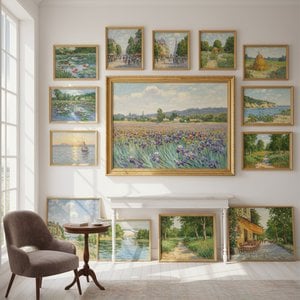
The Impressionist Rebellion: Breaking from Academic Tradition Impressionist Landscapes: 10 Masterpieces for Your Home | ArtsDot Introduction Imagine stepping into a world bathed in dappled sunlight, where colors dance and shimmer with an ethereal qu...
The legacy of Monet’s serial vision extends far beyond the borders of 19th-century France. By breaking the grip of academic realism, he opened the floodgates for generations of artists to explore abstraction, expression, and the subjective nature of reality. His ability to find profound meaning in the fleeting and the mundane redefined the purpose of art, shifting it from a tool of documentation to a medium of pure emotional and sensory exploration.
Today, we see his influence in every movement that prioritates feeling over form. The way he utilized color to evoke mood and texture to suggest movement remains a cornerstone of artistic practice. For the modern enthusiast, Monet’s work offers more than just historical interest; it provides a timeless invitation to find beauty in the ephemeral. His life's work serves as a reminder that art is not about achieving perfect accuracy, but about capturing a glimpse into the soul of the world—a legacy of light that continues to illuminate our understanding of beauty and creativity.
If you find yourself inspired by the luminous textures of Monet’s masterpieces, discover how ArtsDot.com can bring that same magic into your home. Whether you seek a high-quality handmade oil reproduction to capture the impasto depth of his brushstrokes or a modern Giclée print for a contemporary touch, our collection is curated for those who love to decorate meaningfully. Explore our world of color and mood today.
Explore the revolutionary world of Claude Monet and Impressionism. Discover how the mastery of light and color transformed art history, from plein air landscapes to the iconic Water Lilies series, and learn how to bring this timeless elegance into your home decor.
Explore the revolutionary history of Impressionism and the luminous legacy of Claude Monet. Discover how his mastery of light and color redefined modern art through an expert-led journey into the heart of 19th-century France.
Oplev de 25 mest ikoniske kunstværker på Musée d'Orsay! Fra Monet og Renoir til Van Gogh – udforsk impressionisme & post-impressionisme. Find inspiration til dit hjem med museumskvalitets reproduktioner hos ArtsDot.com.
Udforsk den vedvarende værdi af håndmalet oliekunst. Ekspertvurderinger, investeringsrådgivning og unikke kunstværker til samlere. Sikr dig et tidløst mesterværk med ArtsDot.
Oplev impressionismens magi! Dyk ned i top 10 landskabsmalerier af Monet, Renoir & Degas. Lær historierne bag disse ikoniske kunstværker og find inspiration til dit hjem hos ArtsDot.com – museumskvalitet reproduktioner online.



 First Impressionist Exhibition
 Rouen Cathedral (Monet series)
 Water Lilies (Monet series)
 Monet's Serial Vision: How Capturing Light Transformed Art History