


Billedet følger dine valg: , .
 Vis mere
Bestil din i fire enkle trin
Tag dig god tid. Du kan ændre alle svar; prisen i din indkøbskurv opdateres efter hvert valg.
1 Trin et af fire
On which medium should it be printed?
Canvas is printed with giclée inks and can be stretched or framed like a painting; paper comes flat, or framed behind glass.
2 Trin to ud af fire
Hvilken størrelse ønsker du?
Disse størrelser bevarer det originale maleris proportioner. Tegningen viser dit valg på en væg, over en to meter lang sofa.
Eller angiv dine egne mål
Vælg mellem vores forudindstillede størrelser, der matcher kunstværkets originale proportioner.

Indtast den bredde og højde, du har brug for, så det passer til din ramme eller din væg. Et print kan kun beskæres, aldrig gøres større end selve billedet, så en størrelse med et andet format vil medføre, at dele af motivet går tabt. Vi sender dig en digital mockup til godkendelse, før vi printer noget. Billedet vist på denne side viser ikke den faktiske beskæring — det er kun mockuppen, der gør.
3 Trin tre ud af fire
Hvordan skal det klargøres: rullet, udstrakt eller indrammet?
Priserne nedenfor gælder for den størrelse, du valgte i trin ét.
Vælg kanterne på det opspændte lærred
Vælg din ramme

Hvid kant Dkr1

Udvasket kant Dkr1

Fortsat motiv Dkr1

P118B Dkr10

P118H Dkr10

P118W Dkr10

P438Z Dkr10

P508JH Dkr12

P508YH Dkr12

P805H Dkr10

P805Z Dkr10

P919BZ Dkr10

P919G Dkr10

P919XJ Dkr10

P959ZH Dkr10

P968JZ Dkr12

W106C Dkr8

W218G Dkr10

W218JH Dkr8

W218Y Dkr10

W307PJ Dkr10

W316G Dkr10

W316PJ Dkr8

W316Y Dkr10

W398PJ Dkr8

W4111J Dkr10

W500HY Dkr15

W500JH Dkr15

W692G Dkr12

W849H Dkr8

W940BG Dkr15

W953PJ Dkr8

H24-GOLD Dkr30

H24-SILVER Dkr30

H36-GOLD Dkr45

H36-SILVER Dkr45
Indrammet
Profil: . Samlet størrelse med ramme: .
4 Trin fire ud af fire
Et par forskellige efterbehandlingsmuligheder
Alle er valgfrie. De svar, der allerede er valgt, koster ikke ekstra.
Verdensomspændende levering () på 2 uger i stedet for de sædvanlige 4/5 uger. (21 november)
En navneplade, ligesom på et museum?
Detaljer om indgraveret bronzeskilt
This elegant plaque features the artist's name and the title of the artwork, finely engraved for a timeless presentation.
It is made from bronze with a refined, elegant finish. The text is precisely laser-engraved for a sharp and permanent result. Measuring 9x2 cm, the plaque is compact yet easy to read. It's built to be durable and scratch-resistant, offering a professional, museum-quality look. Mounting is simple thanks to the included adhesive backing.
Detaljer om gennemsigtig akrylplade
The plaque includes essential engraved details such as the artist's name, the title of the artwork, the date it was created, the type of media used-like oil on canvas or watercolor-a brief description of the piece, and a QR code that links to the complete artwork information.
It is crafted from clear acrylic, offering a sleek, modern appearance. The text is UV-engraved in black to ensure strong visual contrast. With a size of 10x15 cm, it ensures optimal readability. It comes equipped with two metal hooks for secure wall mounting. The plaque is designed to be weather-resistant, making it suitable for various environments, and it includes interactive features that work seamlessly with smartphone scanning.
Detaljer om sort akrylplade
This elegant plaque includes engraved information such as the artist's name, the title of the artwork, the date it was created, the type of media used (like oil on canvas or watercolor), a short description of the artwork, and a QR code for quick access to more information.
The plaque itself is made from refined black acrylic with a premium finish. The text is laser-engraved in white for high contrast and readability. Its size is 10x15 cm, designed to be easy to read. It comes with two metal hooks for professional mounting. The design is sleek and fits any interior style. It is also weather-resistant and durable, with built-in digital integration for mobile compatibility.
En beskyttende lak?
Hvornår skal det leveres?
✓ Tjek og bestil
Your print, as you ordered it

Landscape
Reproduktionsmetode
Størrelse på reproduktion
-

Indramning af reproduktion
-
-
For kunstværker eller reproduktioner, der er større end 105 cm (ca. 41 tommer) på en hvilken som helst side, vil rammen blive leveret som et adskilt sæt. Denne metode sikrer sikker levering og forhindrer skader under transport.
Professionel montering er påkrævet – dette er ikke et gør-det-selv produkt.
Sættet skal samles, og lærredet skal opspændes af en erfaren professionel indrammer ved brug af trælim (ikke medfølger), en lærredsspænder og klemmer til at holde blindrammen vinkelret, mens limen tørrer. Forkert samling eller ujævn spænding af lærredet kan beskadige kunstværket permanent og er ikke dækket af vores garanti.
 For kunstværker eller reproduktioner, der er større end 105 cm (ca. 41 tommer) på en hvilken som helst side, vil rammen blive leveret som et adskilt sæt. Denne metode sikrer sikker levering og forhindrer skader under transport.
Alle massive trælister er inkluderet, præcist tilpasset i størrelsen.
Samles med de medfølgende skruer samt trælim til hjørneforbindelserne, som ikke medfølger og skal anskaffes af din indrammer.
Professionelt værktøj er påkrævet og medfølger ikke: en lærredsstrækker (spændetang) og klemmer til at holde blindrammen vinkelret, mens limen tørrer.
Vigtigt:
Hjørneforbindelserne kræver trælim, listerne skal holdes fast med skruetvinger, indtil limen er helt tør, og opspænding af lærredet på den samlede ramme kræver en lærredsspænder. Ingen af disse dele er inkluderet i sættet. Vi anbefaler, at du kontakter en erfaren professionel indrammer, før du bestiller denne størrelse.

Navneskilt
-
-

Beskyttende fernis
Blank lak (fremhæver farverne og beskytter mod lys og fugt)
-

Hurtig levering
Verdensomspændende levering () på 2 uger i stedet for de sædvanlige 4/5 uger. (21 november)
-
Ekspreslevering
Verdensomspændende levering () på 4-5 uger. (28 november).
Inkluderet
Samlet pris
Dkr 421
Glasmulighed er kun tilgængelig i størrelser under 110 cm
Inkluderet i hver ordre
- Gratis ekspresforsendelse til hele verden
- Lærred af linned i høj kvalitet
- Fuld transportforsikring
- Garanti for refusion af told og importafgifter
- Garanti for præcis farvegengivelse
- 100 dages returret ved fabrikationsfejl
- 100% fuld returret
- Mængderabat ved flere køb


Spørgsmål og svar
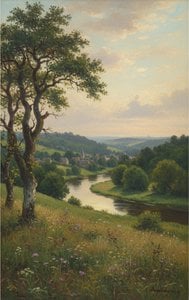
Hvilke andre navne er Eugène Cicéri kendt under?
Andre navne registreret for Eugène Cicéri, skaberen af "Landscape", inkluderer Eugenio Ciceri, E. Ciceri, Eug. Ciceri, Eug. Cicery, Cicery.
Hvad er den dominerende farve i "Landscape" af Eugène Cicéri?
Cobalt Violet (#869dc4) er den dominerende farve i "Landscape" af Eugène Cicéri.
Kan man se et diasshow af "Landscape" af Eugène Cicéri?
Se diaporamabillederne af "Landscape" på værkets side Billedserie.
Læs mere om dette maleri
 Se i rummet
 Køb håndmalet maleri
 Del som kort
 Del
Del
 Detaljer
 Guide
Guide

 Download
 Lignende værker
 Røntgenundersøgelse
 Diasshow
 Spørgsmål og svar
 Statistikker
Lignende kunstværker


Eugène Cicéri
1813 - 1890, France
Kunstnerbiografi
Eugène Cicéri: A Painter of Soul and Alpine Landscapes
Eugène Cicéri (1813 – 1890) was a French landscape painter who emerged from the Bourron-Marlotte School, a movement dedicated to capturing the essence of rural life and the sublime beauty of the French Alps. Though overshadowed by his contemporaries like Jean-François Millet and Frédéric Bazille, Cicéri’s distinctive style—characterized by meticulous realism combined with expressive tonal harmonies—earned him recognition within the Barbizon School and established him as a significant contributor to European Romanticism.- Early Life & Training: Born in Paris, Cicéri received his initial artistic training from Jean-Baptiste Camille Bouchardy, a respected teacher known for his academic approach to painting. This grounding in classical principles would profoundly influence his later work, shaping his meticulous observation of nature and his commitment to portraying it with accuracy.
- The Bourron School & Alpine Inspiration: Cicéri joined the Bourron School around 1840, immersing himself in a collective effort to depict the landscapes of Auvergne and Provence. The school’s ethos—rooted in plein air painting and an idealized vision of rural life—provided Cicéri with fertile ground for experimentation and artistic growth. However, it was his fascination with the Alpine region that truly captivated him, becoming the dominant subject of his oeuvre.
- Technique & Style: Cicéri’s technique was marked by painstaking detail and a masterful command of watercolor pigments. He employed subtle gradations of tone—a hallmark of Barbizon painting—to convey atmospheric depth and luminosity. Unlike some of his peers who favored looser brushstrokes, Cicéri meticulously rendered textures and contours, striving to capture the palpable presence of the natural world.
- Notable Works & Recognition: Cicéri’s landscapes gained considerable acclaim during his lifetime, particularly those depicting Alpine vistas bathed in golden light. Among his most celebrated paintings are “Wallachians,” a dramatic depiction of Romanian peasants amidst rugged mountains, and “Lithograph of Mosburg in Wiesbaden,” showcasing the grandeur of Wiesbaden Castle against a backdrop of snow-capped peaks. His prints were exhibited at the Salon and garnered critical praise for their artistic merit.
- Legacy & Influence: Cicéri’s work continues to resonate with viewers today, embodying the Romantic ideal of communion with nature and reflecting the profound impact of topographical illustration on 19th-century art. Although he didn't achieve the fame of some other Barbizon artists, his dedication to realism and tonal harmony cemented his place as a pivotal figure in French landscape painting—a painter who truly captured ‘the soul’ of Alpine scenery.
Connections & Collaborations
Cicéri's artistic journey intersected with the influential Isabey family, particularly Jean-Hippolyte Isabey Sr., who championed his work and encouraged him to explore lithography as a medium for disseminating landscape prints. This collaboration resulted in stunning topographical illustrations that documented Alpine expeditions and contributed significantly to the visual culture of the era. Furthermore, Cicéri’s artistic sensibilities aligned with those of Eugène Carrière and Frédéric Bazille—fellow Bourron School members—creating a vibrant intellectual and aesthetic environment conducive to artistic innovation.Relaterede artikler
Henri-Joseph Harpignies: Capturing the Poetic Essence of the French Landscape
Explore the serene landscapes of Henri-Joseph Harpignies, a master of the Barbizon School. Discover his atmospheric paintings, recurring themes & enduring legacy in 19th-century French art. Learn more at ArtsDot.

25 Masterpieces by Ernst Ludwig Kirchner: The Soul of German Expressionism
Explore 25 iconic Ernst Ludwig Kirchner masterpieces of German Expressionism. Discover the full collection online at ArtsDot.com.

Masterpieces of the Soil: The Top 25 Artworks by Jean-François Millet
Immerse yourself in the soul of French Realism with our curated guide to the top 25 Jean-François Millet artworks. Explore the profound beauty of Barbizon school masterpieces and find museum-quality art reproductions for your home. Discover all masterpieces on ArtsDot.com.