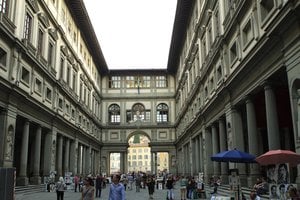
Portræt af Giuliano da Sangallo

Giuliano da Sangallos mest berømte malerier: Alle 9, rangeret

Opdateret oktober 2026 · rangeret efter vores popularitetsscore (søgninger, besøg og ordrer for hvert værk) · 10 værker af Giuliano da Sangallo i vores katalog

Kort sagt

Det mest kendte maleri af Giuliano da Sangallo er Design for the façade of San Lorenzo, Florence (1516), som du kan se på Galleria degli Uffizi i Firenze. Lige efter følger Tomb of Francesco Sassetti (detail) (1485) og Villa Medici (1480). Ud af 10 værker af Giuliano da Sangallo i vores katalog er disse 9 de mest kendte. Hvert værk er ledsaget af årstal, museum og en kort note om, hvad der gør det bemærkelsesværdigt.

1443 – 1516, Florence High renaissance Flest værker: Santa Trinità

Giuliano da Sangallos top 10: de værker alle kender

1
Design for the façade of San Lorenzo, Florence (1516) af Giuliano da Sangallo

Design for the façade of San Lorenzo, Florence

1516 · Acrylic On Canvas · Galleria degli Uffizi, Firenze

Design for the Façade of San Lorenzo, Florence Giuliano da Sangallo’s Design for the Façade of San Lorenzo stands as a testament to Renaissance architectural ambition and humanist ideals—a project born from the patronage of Lorenzo de' Medici and destined to reshape the spiritual heart of Florence. Completed in 1516, just before his untimely demise, this monumental undertaking represents more than merely a building; it embodies Sangallo’s profound understanding of…

Hand-painted oil reproduction from $175 30 × 34 cm
Bestil dette værk Mere om dette værk
2
Tomb of Francesco Sassetti (detail) (1485) af Giuliano da Sangallo

Tomb of Francesco Sassetti (detail)

1485 · Stone · Santa Trinità, Firenze

Located within the Basilica of Santa Trinita in Florence, this stone relief carving by Giuliano da Sangallo offers a tactile encounter with Renaissance funerary art. Created in 1485, the work functions as a detailed section of the larger tomb commissioned for Francesco Sassetti and his wife, Nera Corsi. The relief is characterized by a high-relief technique, where the figures emerge from the marble surface with a palpable three-dimensionality. This subtractive…

7
Ruins of the Ancient Roman Theater of Marcellus (1480) af Giuliano da Sangallo

Ruins of the Ancient Roman Theater of Marcellus

1480 · Ink On Paper · Biblioteca Apostolica Vaticana, Vatikanstaten

Ruins of the Ancient Roman Theater of Marcellus: A Testament to Time’s Passage The drawing by Giuliano da Sangallo, titled “Ruins of the Ancient Roman Theater of Marcellus,” transcends mere architectural representation; it embodies a profound meditation on history and decay. Executed in 1480s Florence during the High Renaissance, this piece stands as a cornerstone of humanist artistic thought—a deliberate effort to recapture the grandeur of antiquity while acknowledging its…

Hand-painted oil reproduction from $175 29 × 35 cm
Bestil dette værk Mere om dette værk
9
Exterior of the church af Giuliano da Sangallo

Exterior of the church

Giuliano Da Sangallo, an Italian architect and sculptor, was a prominent figure during the Renaissance period. He is best known for his work on religious buildings, including Santa Maria delle Carceri in Prato, Italy. This church is considered one of the earliest examples of Greek cross plan architecture in the Italian Renaissance. The Architecture of Santa Maria delle Carceri Designed by Giuliano da Sangallo and built between 1485 and 1490,…

Hand-painted oil reproduction from $175 28 × 36 cm
Bestil dette værk Mere om dette værk

Hvad Giuliano da Sangallo har malet mest af

De fire motiver, der optræder hyppigst i disse værker, hver med sit mest kendte eksempel.

Hvor du kan se Giuliano da Sangallo's malerier

De 5 museer, der rummer flest af malerierne på denne side.

Museum By Værker af Giuliano da Sangallo Malerier fra denne liste
Santa Trinità, FirenzeSanta Trinità Firenze 2 Tomb of Francesco Sassetti (detail), Tomb of Francesco Sassetti's Wife
Santa Maria delle Carceri, PratoSanta Maria delle Carceri Prato 2 Exterior, Exterior of the church
Galleria degli Uffizi, FirenzeGalleria degli Uffizi Firenze 1 Design for the façade of San Lorenzo, Florence
Palazzo Gondi, FlorencePalazzo Gondi Florence 1 Façade
Biblioteca Apostolica Vaticana, VatikanstatenBiblioteca Apostolica Vaticana Vatikanstaten 1 Ruins of the Ancient Roman Theater of Marcellus

Et berømt værk af Giuliano da Sangallo for hvert årti

Værker per årti

Vælg et årti for at se dets mest fremtrædende værk.

Giuliano da Sangallo malerier: det, folk gerne vil vide

Hvilket maleri er Giuliano da Sangallo bedst kendt for?Se svaret

Øverst på listen er Design for the façade of San Lorenzo, Florence (1516), Galleria degli Uffizi, Firenze. Lige efter kommer: Tomb of Francesco Sassetti (detail) (1485) og Villa Medici (1480).

Hvor gammel var Giuliano da Sangallo på tidspunktet for Design for the façade of San Lorenzo, Florence?Se svaret

73 år gammel. Giuliano da Sangallo blev født i 1443, og Design for the façade of San Lorenzo, Florence er fra 1516.

Hvor mange værker af Giuliano da Sangallo er der?Se svaret

Vi har 10 værker af Giuliano da Sangallo i vores katalog, dateret fra 1480 til 1516.

Hvilke museer har Giuliano da Sangallos mest kendte malerier?Se svaret

Du finder de fleste af dem i Santa Trinità (Firenze), Santa Maria delle Carceri (Prato) og Galleria degli Uffizi (Firenze). Listen over museer ovenfor giver en fuldstændig oversigt.

Hvornår blev Giuliano da Sangallos mest berømte værker malet?Se svaret

I 1480s, mere end på andre tidspunkter: 5 af de 9 værker på denne side stammer fra dengang, herunder Tomb of Francesco Sassetti (detail).

Hvad er de ældste og nyeste berømte malerier af Giuliano da Sangallo?Se svaret

Det tidligste værk her er Villa Medici (1480); det nyeste er Design for the façade of San Lorenzo, Florence (1516).

Hvad malede Giuliano da Sangallo mest af?Se svaret

Architecture (2) og Buildings (2) ud af i alt 9 værker på denne side.

Hvilken kunstretning er Giuliano da Sangallo knyttet til?Se svaret

High renaissance, som du kan se i værkerne på denne side.

Hvad kan du se af Giuliano da Sangallo på Santa Trinità?Se svaret

Du kan se 2 af værkerne på denne side på Santa Trinità, Firenze, herunder Tomb of Francesco Sassetti (detail) og Tomb of Francesco Sassetti's Wife.

Kan jeg bestille en Giuliano da Sangallo reproduktion til mit hjem?Se svaret

Ja. Hvert maleri på denne side er tilgængeligt som en håndmalet oliereproduktion eller som et print i den størrelse, der passer dig. Åbn blot maleriets side for at bestille.

Mød Giuliano da Sangallo

The Architect of Renaissance Florence

Giuliano da Sangallo stands as a monumental figure in the Italian Renaissance, an architect whose vision shaped the cultural landscape of Florence and beyond. More than just a builder, he was a craftsman steeped in classical ideals, mentored by luminaries like Leon Battista Alberti and Filippo Brunelleschi. His legacy resides not only in the grandeur of his structures but also in the transmission of artistic knowledge across generations, profoundly influencing masters such as Raphael and Leonardo da Vinci. Born around 1445 in Florence, Giuliano’s formative years were marked by a privileged upbringing thanks to his father, Francesco Giamberti, a skilled woodworker and architect who served under Cosimo de' Medici. This familial connection provided invaluable access to artistic patronage and fostered a lifelong partnership with Lorenzo de' Medici—a relationship that would define Sangallo’s career trajectory.

Like many aspiring artisans of the era, Giuliano began his apprenticeship as a joiner, honing foundational skills in construction and craftsmanship. Crucially, he embraced the humanist ideals championed by Alberti and Brunelleschi, immersing himself in the study of ancient texts and architectural precedents. His ascent to prominence began with Cosimo de' Medici’s commission for a fortified villa—a project that showcased his burgeoning talent for defensive architecture and solidified his reputation as a formidable engineer. This initial undertaking established a crucial bond with Lorenzo the Magnificent, who would become his most enduring patron. Recognizing Sangallo’s versatility, Lorenzo entrusted him with ambitious projects extending beyond fortifications, allowing the architect to weave classical elegance into the very fabric of Florentine urbanism.

Mastery of Form and Classical Influence

The work of Giuliano da Sangallo is characterized by a seamless blend of strength and grace, a hallmark of the High Renaissance style. His designs often sought to revive the mathematical harmony and proportion found in Roman antiquity, yet they remained deeply rooted in the local traditions of Tuscany. One of his most celebrated contributions is the Design for the façade of San Lorenzo in Florence. Commissioned by Lorenzo de' Medici, this project exemplifies the architect's ability to create spaces that are both spiritually uplifting and structurally profound. This basilica, which features the vibrant stained glass windows of Ghirlandaio, stands as a testament to Sangallo’s influence on artistic innovation and his ability to coordinate diverse artistic talents toward a singular, harmonious vision.

Beyond religious structures, Sangallo's mastery extended to the creation of villas and churches that defined the era's aesthetic. His work on Santa Maria delle Carceri remains a pinnacle of his architectural achievement, showcasing a sophisticated use of geometry and classical motifs. The architect's ability to balance the rugged requirements of military engineering with the delicate beauty of residential design allowed him to navigate the complex needs of the Medici court. His influence was not merely structural but also deeply personal; through his brother Antonio da Sangallo the elder and his sons, Antonio and Francesco, the architectural language he helped pioneer continued to evolve and dominate the European landscape for decades.

A Lasting Legacy in Stone and Spirit

The historical significance of Giuliano da Sangallo lies in his role as a bridge between the early innovations of Brunelleschi and the refined classicism of the later Renaissance. He was a pivotal figure who helped translate the intellectual theories of humanism into tangible, enduring monuments. His life's work represents a period where architecture ceased to be merely functional and became an expressive medium for political power, religious devotion, and philosophical inquiry.

To reflect on his impact, one might consider these key pillars of his career:

  • The Medici Connection: His role as the preferred architect for Lorenzo the Magnificent, which allowed him to shape the physical identity of the Medici era.
  • Architectural Synthesis: The successful integration of Alberti's theoretical classical principles with the practical engineering traditions of Florence.
  • Generational Influence: The establishment of a family dynasty of architects that carried his stylistic DNA into the 16th century.
  • Urban Transformation: His contribution to the development of both fortified defensive structures and elegant, light-filled religious and residential spaces.

Though he passed away in 1516, the stones of Florence continue to speak his name. Every time a viewer gazes upon the balanced proportions of a Renaissance facade or feels the rhythmic harmony of a classical courtyard, they are experiencing the enduring spirit of Giuliano da Sangallo.