The Quiet Brush of Suzhou
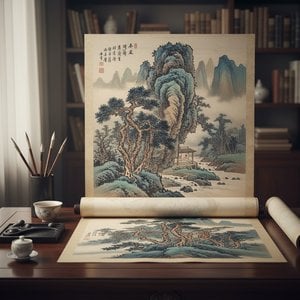
Born in Suzhou, in the Jiangsu region, Zhu Lu lived through the shifting landscape of the Ming dynasty. His life spanned the late sixteenth and early seventeenth centuries, a period when the ink on a scholar's brush carried the weight of deep personal reflection. He was a painter who found meaning in the subtle details of the natural world, focusing his attention on the delicate textures of the landscape and the quiet strength of flora.
His work often appeared on intimate objects, such as folding fans, where the art was meant to be held and appreciated closely. These pieces were not intended for grand halls but for the private moments of a viewer's life. He worked with ink and color on gold-flecked paper, a technique that allowed the light to catch the surface of his compositions, bringing a soft glow to his depictions of nature.
Nature and Inscription
Zhu Lu’s hand was most frequently seen in his depictions of bamboo, a subject that requires both precision and a sense of rhythm. His compositions often paired these botanical studies with poetry, creating a dialogue between the visual image and the written word. This integration of text and image was a hallmark of his approach, where the poem and the painting were inseparable parts of a single thought.
The technical aspects of his work reveal a careful hand:
- The use of semi-cursive script in his inscriptions.
- The application of ink and color on fan-shaped gold paper.
- The careful mounting of works as album leaves.
In one notable work, he captured the essence of "Wild Grasses," using ink to define the movement of the plants. The presence of his artist seals on these works provides a physical connection to the man himself, marking the paper with his personal identity and his presence in the moment of creation.
A Legacy in Ink
The survival of his work in collections like the Metropolitan Museum of Art and the Yale University Art Gallery ensures that his vision remains accessible. His paintings, such as those featuring bamboo, have moved from the hands of private collectors into the care of public institutions. These objects offer a glimpse into the aesthetic preferences of the Ming dynasty, showing how a painter could find depth in a single stalk of bamboo or a line of verse.
He died in 1632, leaving behind a body of work that reflects a life spent observing the subtle shifts of the natural world. His ability to capture the "jade feeling" of a new shoot or the shade of a thicket allows his quiet observations to persist long after the ink has dried.
Otázky a odpovědi
Jak se umění umělce Zhu Lu v čase vyvíjelo?
Chronologický přehled tvorby umělce Zhu Lu naleznete na jeho stránce Kronika umělce, kde jsou díla uspořádána podle jejich vzniku v jednotlivých kapitolách.
Kde mohu najít statistiky o dílech umělce Zhu Lu?
Pro umělce Zhu Lu je k dispozici stránka Statistiky, která zobrazuje statistiky o jeho dílech na tato webová stránka.
V jakém městě a z jaké země pochází Zhu Lu?
Zhu Lu se narodil(a) ve městě Suzhou v zemi People's Republic of China.
Kde mohu vidět díla umělce Zhu Lu v 3D galerii?
Možná je i virtuální prohlídka: na stránce 3D galerie umělce Zhu Lu můžete obdivovat jeho díla v trojrozměrné galerii.