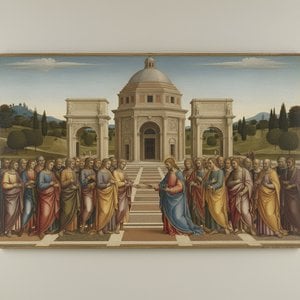
The Life and Legacy of Umberto Veruda
Born in the vibrant, multicultural atmosphere of Trieste in 1868, Umberto Veruda emerged as a painter of profound sensitivity and technical mastery. His journey from a family of modest means to the prestigious halls of European academies is a testament to a raw, burgeoning talent that could not be contained by social boundaries. The seeds of his artistic vocation were sown early through the guidance of Raffaele Astolfi, a master of the Academic style, whose influence instilled in Veruda a foundational respect for classical portraiture and precise draftsmanship. This early mentorship provided the scaffolding upon which Veruda would build a career defined by elegance and an acute observation of the human condition.
Veruda’s artistic evolution was shaped by a restless spirit and a nomadic pursuit of excellence. At only sixteen, he ventured to Munich to enroll at the Academy of Fine Arts, a pivotal moment that placed him among the leading artistic minds of his generation. Under the tutelage of Alexander von Wagner and influenced by the impressionistic nuances of Max Liebermann, Veruda began to move beyond rigid academicism toward a more nuanced rendering of light and atmosphere. His travels through Paris allowed him to absorb the delicate techniques of William Adolphe Bouguereau and Joseph Nicolas Robert-Fleury, while his time in Venice brought him into direct contact with the ghosts of greatness—the rich textures of Titian, Tintoretto, and Velázquez. This synthesis of German precision, French refinement, and Venetian color would become the hallmark of his mature style.
Mastery of Portraiture and Society Scenes
Veruda achieved his greatest renown through his ability to capture the essence of the upper-class society that populated the great capitals of Europe. He was not merely a recorder of faces, but a chronicler of status, grace, and the quiet psychological depths of his subjects. His work often oscillated between the formal dignity required for aristocratic commissions and a more intimate, soulful approach to character study. This versatility earned him significant accolades, including an art prize established by Baroness Cecilia de Rittmeyer, which facilitated his transformative years in Rome.
The breadth of his professional achievements is reflected in the prestigious institutions that recognized his talent:
- Galleria Nazionale d'Arte Moderna: The acquisition of his painting "Sii onesta" (Be Honest) marked his arrival as a significant figure in the Italian art scene.
- Blenheim Palace: His invitation to paint members of the Spencer family in London stands as a pinnacle of his international reputation, showcasing his ability to command the highest levels of European nobility.
- The Viennese Stage: His works found immense success in Vienna, where his sophisticated aesthetic resonated deeply with the cultural zeitgeist of the Austro-Hungarian Empire.
A Tragic Departure and Enduring Significance
Despite a career marked by rapid ascent and international acclaim, Veruda’s life was cut tragically short. The loss of his mother in 1904 cast a profound shadow over his final months, a period during which he sought solace in the company of intellectuals like the author Italo Svevo. His death in August 1904, at the age of only thirty-six, silenced a voice that was just beginning to bridge the gap between traditional academicism and the burgeoning modern movements of the early twentieth century.
Today, Umberto Veruda is remembered as an artist who possessed the rare ability to navigate the complexities of different national schools—German, French, Italian, and English—to create a unified, sophisticated visual language. His portraits remain enduring windows into a vanished era of elegance, capturing not just the physical likeness of his subjects, but the very spirit of a cosmopolitan Europe on the cusp of monumental change. Through his brush, the fleeting glances and dignified postures of the late nineteenth century are preserved with an eternal, luminous grace.
Otázky a odpovědi
Jak mohu sledovat tvorbu umělce Umberto Veruda chronologicky?
Prohlédněte si časovou osu děl umělce Umberto Veruda: na stránce Chronologie děl jsou díla seřazena podle data jejich vzniku.
Jaké nálady vyjadřují umělecká díla umělce Umberto Veruda?
Stránka Galerie nálad umělce Umberto Veruda nabízí prohlížení jeho děl rozřazených podle nálady.
Mohu si prohlédnout díla umělce Umberto Veruda podle uměleckých směrů?
Stránka Všechna umělecká hnutí seskupuje díla umělce Umberto Veruda podle jednotlivých uměleckých směrů.
Kde mohu vidět barevný profil děl umělce Umberto Veruda?
Použití barev v dílech umělce Umberto Veruda uvedených na tato webová stránka můžete prozkoumat na stránce Genom palety tohoto umělce.