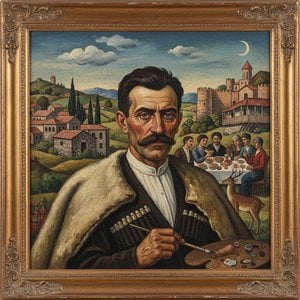
A Life Shaped by Conviction
Štefan Bednár was a man whose brush was often guided by the heavy currents of history. Born in Myjava, Slovakia, his early years were defined by a pursuit of craft that would eventually lead him far from his roots. After studying applied arts in Prague, he found himself navigating the creative energy of both the Czech capital and the streets of Paris. His life was not lived in a vacuum of aesthetics; rather, his art was deeply intertwined with the political struggles of his era. As a member of the Slovak Communist Party, he faced the harsh realities of war, including imprisonment by Nazi German authorities during the Second World War. These experiences of resistance and upheaval left an indelible mark on his perspective, turning his focus toward the social and political realities of the human condition.
His commitment to his beliefs extended beyond the canvas. During the Slovak National Uprising, he became an active participant in the resistance movement. This period of his life saw him transitioning from a painter to a voice for change, serving as an editor for the political weekly Nové slovo. He used his technical skills to serve a cause, producing graphic illustrations, leaflets, posters, and linocuts that spoke to the immediate needs of a nation in turmoil. His work was a tool for communication, a way to make the invisible struggles of his people visible through stark, purposeful imagery.
The Breadth of His Creative Output
Bednár’s artistic identity was multifaceted, blending the precision of a draftsperson with the expressive needs of a political commentator. His output was diverse, spanning several disciplines that allowed him to engage with different audiences and purposes:
- Painting, including easel works that addressed social themes.
- Graphic arts such as linocuts and posters.
- Draftsmanship and political caricature.
- Journalistic illustration and editorial work.
Even as he engaged in the urgent work of political graphic design, he continued to paint. His canvases often reflected the social themes that occupied his mind, capturing moments of human connection or the quiet weight of daily life. Whether he was working on a small linocut or a larger painting, there was a sense of purpose in his hand, a desire to document the world as he saw it, both in its political friction and its personal intimacy.
Legacy and Recognition
The historical significance of Štefan Bednár lies in how he bridged the gap between fine art and social activism. He was a participant in the 1936 Summer Olympics, contributing to the painting event, a moment that highlighted his technical standing on an international stage. His ability to move between the refined studies of applied arts and the raw, urgent demands of wartime resistance makes him a significant figure in Slovak art history. His works remain held in collections such as the Ernest Zmeták Art Gallery in Nové Zámky, preserved as records of a life lived with intense conviction. Through his paintings and his graphics, he left behind a visual history of a man who refused to remain a bystander to the events of his time.
Otázky a odpovědi
Mohu si prohlédnout díla umělce Štefan Bednár podle uměleckých směrů?
Umělecká směry, ve kterých Štefan Bednár působil/a, si můžete prohlédnout na stránce Všechna umělecká hnutí, která seskupuje díla podle jednotlivých směrů.
V jakém městě a z jaké země pochází Štefan Bednár?
Štefan Bednár se narodil(a) ve městě Myjava v zemi Slovakia.
Mohu si u Štefan Bednár prozkoumat používání barev napříč všemi jeho díly?
Použití barev v dílech umělce Štefan Bednár uvedených na tato webová stránka můžete prozkoumat na stránce Genom palety tohoto umělce.
Kde a v jakém roce se narodil/a Štefan Bednár?
Štefan Bednár se narodil(a) v roce 1909 ve městě Myjava.