The Shift from Science to Color
The path toward the canvas begins not with a brush, but with the clinical precision of biology. In Switzerland, the young Oskar Moll studies the natural world through a scientific lens, a discipline that would later inform his structural understanding of form. Yet, the impulse to observe is quickly overtaken by the impulse to create. He abandons the laboratory for the studio, teaching himself the language of paint and moving through Munich toward the intense energy of Berlin. There, he enters the orbit of Lovis Corinth, working as an assistant and absorbing the weight of German tradition before the winds of change pull him toward the heart of the avant-garde.
Paris in 1907 is a fever dream of color and radical thought. In the smoky atmosphere of Le Dôme Café, Moll moves within a circle of revolutionaries. He is no longer merely a student; he is a participant in the creation of the Académie Matisse. Alongside Margarethe Haeffner, a sculptor and painter who becomes his wife, and Hans Purrmann, he navigates a landscape where color is liberated from the duty of representation. This period marks his emergence as a Fauvist, a painter who uses the palette to express internal rhythms rather than external realities.
The Weight of Ideology
The stability of his academic career is met by the violent shifts of European politics. Moll moves from the lecture halls of the Staatliche Akademie für Kunst und Kunstgewerbe Breslau, where he serves as Director, to the Kunstakademie Düsseldorf. His tenure is cut short by the rise of a regime that views his aesthetic language as a threat. The state labels his work "degenerate," a designation that carries the weight of erasure. His exhibitions are shuttered, and his creative life is forced into a defensive posture against the machinery of propaganda.
The tension of these years is captured in the following facets of his professional life:
- The transition from biological studies to professional painting.
- His leadership at the Staatliche Akademie für Kunst und Kunstgewerbe Breslau.
- The confiscation of thirty-five works for the 1937 Degenerate Art Exhibition in Munich.
- The destruction of his Berlin studio and collection during the 1943 air raids.
By 1936, the public life of the artist has vanished. He and Margarethe retreat into a reclusive existence in Berlin. The war brings a physical destruction that mirrors the political one; an air raid in 1943 claims his home, his studio, and a collection of works by Matisse and Picasso. He survives the occupation of Berlin, returning to the city as the Red Army moves through, eventually passing away in 1947.
The Language of Form
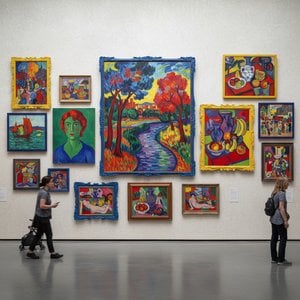
Moll’s output remains a study in the balance between the recognizable and the abstract. His landscapes, portraits, and still-lifes do not seek to mimic the world, but to distill it. He finds a particular resonance in the way light hits a subject, whether it is a figure like Brigitte in a Red Dress or the quiet geometry of a Cat with a House Plant. His work occupies a space where the subject is clear, yet the execution leans toward the distilled essence of the object. Even in his more abstract still-lifes, the structural integrity of the composition remains, a lingering echo of his early scientific training and his Fauvist training in Paris.
Otázky a odpovědi
Kolik děl umělce Oskar Moll je možné si prohlédnout?
Na stránce Všechná umělecká díla si můžete prohlédnout 17 uměleckých děl děl autora Oskar Moll.
Mohu navštívit virtuální muzeum děl umělce Oskar Moll?
3D galerie umělce Oskar Moll je stránka, která v rámci virtuální trojrozměrné galerie prezentuje umělecká díla tohoto tvůrce.
Mohu si u Oskar Moll prozkoumat používání barev napříč všemi jeho díly?
Použití barev v dílech umělce Oskar Moll uvedených na tato webová stránka můžete prozkoumat na stránce Genom palety tohoto umělce.
Existuje přehled všech témat, která Oskar Moll maloval/a?
Stránka Atlas témat mapuje díla umělce Oskar Moll podle tématu.