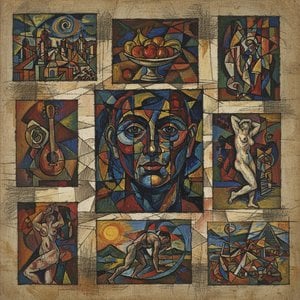
The Search for Harmony
Olev Subbi’s life was marked by a profound tension between the harsh realities of history and a persistent, internal drive toward order. Born in Tartu, his early aspirations were interrupted by the sudden, violent disruptions of the mid-twentieth century. In 1949, he was deported to Siberia, spending eight years in the Krasnoyarsk Krai. This period of forced hiatus did not extinguish his creative impulse; instead, it seemed to deepen the necessity of his later pursuit of beauty. Upon returning and resuming his studies at the State Art Institute in Tallinn, he began a career that would span half a century, characterized by a search for a parallel world where color and form could exist in a state of grace.
His approach to the canvas was labor-intensive and deliberate. He utilized a multilayered manner of painting, applying dense brushstrokes that overlapped and intertwined to create subtle, shifting surfaces. This technique allowed him to explore the independence of color, moving from the depiction of tangible objects to a more profound investigation of light and space. His work often functioned as a way to reconcile memory with the present, using the visual language of the past to construct an ideal landscape.
A Diverse Visual Language
The evolution of his style saw him move through various genres, each serving as a different lens through which to view his pursuit of perfection. His imagery often drew from the aesthetics of fin-de-siecle French Impressionism and the traditions of pre-war Estonian painting, blending these influences with the specific lessons of the Pallas Art School. His subject matter included:
- Landscapes and memory landscapes that referenced his childhood in the 1930s.
- Nudes that sought to create an idealized, harmonious world rather than mere eroticism.
- Portraits and group portraits that explored human presence within a composed space.
- (Semi-)abstract works that emerged in his later years as he focused on the autonomy of color.
By the 1980s, his interest in the limits of representation led him toward abstraction. In these works, color was no longer a tool for describing the world but became the subject itself. This progression reflected a lifelong attempt to find a sense of permanence and stability through the medium of paint.
Recognition and Legacy
Subbi’s influence was felt deeply within the Estonian art community and beyond. He was a member of the Estonian Artist’s Association and worked as a freelance artist from 1967 until his death in 2013. His ability to command the attention of exhibition halls was matched by the respect of his peers, earning him several high honors, including the Kristjan Raud Art Award and the Konrad Mägi Award for painting. He was also recognized as a Meritorious Artist and a People’s Artist of the Estonian SSR, and he received the Order of the White Star and the Order of the Tallinn Coat of Arms.
His paintings are held in significant collections, including the Art Museum of Estonia and the Tartu Art Museum, as well as various private collections across Europe and Russia. Through his meticulous application of pigment and his dedication to the search for an ideal, harmonious reality, he remains a central figure in the history of Estonian painting.
Otázky a odpovědi
Kolik děl umělce Olev Subbi je možné si prohlédnout?
Na stránce Všechná umělecká díla si můžete prohlédnout 18 uměleckých děl děl autora Olev Subbi.
Kde mohu vidět barevný profil děl umělce Olev Subbi?
Barevný profil děl umělce Olev Subbi naleznete na jeho stránce Genom palety.
Existuje přehled všech témat, která Olev Subbi maloval/a?
Stránka Atlas témat mapuje díla umělce Olev Subbi podle tématu.
Kde si mohu prohlédnout díla umělce Olev Subbi uspořádaná podle atmosféry?
Stránka Galerie nálad umělce Olev Subbi nabízí prohlížení jeho děl rozřazených podle nálady.