Early Life, Family and Training
Nils Gude enters the world on 4 April 1859 in Düsseldorf, Kingdom of Prussia. He is born into a lineage of significant artistic and social standing. His father, the prominent painter Hans Gude, is teaching at the Düsseldorf school of painting at the time. Nils grows up alongside his brother, the diplomat Ove Gude. The environment is one of disciplined instruction and established tradition.
The apprenticeship begins at home. Nils Gude studies under his father, absorbing the technical foundations of the craft within the family circle. This early instruction provides the groundwork for a career as a Norwegian portrait painter. The focus remains on the mechanics of the medium and the precision required by his lineage.
In 1877, the training moves beyond the domestic sphere. Nils enters the Academy of Fine Arts, Karlsruhe. Here, the instruction shifts to the hands of Eduard Hildebrandt and Karl Gussow. This period marks a transition from familial guidance to formal academic rigor, shaping the technical capabilities he will carry into his later professional life.
Studies in Berlin and Norway
The academic path moves from the structured environment of Karlsruhe toward the urban intensity of Berlin. Between 1881 and 1882, Gude continues his formal training in the German capital. This period marks a transition, a brief, focused chapter of study before the pull of his homeland becomes the primary driver of his life.
The shift toward Norway follows. He relocates to Christiania, the city known today as Oslo. This move anchors his career in Norwegian soil, a setting that defines his professional identity as a portrait painter. He remains active in this landscape until his death in Christiania on 24 December 1908.
Notable Portraits and Key Works
Gude finds his most significant subjects in the faces of the era's influential figures. He turns his brush toward the prominent men of his day, capturing the likenesses of those shaping Norwegian society. Among these notable subjects is Henrik Ibsen, whose presence in Gude's oeuvre marks a connection to the cultural weight of the period. The artist does not merely observe; he documents the likeness of the era's leadership through these focused studies.
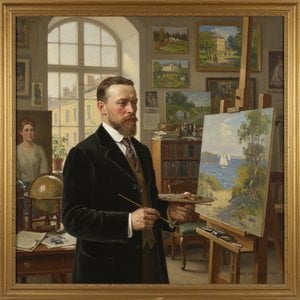
The lineage of the artist informs much of his subject matter. He returns his gaze to his own family, producing portraits of his father, Hans Gude. One specific work, Maleren professor Hans Gude, dates from about 1889. This portrait functions as a visual record of the man who was both his progenitor and his first teacher. Through these works, the distinction between the student and the master blurs into a shared visual history.
Otázky a odpovědi
Jak se umění umělce Nils Gude v čase vyvíjelo?
Chronologický přehled tvorby umělce Nils Gude naleznete na jeho stránce Kronika umělce, kde jsou díla uspořádána podle jejich vzniku v jednotlivých kapitolách.
V jakém historickém období působil/a Nils Gude?
Nils Gude působil v období 19th Century. Toto období historicky vymezuje uměleckou činnost tohoto autora.
Kolik děl umělce Nils Gude je možné si prohlédnout?
Na stránce Všechná umělecká díla si můžete prohlédnout 3 uměleckých děl děl autora Nils Gude.
Kde a v jakém roce se narodil/a Nils Gude?
Nils Gude se narodil(a) v roce 1859 ve městě Düsseldorf.