The Life and Origins of Maxime Noiré
Maxime Noiré was born in Moselle, France, on November 9, 1861. He did not follow the formal paths of academic training, developing his skills as a self-taught artist. His early years were shaped by a need to find a different environment, leading him to leave France for Algeria around 1882. He made this move primarily for health reasons, seeking a climate that would suit his physical well-being.
His life became deeply rooted in the North African landscape. After settling in Algiers, he spent much of his time observing the light and the terrain of the region. He eventually moved toward the southern reaches of the country, finding a place among the oases and the mountains. He remained in this part of the world for the rest of his life, working and living in the heat of the Algerian sun until his death in Algiers on July 4, 1927.
Artistic Activity in Algeria
After arriving in Algeria for health reasons, he settled in Algiers. His presence in the city was marked by several workshops, including one at Frais-Vallon, another in the Jardin d’Essai, and a third near Bab El-Oued. It was here that he began to build a reputation as an Orientalist painter, observing the local light and the daily life of the city.
His focus eventually moved toward the south. He traveled through the Algerian desert, seeking out the oases and the Aurès mountains. These excursions led him to settle in Bou-Saâda, a place that gained significant recognition through his work and that of Étienne Dinet. His time in the south allowed him to study the specific textures of the landscape and the way light hits the desert terrain.
He was deeply involved in the local art community, helping to establish the Société des artistes algériens et orientalistes. His work from this period includes:
Official Commissions and Professional Roles
His standing within the artistic community grew through formal recognition and institutional involvement. In 1905, he received the title of official painter of the Navy and the Colonies. This role placed his work within the official visual record of the era. He also took part in the establishment and the promotion of the Prix Abd-el-Tif and the Villa Abd-el-Tif, helping to shape the support systems for artists working in the region.
His presence was felt in the organized circles of his adopted home. He was a founding member of the Société des artistes algériens et orientalistes. This involvement helped structure the professional life of painters in Algeria. He also took his canvases to the Salon des artistes français to show his work to a wider audience.
Technique and Artistic Style
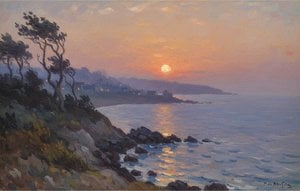
Maxime Noiré’s approach to the Algerian landscape was rooted in the direct observation of light and the desert. He moved away from the crowded, figure-heavy scenes common in his time, choosing instead to focus on the physical elements of the terrain. His brushwork often creates a blurring effect, a choice that emphasizes the atmosphere and the way light settles over the land. This technique allows the colors to appear slightly distorted, capturing a sense of luminosity that feels more like a memory than a literal transcription. He often worked in panoramic formats, a choice that suits the wide, open stretches of the desert and the way the horizon meets the sky.
The compositions frequently lean into dreamlike settings, where the focus remains on the natural world. He spent much of his time studying the specific textures of oases, mountains, wadis, and palm groves. Instead of meticulous detail, he sought to capture the way a landscape feels under a heavy sun. His work often highlights the interplay between the mineral surfaces of the mountains and the soft, shifting light of the desert. This focus on the environment itself helped establish him as a pioneer in how the Algerian landscape was represented on canvas.
Notable Works and Collections
The traces of his brushwork remain in several public institutions across France and Algeria. In Algiers, the Musée national des beaux-arts d'Alger holds Young oriental girl on a terrace in Algiers. This work, dating from about 1889, captures a quiet moment of stillness. Another piece, L'Oued de Bou-Saâda, from about 1897, is part of the public collections and reflects his time spent in the southern landscapes.
His presence is felt in various museums that preserve the visual history of the era. The Musée Bonnat-Helleu in Bayonne contains his paintings, alongside works held at the Palais de la Porte Dorée in Paris. In Narbonne, the Musée d’art et d’histoire also keeps his pieces within its walls. These collections preserve the way he observed the light and the specific textures of the terrain.
Personal Connections and Legacy
Maxime Noiré’s presence in the Algerian art scene was deeply felt through the institutions he helped build. He was a founding member of the Société des artistes algériens et orientalistes, a group that helped shape the local creative landscape. His influence extended into the formal structures of art through his involvement in the creation and promotion of the Prix Abd-el-Tif and the Villa Abd-el-Tif. These efforts helped establish a lasting framework for artists working in the region.
His personal life was tied to the artistic community through family and the respect of his peers. He was the father-in-law of the painter Paul Jouve. His ability to capture the specific light of the landscape earned him a place in the writings of others; Isabelle Eberhardt dedicated her work, Les Pleurs d’amandiers, to him. He remained a central figure in the artistic life of Algeria throughout his years there, moving from the workshops of Algiers to the quiet surroundings of Bou-Saâda.
Otázky a odpovědi
Jak najdu díla umělce Maxime Noiré v určité barevné paletě?
Stránka Podle palet seskupuje díla umělce Maxime Noiré podle jejich barevných palet.
V jakém městě a z jaké země pochází Maxime Noiré?
Maxime Noiré se narodil(a) ve městě Moselle v zemi France.
Jaké barvy používal/a Maxime Noiré nejčastěji?
Barevný profil děl umělce Maxime Noiré naleznete na jeho stránce Genom palety.
Kolik děl umělce Maxime Noiré je možné si prohlédnout?
Na stránce Všechná umělecká díla si můžete prohlédnout 2 uměleckých děl děl autora Maxime Noiré.