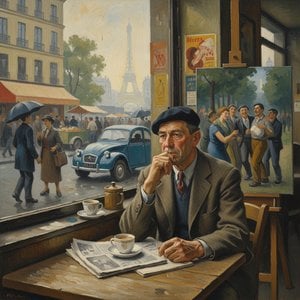
The Quiet Observer of History
Maurice Orange was born in Granville, a place shaped by the salt air and the lingering shadows of the Franco-Prussian War. This early exposure to the aftermath of conflict seemed to settle deep within his way of seeing. He possessed a natural hand for drawing, a talent that eventually led him away from the coast of Normandy toward the classrooms of the École des Beaux-Arts. There, he sat under the guidance of Jean-Léon Gérôme and François Flameng, learning to translate the weight of history onto a flat surface. His work often looked backward, finding its pulse in the Napoleonic era, though his eyes were just as frequently turned toward the quietude of landscapes and the specific lines of a townscape.
His hands were never limited to a single medium. He moved between the heavy application of oils and the delicate, fleeting touch of watercolour. He worked with gouache, pastel, and charcoal, choosing the tool that best suited the mood of the moment. Whether he was sketching a scene for a personal letter or preparing a formal piece for the Salon des Artistes Français, there was a sense of a man recording what he saw, rather than performing for an audience.
A Life of Movement and Light
The years between 1887 and 1914 were marked by a steady presence at the Salon des Artistes Français. He earned medals and travel bursaries that allowed him to step beyond the familiar borders of France. He traveled through Spain, Greece, Italy, and Portugal, and his gaze extended further to Africa and Egypt. These journeys brought new light and different textures into his repertoire. His studio moved from the streets of Granville, specifically Rue Georges-Clemenceau and later Rue Saint-Jean, to the larger stage of Paris.
His interests were varied, reflecting a man who found meaning in both the grand and the small:
- Military scenes and historical subjects
- Portraits of individuals
- Landscapes and townscapes
- Sketches and personal drawings
The Final Chapter
The end came unexpectedly in Paris, when typhoid fever took him at the age of 48. He died in February 1916, leaving behind a body of work that captured the tension between the historical past and the changing world of his own time. He was laid to rest in the Cimetière Notre-Dame in Granville, returning to the soil of his birth. His legacy remains in the collections of the Musée d'Art et d'Histoire de Granville, where his vision of the world stays preserved in paint and ink.
Otázky a odpovědi
Jak je kariéra umělce Maurice Orange rozdělena do období?
Chronologický přehled tvorby umělce Maurice Orange naleznete na jeho stránce Kronika umělce, kde jsou díla uspořádána podle jejich vzniku v jednotlivých kapitolách.
V jakých uměleckých směrech působil/a Maurice Orange?
Umělecká směry, ve kterých Maurice Orange působil/a, si můžete prohlédnout na stránce Všechna umělecká hnutí, která seskupuje díla podle jednotlivých směrů.
Kde mohu vidět díla umělce Maurice Orange v 3D galerii?
3D galerie umělce Maurice Orange je stránka, která v rámci virtuální trojrozměrné galerie prezentuje umělecká díla tohoto tvůrce.
Kde mohu najít statistiky o dílech umělce Maurice Orange?
Pro umělce Maurice Orange je k dispozici stránka Statistiky, která zobrazuje statistiky o jeho dílech na tato webová stránka.