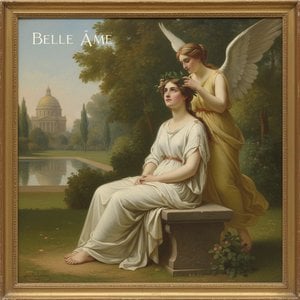
A Life Shaped by the Forge and the Front
Born in Anzin, France, on April 8, 1880, Lucien Hector Jonas entered a world of industry and heavy labor. The son of industrialists who managed a large distillery, his early years were marked by a dual education in both the arts and the family business. He studied music theory and violin at the Conservatoire de Valenciennes for seven years before turning his focus toward the canvas. After receiving his bachelor of letters in 1898, he moved to Paris to enter the École des Beaux-Arts. There, under the guidance of masters like Albert Maignan, Léon Bonnat, and Henri Harpignies, he began to refine a style that would eventually bridge the gap between academic precision and the raw reality of contemporary life.
The trajectory of his career was interrupted by personal responsibility. Following the death of his father in 1902, Jonas returned to Anzin to assist with the family distillery alongside his mother. This period of domestic duty provided him with a unique perspective on the working classes of northern France. He found inspiration in the vast warehouses and the rhythmic toil of the mines, themes that would later define much of his early work. Even while managing industrial affairs, his talent remained undeniable; he secured a silver medal at the Salon of 1905 and won the second Grand Prix de Rome that same year.
The Witness to War
The outbreak of the First World War transformed Jonas from a painter of genre scenes into a chronicler of conflict. Mobilized in 1914, he was eventually approved as a military painter attached to the Army Museum. He traveled through the front lines, from Belgium to the Vosges, capturing the grit and the gravity of the era. His sketches and oil paintings provided a window into the lives of soldiers and the landscapes scarred by combat. This period saw him producing hundreds of drawings that were widely reproduced in publications such as L'Illustration and various Allied newspapers.
His wartime output was not limited to the trenches. He was frequently commissioned to paint portraits of significant military leaders, including General Pershing, Marshal Foch, and General Kœnig. These works possessed a certain patriotic weight, often presenting an idealized view of duty and honor. His ability to capture the human element within the machinery of war earned him high honors, including being named a Knight of the Legion of Honor in 1929 and later becoming the official painter of the French Navy in 1931.
Artistry Beyond the Battlefield
As the decades progressed, Jonas’s interests expanded into the decorative and the commercial. He found success with large-scale murals in the Art Deco style, decorating public buildings such as the Valenciennes Town Hall and the Maison des Centraux in Paris. His versatility also extended to the design of currency; starting in 1933, he collaborated with the Banque de France to create banknotes. These designs, including the 10-franc Mineur and the 20-franc Pêcheur, utilized his skill for realistic depiction to celebrate French trades and historical figures like Descartes and Sully.
In his later years, Jonas continued to produce a diverse body of work that ranged from intimate landscapes to religious triptychs. He remained active in the art community, serving on juries for both painting and engraving by 1945. His life concluded in Paris on September 20, 1947. He left behind a significant archive consisting of several hundred oil panels and nearly four thousand drawings, a record of a man who saw the world through the lens of both the industrial north and the shifting borders of a changing Europe.
Otázky a odpovědi
Existuje časová osa děl umělce Lucien Jonas?
Díla umělce Lucien Jonas můžete prohlédnout v chronologickém pořadí na stránce Chronologie děl.
Jaké nálady vyjadřují umělecká díla umělce Lucien Jonas?
Stránka umělce Galerie nálad nabízí díla Lucien Jonas uspořádaná podle jejich atmosféry.
V jakém historickém období působil/a Lucien Jonas?
Lucien Jonas působil v období Modern. Toto období historicky vymezuje uměleckou činnost tohoto autora.
Existuje chronologický přehled tvorby umělce Lucien Jonas?
Kariéra umělce Lucien Jonas se na stránce Kronika umělce odvíjí období po období v podobě horizontální časové osy děl uspořádaných do kapitol podle tvůrčích etap.