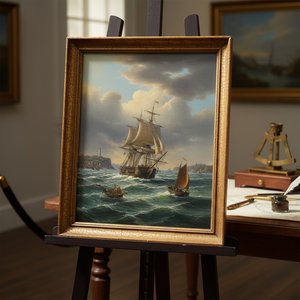
A Life Between Canvas and Timber
Julius Prömmel lived a life defined by the sea, though he approached it from two very different angles. Born in Wandsbek, Germany, in 1812, his hands were as comfortable with a paintbrush as they were with the heavy tools of a shipbuilder. This dual nature shaped a career that was never confined to a single studio. He was a man of the coast, moving between the bustling ports of Northern Europe and the warmer waters of the Mediterranean, always tethered to the vessels that defined his era.
His formal training began in Copenhagen, where he spent over a decade studying the art of painting. Between 1833 and 1844, he worked under the guidance of Christoffer Wilhelm Eckersberg, a period that deeply influenced his understanding of light and form. Yet, even as he mastered the delicate application of gouache and watercolor, he was also learning the practical, rugged mechanics of shipbuilding. He did not merely want to capture the likeness of a ship; he understood how its masts were stepped and how its rigging functioned.
The Precision of the Marine Painter
Prömmel’s work is characterized by a technical accuracy that stems from his professional knowledge. He did not rely on imagination alone to depict a vessel; he relied on the structural reality of the wood and iron he knew so well. His paintings often focused on the specific details of sailing ships, capturing them in moments of stillness or movement. This precision made his art useful as well as visual, as he possessed a deep understanding of the anatomy of a ship.
His technical expertise extended beyond the canvas and into the written word. Throughout his life, he contributed to the maritime world through several specific avenues:
- The creation of detailed paintings of sailing vessels, often commissioned by the very builders who constructed them.
- The authorship of technical manuals regarding the design and construction of both wooden and iron ships.
- The production of instructional works for the imperial navy, detailing the various parts of a ship, including its spars, sails, and standing and running rigging.
Final Years in Trieste
As his life progressed, Prömmel moved toward Trieste, a significant port in the service of the Austrian Empire. It was here that his identity as a shipbuilder and a marine painter fully merged. He worked as a shipbuilder under the Austrian administration, applying his engineering knowledge to the practical needs of the era. His presence in Trieste allowed him to witness the transition of maritime technology, a change reflected in his interest in both sail and steam.
He remained active in his dual pursuits until his death in 1870. His legacy is found in the quiet, accurate depictions of ships like the schooner Apenrader Paket, which remains a notable example of his ability to marry the artist's eye with the builder's hand. He left behind a body of work that serves as a record of the ships and the craftsmanship of the nineteenth century.
Otázky a odpovědi
Která umělecká díla umělce Julius Prömmel mají nejvyšší počet zhlédnutí?
Pro umělce Julius Prömmel je k dispozici stránka Statistiky, která zobrazuje statistiky o jeho dílech na tato webová stránka.
Kde mohu vidět díla umělce Julius Prömmel v chronologickém pořadí?
Díla umělce Julius Prömmel můžete prohlédnout v chronologickém pořadí na stránce Chronologie děl.
V jakých uměleckých směrech působil/a Julius Prömmel?
Stránka Všechna umělecká hnutí seskupuje díla umělce Julius Prömmel podle jednotlivých uměleckých směrů.
Jak najdu díla umělce Julius Prömmel v určité barevné paletě?
Chcete-li najít díla umělce Julius Prömmel v určité barevné paletě, navštivte jeho stránku Podle palet.