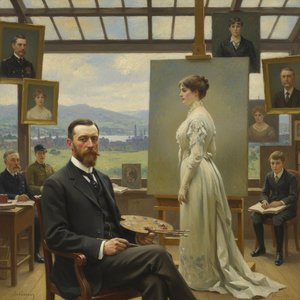
The Wandering Brush: The Life and Legacy of John Mulvany
To trace the life of John Mulvany is to follow a path of profound movement, much like the sweeping landscapes and tumultuous battlefields he so masterfully captured on canvas. Born in the rugged landscape of Moynalty, Meath, Ireland, around 1844, Mulvany’s early years were shadowed by the harrowing realities of the Great Famine. This formative experience of hardship and displacement likely instilled in him a deep empathy for the human condition and a keen eye for the dramatic shifts of history. Arriving in New York City as a young stowaway, he transitioned from the struggles of an immigrant child to the disciplined halls of the National Academy of Design, where his innate talent began to flourish under the guidance of established masters.
Mulvany’s artistic journey was never stationary; he was a nomad of the nineteenth century, drifting through the burgeoning urban centers of America and the prestigious art capitals of Europe. His career was punctuated by significant historical milestones, as he moved from the bustling streets of New York to the photographic studios of Chicago, and eventually to the grand academies of Munich and Paris. This cosmopolitan education allowed him to absorb the rigorous techniques of the Royal Academy of Fine Arts in Munich and the delicate realism of Jean-Léon Gérôme. By studying the works of Rembrandt in Antwerp, Mulvany refined a style that could balance the grand scale of historical epic with the intimate, psychological depth required for portraiture.
Capturing the American Epic
While his training was European, his soul was deeply entwined with the unfolding drama of the American West and the scars of the Civil War. Mulvany possessed a rare ability to act as a visual chronicler of the era's most defining moments. He did not merely paint scenes; he reconstructed them with a visceral realism that transported viewers directly into the fray. His work during the American Civil War, such as Sheridan’s Ride at Winchester and Battle of Shiloh, earned him acclaim for its unflinching accuracy and emotional resonance. He captured the smoke, the chaos, and the heavy atmosphere of conflict, making the distant struggles of the battlefield feel immediate and hauntingly present.
However, it was his monumental achievement, Custer’s Last Rally, that would secure his place in the annals of American art history. This massive canvas, measuring an astounding eleven by twenty feet, depicted the tragic defeat of General Custer at the Little Bighorn in 1876. The painting was more than a historical record; it was a cultural phenomenon. When it was exhibited, even the legendary poet Walt Whitman found himself transfixed, noting that the work provided a deliberate artistic expression for the American people. Through this gargantuan work, Mulvany achieved a sense of scale that matched the magnitude of the event itself, blending the grit of frontier warfare with the grandeur of classical history painting.
A Legacy of Color and Conflict
Beyond the grand battle scenes, Mulvany’s repertoire was diverse, encompassing delicate portraiture and significant nods to his Irish heritage. His connection to Ireland remained a vital thread in his creative tapestry, evidenced by works like The Battle of Aughrim, which brought a sense of historical continuity to his American audience. Whether he was painting the stoic face of Sitting Bull or documenting the reconstruction of a nation, his brushwork remained characterized by a certain cinematic vitality—a quality born from his time working as a photography colorist and his exposure to the emerging medium of photography.
Though his life ended in New York in 1906, leaving behind a legacy of movement and memory, the impact of John Mulvany remains. He stands as a bridge between the Old World traditions of European academic training and the raw, burgeoning identity of the American frontier. His ability to synthesize these two worlds allowed him to create art that was both technically sophisticated and profoundly visceral, ensuring that the fleeting moments of nineteenth-century history were frozen in time for generations to witness.
Otázky a odpovědi
Kolik děl umělce John Mulvany je možné si prohlédnout?
Na stránce Všechná umělecká díla si můžete prohlédnout 1 uměleckých děl děl autora John Mulvany.
Existuje kompletní seznam děl umělce John Mulvany?
Veškerá díla umělce John Mulvany na tato webová stránka si můžete prohlédnout na jeho stránce Všechná umělecká díla.
Existuje chronologický přehled tvorby umělce John Mulvany?
Chronologický přehled tvorby umělce John Mulvany naleznete na jeho stránce Kronika umělce, kde jsou díla uspořádána podle jejich vzniku v jednotlivých kapitolách.
Mohu si prohlédnout díla umělce John Mulvany podle použité techniky?
Díla umělce John Mulvany si můžete prohlédnout podle použité techniky na jeho stránce Podle techniky.