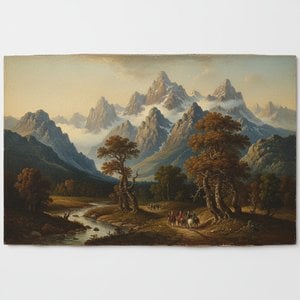
The Precision of the Alpine View
Hubert Haider did not rely on abstraction or grand gestures to define his place in German landscape painting. Instead, he focused on a meticulous, almost clinical accuracy that captured the specific topography of the Upper Bavarian Alpine foothills. His work avoids the romanticized fuzziness often found in mountain scenes, opting instead for a style described as having a very exactness. This approach allowed him to document the rugged textures of the mountains with a clarity that feels direct and unpretentious. He was not interested in the sublime as a vague concept, but in the landscape as a tangible, physical reality.
His connection to the land was deeply rooted in his lineage and his geography. Born in Munich, Germany, Haider was part of a family of creators, being the son of the Munich painter Karl Haider and the grandson of the forester draughtsman Max Haider. This heritage likely contributed to his ability to render natural details with such precision. His life was spent moving through the very landscapes he painted, living in Eicherloh, Altötting, and Schliersee, ensuring his depictions were grounded in firsthand observation rather than mere imagination.
Technical Focus and Subject Matter
Haider’s output was defined by a consistent dedication to the mountainous regions of Bavaria. He focused his attention on specific landmarks and seasonal shifts, using oil on canvas, linen, or cardboard to achieve varying levels of detail. His technical approach was characterized by a certain structural honesty, often described as having an almost naïve conception of the image, which suggests a preference for directness over complex artifice.
- The Wendelstein
- Der Wilde Kaiser bei Kufstein
- Salzach Valley
- Jägerkamp near Schliersee
- Peissenberg
Artistic Associations and Legacy
His professional life was integrated into the established structures of the Munich art scene. He was a member of the Munich Artists' Cooperative and the Reichsverband bildender Künstler Deutschlands. Through his relationship with the landscape painter Edmund Steppes, he became connected to a wider circle of regional artists. Between 1925 and 1939, he was a regular presence in the Munich annual exhibitions, establishing a consistent professional footprint during a transformative era in German art history.
Today, his works reside in significant collections, including the Bavarian State Painting Collections and the Lenbachhaus. These placements confirm his status as a significant chronicler of the Bavarian landscape. He died in 1971 in Altötting, leaving behind a body of work that remains a factual, detailed record of the Alpine terrain he spent his life observing.
Otázky a odpovědi
Kde a v jakém roce se narodil/a Hubert Haider?
Hubert Haider se narodil(a) v roce 1879 ve městě Munich.
Jak najdu díla umělce Hubert Haider v určité barevné paletě?
Díla umělce Hubert Haider si můžete prohlédnout podle barevné palety na jeho stránce Podle palet.
Je k dispozici 3D virtuální prohlídka děl umělce Hubert Haider?
Díla umělce Hubert Haider si můžete prohlédnout v 3D galerii na jeho stránce 3D galerie.
Mohu si prohlédnout díla umělce Hubert Haider podle tématu?
Stránka Atlas témat mapuje díla umělce Hubert Haider podle tématu.