Early Life, Family and Training
Harold Workman was born in Oldham, Manchester, into a household where color and surface were part of daily life. As the son of a decorator, he grew up surrounded by the practical application of pigments and the textures of interior finishes. This early exposure to the physical properties of paint likely shaped his later preoccupation with how light interacts with different surfaces.
His formal education began in his hometown at the Oldham School of Art. Seeking to refine his technical abilities, he moved on to study at the Manchester School of Art. These formative years of study provided the foundation for a career spent observing the world with a disciplined eye. He developed a way of seeing that favored the quiet details of a scene over grand, sweeping gestures.
Professional Career and Exhibitions
Workman’s professional life was marked by steady recognition within the British art establishment. He became a member of the Royal Society of British Artists in 1937, a milestone that reflected his growing presence in the art world. By 1948, he had also gained membership in the Royal Institute of Oil Painters. His leadership qualities were recognized by his peers when he was elected President of the United Society of Artists, a role that placed him at the center of many artistic circles.
His work found its way into many significant galleries and exhibition spaces across the country. He was a regular presence at the Royal Academy and the New English Art Club, showing his paintings alongside many of his contemporaries. His reach extended beyond London, with exhibitions held at the Walker Art Gallery in Liverpool and the Glasgow Institute of the Fine Arts. He also presented his work at the Manchester Academy of Fine Arts and the Royal Cambrian Academy.
His reputation was built through these consistent appearances in major venues. He was not a man of sudden, fleeting fame, but rather one of steady, professional engagement with the institutions of his time. His paintings were held in several provincial collections, including those in Oldham, Salford, and Manchester, ensuring his vision reached a wide variety of viewers throughout his career.
Teaching and Artistic Contributions
Workman’s influence extended well beyond the canvas and into the classrooms where the next generation of artists found their footing. He shared his technical knowledge through various teaching roles, including time spent at the AA, Hammersmith School of Art, and St. Martin's School of Art. His expertise was particularly sought after in the study of color; he served as a visiting lecturer on colour and pigments at both Sir John Cass College and the Hammersmith School of Arts and Crafts. This deep understanding of the physical properties of paint was a cornerstone of his professional life.
In his later years, his focus shifted toward the evolving science of art materials. He became deeply interested in polymer painting, a medium that offered artists a different kind of flexibility and brilliance compared to traditional oils. He spent much of his time writing about these new acrylic pigments, seeking to explain their unique qualities to others. This dedication to the technical evolution of his craft culminated in 1967, when he published a book on the subject of polymer painting.
Key Works and Subject Matter
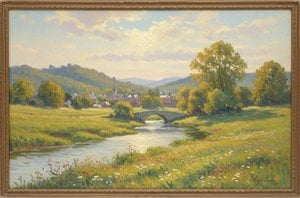
Workman’s brush moved between the quietude of the English countryside and the steady pulse of urban life. He was a painter of landscapes, townscapes, interiors, and marine subjects, working primarily in oils and watercolours. His eyes were often drawn to the way light settled on a specific street or the texture of a rural scene. In his depictions of London, he found a particular kind of stillness. About 1935, he captured the atmosphere of Upper Cheyne Row in Chelsea, and his interest in the city extended to the streets of Soho, as seen in Manette Street, which he painted about 1935. He also turned his attention to the hills of Hampstead, producing Heath Street about 1935.
The artist had a way of finding beauty in the ordinary rhythms of daily existence. His works often featured people engaged in the simple tasks of life, such as in his painting Market Carts from about 1940. He was equally comfortable in the more open, pastoral settings of the south, painting scenes like Bridge Street, Christchurch, in Hampshire. His compositions often focused on the intersection of architecture and nature, whether it was the quietude of Barge Corner or the structured lines of a townscape. Even during the tensions of the mid-1940s, his subject matter remained grounded in the tangible world, as seen in his 1945 work, Printing Camouflage Cloth.
Otázky a odpovědi
Mohu si prohlédnout díla umělce Harold Workman podle klíčových slov?
Stránka Podle klíčových slov umělce Harold Workman seskupuje jeho díla podle klíčových slov.
Mohu navštívit virtuální muzeum děl umělce Harold Workman?
Možná je i virtuální prohlídka: na stránce 3D galerie umělce Harold Workman můžete obdivovat jeho díla v trojrozměrné galerii.
Kde mohu najít statistiky o dílech umělce Harold Workman?
Statistiky o dílech umělce Harold Workman naleznete na jeho profilové stránce Statistiky.
Kde najdu díla umělce Harold Workman seskupená podle barevné palety?
Chcete-li najít díla umělce Harold Workman v určité barevné paletě, navštivte jeho stránku Podle palet.