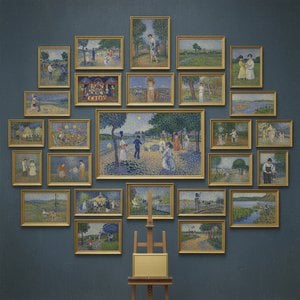
The Formative Years in Prussia and Karlsruhe
The story begins in Königsberg, Prussia, where Georg Tyrahn enters the world in 1860. His early training takes root in his birthplace, but the trajectory of his brushwork shifts when he moves toward the Grand Ducal School of Fine Arts in Karlsruhe. Here, he enters the studio of Ferdinand Keller. The influence of Keller settles into Tyrahn’s technique, shaping how he perceives light and the human form. He does not remain confined to the German academies; the pull of Paris draws him to the Académie Julian, a period of intense study that refines his approach to composition and subject matter.
By 1896, Tyrahn has established himself in Karlsruhe, a city that becomes the anchor for his professional life. He moves through the landscape of German art as a painter of portraits and genre scenes, capturing the quietude of daily life and the specific character of his sitters. His work finds its way into the pages of the Gartenlaube, reaching a wider public through the printed word.
Technical Focus and Subject Matter
Tyrahn’s output reflects a dedication to the nuances of genre painting and the delicate interplay of nature and human presence. His hands often worked with oil on cardboard, a choice that lends a specific texture to his depictions of light and shadow. His repertoire includes:
- Landscape studies of the Reichenau Island and its monastery.
- Portraits that define the social and personal essence of his subjects.
- Genre scenes, such as a young woman picking water lilies.
- Allegorical works exploring seasonal themes.
In 1904, his work Bathing Girl, Picking Water Lilies finds its place in the Staatliche Kunsthalle Karlsruhe. The painting captures a fleeting moment of grace, a hallmark of his genre work. He navigates the tension between the natural world and the human figure, often placing his subjects within lush, detailed environments.
The Final Chapter in Karlsruhe
The later years of Tyrahn's life remain tied to the artistic circles of Karlsruhe. He continues to paint, maintaining his presence in the German art scene until his death in 1917. His legacy is preserved in museum collections and through the auction of his works, which continue to surface in European galleries. He leaves behind a body of work that captures the specific atmosphere of the turn of the century, from the quietude of a monastery landscape to the intimate details of a summer afternoon.
Otázky a odpovědi
Jak je kariéra umělce Georg Tyrahn rozdělena do období?
Chronologický přehled tvorby umělce Georg Tyrahn naleznete na jeho stránce Kronika umělce, kde jsou díla uspořádána podle jejich vzniku v jednotlivých kapitolách.
Kde najdu díla umělce Georg Tyrahn seskupená podle barevné palety?
Stránka Podle palet seskupuje díla umělce Georg Tyrahn podle jejich barevných palet.
Mohu si prohlédnout díla umělce Georg Tyrahn podle uměleckých směrů?
Stránka Všechna umělecká hnutí seskupuje díla umělce Georg Tyrahn podle jednotlivých uměleckých směrů.
Mohu si prohlédnout díla umělce Georg Tyrahn podle použité techniky?
Chcete-li najít všechna díla umělce Georg Tyrahn v určité technice, navštivte jeho stránku Podle techniky.