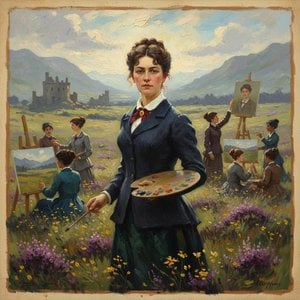
The Quiet Observer of Irish Life
Francis Sylvester Walker lived a life shaped by the light and textures of Ireland. Born in 1848, he spent his years observing the subtle shifts in the landscape and the quiet movements of people. His training took place within the walls of the Royal Dublin Society and the Royal Hibernian Academy, where he learned to translate the physical world onto canvas and plate. He was a man of many tools, working as a painter, an illustrator, and an etcher. His hands were as comfortable with the broad strokes of a landscape as they were with the fine, precise lines of an etching needle.
His work often focused on the specificities of place. He did not merely paint scenery; he captured the character of the land and the people who inhabited it. From the quietude of a convent garden to the sweeping views of Killiney Bay looking towards Bray, his eyes were always searching for the particular. He sought to document the essence of Irish life through genre scenes and portraits, often providing the visual language for books that sought to describe the country's character and history.
A Record of Place and Page
Walker’s output was diverse, moving between the large scale of exhibition paintings and the intimate scale of book illustrations. His ability to adapt his technique allowed him to move through different circles of the art world, from the galleries of Dublin to the exhibition halls of London, Birmingham, Liverpool, and Glasgow. His technical skill was recognized by his membership in the Royal Society of Painter-Etchers and Engravers.
His contributions to literature helped shape how many saw the Irish landscape during his lifetime. Some of his notable engagements included:
- Illustrating the works of William Senior, specifically The Thames: from Oxford to the Tower.
- Providing imagery for the writings of Sir Walter Besant.
- Contributing seventy-nine colour illustrations to the book Ireland, published in 1912.
- Illustrating various volumes of Ireland: its scenery, character and history.
The Legacy of the Etcher and Painter
By the time of his death in 1916, Walker had left behind a body of work that remains held in significant collections. His paintings and etchings are found in the National Gallery of Ireland in Dublin, the British Museum, and the Victoria and Albert Museum in London. These works act as a visual record of a specific era, capturing the light of the Irish coast and the quiet details of social life. His presence in the Royal Hibernian Academy and his exhibitions at Burlington House ensure that his hand remains part of the historical conversation regarding Irish art and illustration.
Otázky a odpovědi
Existuje přehled všech témat, která Francis S. Walker maloval/a?
Díla umělce Francis S. Walker si můžete prohlédnout podle tématu na stránce Atlas témat.
Jak najdu díla umělce Francis S. Walker na konkrétní téma?
Stránka Podle klíčových slov umělce Francis S. Walker seskupuje jeho díla podle klíčových slov.
Odkud pochází Francis S. Walker?
Francis S. Walker se narodil(a) v Ireland.
Kolik děl umělce Francis S. Walker je možné si prohlédnout?
Na stránce Všechná umělecká díla si můžete prohlédnout 3 uměleckých děl děl autora Francis S. Walker.