Early Life, Family and Training
Eugen Taube enters the historical record on June 4, 1869, in Saint Petersburg, Russia. He is born into the Baltic nobility, a social stratum defined by its distinct lineage and service. His father, Julius Ferdinand Taube, holds the rank of baron and works as an engineer. This background places the young Taube within a specific, disciplined social framework from birth.
The trajectory of his life follows two distinct paths: the military and the canvas. Taube serves as a military officer within the Russian troops stationed in Viipuri. This professional life as a soldier exists alongside his developing identity as a painter. While his official duties involve the rigors of military service, his creative inclinations lead him toward the study of art. He likely undergoes his formal artistic training in Saint Petersburg, absorbing the technical foundations of the medium in the imperial capital.
Artistic Activity and Travels
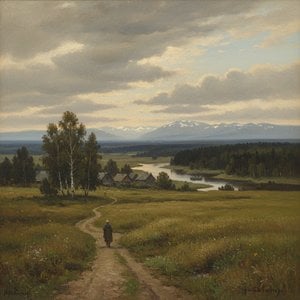
Taube’s professional presence in the Finnish art scene emerges through his participation in the Finnish Artists' Exhibition in 1892 and again in 1893. During this period, his creative focus narrows toward a singular obsession: the landscape. He moves away from the broader possibilities of portraiture or genre scenes to concentrate almost exclusively on the natural world, capturing the specificities of terrain and light.
The pursuit of these subjects leads him into the field. He undertakes painting trips alongside the artist Hjalmar Munsterhjelmin, seeking out the specific qualities of the Nordic environment. These excursions are not mere excursions but essential components of his practice, allowing him to translate the physical reality of the outdoors onto canvas. His work from this era reflects a commitment to the topographical and atmospheric details of the landscapes he encounters.
- VIEW FROM THE SHORE (1895)
- At sea
- Lake landscape
Key Works and Artistic Output
Taube’s focus remains fixed on the landscape, often capturing the shifting light of the northern terrain. In 1892, he produced Talviaurinko, a work that captures a specific solar quality. By 1895, his brush moved to the coast in VIEW FROM THE SHORE. His output frequently returns to the water and the shoreline, seen in the oil painting Rantamaisema and the composition At sea. These works often utilize oil on canvas to define the boundaries between land and water.
The artist’s palette shifts according to the atmosphere he encounters. He explores the quietude of the natural world through pieces like Lake landscape and the nocturnal mood of Kuutamo. Even the weather becomes a subject, as seen in Sade tulossa. Later in his career, his focus turned toward specific locations, such as the 1907 work Koli.
- Talviaurinko (1892)
- VIEW FROM THE SHORE (1895)
- Koli (1907)
Death and Where to See the Works
The artist's life comes to an end in Espoo. He dies on March 12, 1913. His presence in the Finnish landscape remains through the physical remnants of his oil paintings.
One specific work, Rantamaisema, remains part of the Finnish National Gallery Collection at the Ateneum Art Museum. This piece, measuring 31,5 × 46,5 cm, is held by the Finnish state. It exists as a permanent part of the national collection, preserved within the museum's holdings.
Otázky a odpovědi
V jakém historickém období působil/a Eugen Taube?
Eugen Taube působil v období 19th Century. Toto období historicky vymezuje uměleckou činnost tohoto autora.
Existuje chronologický přehled tvorby umělce Eugen Taube?
Kariéra umělce Eugen Taube se na stránce Kronika umělce odvíjí období po období v podobě horizontální časové osy děl uspořádaných do kapitol podle tvůrčích etap.
Kde najdu díla umělce Eugen Taube seskupená podle klíčových slov?
Díla umělce Eugen Taube můžete prozkoumat podle klíčových slov na jeho stránce Podle klíčových slov. Každé klíčové slovo seskupuje související umělecká díla.
Kolik děl umělce Eugen Taube je možné si prohlédnout?
Na stránce Všechná umělecká díla si můžete prohlédnout 1 uměleckých děl děl autora Eugen Taube.