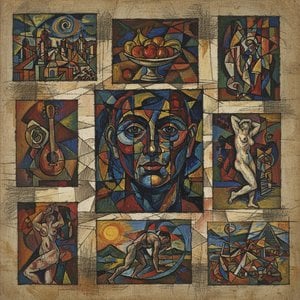
The Quiet Observer of Estonian Life
In the quiet corners of the Estonian landscape, the hand of Elfrina Bergström sought to capture the essence of the everyday. Born in 1887, she moved through a changing era, leaving behind a collection of works that speak to the intimate details of existence. Her vision was not one of grand spectacles, but rather a focused gaze upon the subjects that populate the domestic and natural spheres. Through her eyes, the mundane was granted a sense of permanence, preserved in the delicate layers of watercolor and the steady strokes of paint.
Her presence in the Estonian art scene is felt through the works held in the most respected institutions, such as the Tartu Art Museum and the Art Museum of Estonia. These pieces, spanning from 1910 to 1950, offer a window into a life spent observing the world with a keen and steady eye. She did not seek to overwhelm the viewer, but to invite them into a shared moment of stillness.
A Study of Form and Subject
The breadth of her output reveals a fascination with the character of her subjects, whether they were human or animal. She possessed a particular talent for capturing the weight of a presence, whether it was the soft texture of a bird's feathers or the subtle lines of a human face. Her technical approach varied, allowing her to choose the medium that best suited the spirit of her subject.
The following subjects define much of her recorded output:
- Watercolors of avian life, such as her 1910 work Viis kana
- Portraits of women, capturing the quiet dignity of the female form
- Studies of men, including her Habemiku portree
- Sketches and drawings that explore the simplicity of the human head
The Legacy of the Estonian Hand
As the decades passed, Bergström’s work remained a part of the cultural fabric of her homeland. Her ability to translate the world onto paper and canvas allowed her to participate in the visual history of Estonia during a transformative period. The works she left behind are not merely objects, but records of a specific way of seeing. Even in her simplest sketches, there is a sense of purpose that remains clear to those who study her technique. She remains a significant figure for those interested in the development of Estonian art and the intimate portrayal of life in the early twentieth century.
Otázky a odpovědi
V jakých uměleckých směrech působil/a Elfrina Bergström?
Díla umělce Elfrina Bergström si můžete prohlédnout rozdělená podle uměleckých směrů na jeho stránce Všechna umělecká hnutí.
Existuje přehled všech témat, která Elfrina Bergström maloval/a?
Díla umělce Elfrina Bergström si můžete prohlédnout podle tématu na stránce Atlas témat.
Kde mohu najít statistiky o dílech umělce Elfrina Bergström?
Statistiky o dílech umělce Elfrina Bergström naleznete na jeho profilové stránce Statistiky.
Jak se umění umělce Elfrina Bergström v čase vyvíjelo?
Kariéra umělce Elfrina Bergström se na stránce Kronika umělce odvíjí období po období v podobě horizontální časové osy děl uspořádaných do kapitol podle tvůrčích etap.