Early Life and Artistic Training
Born in New York City in 1909, Dora Kaminsky showed an early inclination toward the arts. At the age of eleven, she entered the Educational Alliance Art School for gifted children. This early immersion in a creative environment provided a foundation for her developing skills. During her youth, she also attended The Educational Alliance and later moved on to study at the Art Students League of New York.
To support her ambitions and sustain herself while pursuing her craft, she worked as an artist's model. This period of her life allowed her to observe the human form closely, a practical experience that often informs a painter's eye. Her dedication to her training eventually took her across the Atlantic. In the 1930s, she traveled to Europe to further her studies, spending time in several cities including Vienna, Paris, Stuttgart, and Munich. These years abroad helped shape the technical breadth she would carry into her later life and work.
Life and Work in Taos and Abroad
In 1944, Kaminsky first visited Taos, New Mexico. That initial summer proved productive, as she produced over 70 watercolor paintings and drawings during her stay. She returned to the high desert every other summer for a decade before finally deciding to move to Taos permanently in 1954. Her life in the Southwest was deeply connected to the local art community, and in 1958, she married the fellow Taos artist Leon Gaspard.
Her curiosity often pulled her away from the desert toward other corners of the globe. In the summer of 1955, she traveled to Greece, where she maintained a studio in Delphi. She also spent a brief period working in Hawaii, focusing her attention on the life found beneath the ocean waves. These travels informed the breadth of her experiences as an artist.
Later in life, her wanderings took her to even more distant landscapes. During 1972 and 1973, she traveled through Ethiopia, India, and Ceylon. These trips allowed her to witness diverse cultures firsthand, adding new layers to her perspective as she continued to work and travel.
Technique and Artistic Style
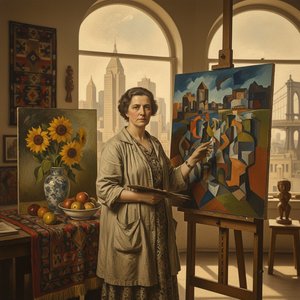
Dora Kaminsky’s creative output was defined by a restless curiosity that refused to settle on a single way of seeing. Her work moved fluidly between the clear lines of realism and the more fragmented language of abstraction. This flexibility allowed her to capture the essence of her surroundings, whether she was documenting the landscapes of New Mexico or the more structured forms of her subjects. She did not feel bound to one method, often shifting her approach to suit the specific mood of her environment.
Her choice of materials was as varied as the places she lived. She worked with oil and watercolor, using ink and pastel to explore different textures and depths. During her time in Hawaii, she turned her attention to the ocean, producing many pastel drawings of marine life. This period showed her ability to translate the movement and life of the sea onto paper. She also experimented with collage and was a dedicated practitioner of serigraph printing, a skill that allowed her to explore the nuances of printmaking alongside her traditional painting and drawing.
The physical nature of her work often reflected her travels. From the light-filled studios of Greece to the desert light of Taos, her hand moved between the delicate touch of a watercolorist and the bold application of oil. This technical range ensured that her body of work remained constantly evolving, never repeating the same visual solution twice.
Awards, Exhibitions and Legacy
Kaminsky’s skill was recognized early in her career through several significant honors. In 1940, she received the National Treasury Competition Purchase Award, followed by the Metropolitan Museum Purchase Prize in 1941. Her mastery of printmaking also earned her the top purchase award in serigraph from the Santa Fe Art Museum. During the mid-1950s, her work was supported by the Wurlitzer Foundation, which awarded her grants for the years 1956 and 1957.
Her prints and paintings found homes in many important institutions. Her serigraphs, in particular, have been included in the collections of the Metropolitan Museum. These works traveled far beyond her immediate surroundings, reaching various galleries and museums as her reputation grew through her diverse output in ink, pastel, and oil.
After the death of her husband, Leon Gaspard, in 1964, Kaminsky took on the responsibility of preserving his artistic presence. She served as a curator for retrospective exhibitions of his work, which were held at the West Texas Museum in Lubbock and the New Mexico Museum of Art in Santa Fe. Through these efforts, she helped ensure his creative history remained accessible to the public.
Otázky a odpovědi
Jak najdu díla umělce Dora Kaminsky v určité barevné paletě?
Stránka Podle palet seskupuje díla umělce Dora Kaminsky podle jejich barevných palet.
Kolik děl umělce Dora Kaminsky je možné si prohlédnout?
Na stránce Všechná umělecká díla si můžete prohlédnout 1 uměleckých děl děl autora Dora Kaminsky.
V jakém městě a z jaké země pochází Dora Kaminsky?
Dora Kaminsky se narodil(a) ve městě New York City v zemi United States.
Existuje časová osa děl umělce Dora Kaminsky?
Prohlédněte si časovou osu děl umělce Dora Kaminsky: na stránce Chronologie děl jsou díla seřazena podle data jejich vzniku.