The Painter of Gaspésie
Quebec City, 1927. A child begins to paint. By fourteen, the prizes from the Exposition Provinciale de Québec are already arriving. Claude Picher does not remain within the confines of traditional instruction; he finds the methods at the École des beaux-arts de Québec too conventional. He moves toward New York, studying at the New School of Social Research, before a French Government grant pulls him toward Paris. In the halls of the École du Louvre and the École nationale supérieure des beaux-arts, his vision expands through the study of European museums.
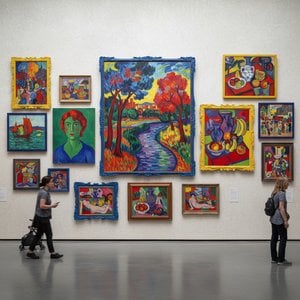
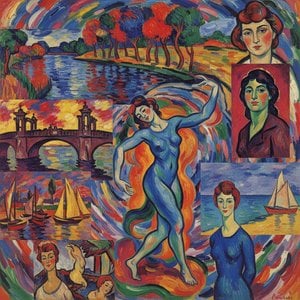
The brushwork shifts. The style settles into Fauvism and a lyrical, gestural abstraction. He captures the rugged topography and the seasonal cadences of the Gaspé Peninsula. His subjects are specific: snowscapes, village scenes, and the marine atmosphere of the coasts. There is a certain folk art quality to his landscapes, a stylized approach to the terrain that makes the landscape recognizable.
A Life Between Administration and Canvas
The career of Picher is split between the gallery and the studio. He occupies significant administrative roles, serving as the Exhibition Director at the Musée du Québec from 1950 to 1958 and later as its Deputy Director. He represents the National Gallery of Canada for the Eastern Region between 1958 and 1962. These are years of institutional weight, yet his personal connection to the land remains the true anchor.
In 1971, a move to Matane changes the trajectory. He teaches at CEGEP but eventually retires to focus entirely on the canvas. Settling on a farm in Saint-Léandre, he turns his attention to the Gaspésie region. This is the era of "The Color of Gaspésie." He does not merely paint the land; he commits it to history through massive donations.
- Donated 100 paintings to the City of Matane, forming a permanent collection.
- Elected a member of the Royal Canadian Academy of Arts in 1960.
- Received the Gaspésie Cultural Merit Prize in 1992.
The Legacy of the End of the Land
The name Gaspésie derives from the Micmac term Gespeg, meaning "end of the land." Picher lives at this edge. His work documents the seasonal shifts of the peninsula, from the frozen stillness of Couchant sur les glaces to the light in Soleil sur l'automne. He views his collection as a legacy to the territory that provided his inspiration.
His death in Matane in 1998 ends a period of intense production, but the works remain in major institutions like the National Gallery of Canada and the Ottawa Art Gallery. The paintings exist as a record of a specific geography—the coasts, the winter sports, and the rural scenes of a region he believed required its own artistic voice.
Otázky a odpovědi
V jakém historickém období působil/a Claude Picher?
Claude Picher působil v období Modern. Toto období historicky vymezuje uměleckou činnost tohoto autora.
Odkud pochází Claude Picher?
Claude Picher se narodil(a) v Canada.
Jak najdu díla umělce Claude Picher na konkrétní téma?
Díla umělce Claude Picher můžete prozkoumat podle klíčových slov na jeho stránce Podle klíčových slov. Každé klíčové slovo seskupuje související umělecká díla.
Kde a v jakém roce se narodil/a Claude Picher?
Claude Picher se narodil(a) v roce 1927 ve městě Quebec City.