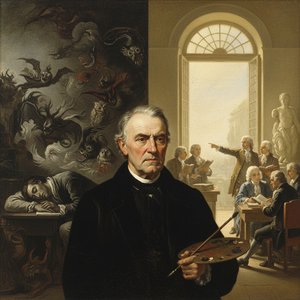
The Artistic Journey of Carlos P. Ripamonte
Born in Buenos Aires, Carlos Pablo Ripamonte began his artistic formation under the portraitist Juan Bautista Curet Cenet and later studied in the studio of Miguel Carmine. His talent led him to the Society for the Stimulus of Fine Arts, where he studied under Reynaldo Giudici, Ángel Della Valle, and Ernesto de la Cárcova. After teaching drawing at the society, he traveled to Italy on a government grant. In Rome, he opened a studio and studied under Giulio Aristide Sartorio, whom he described as his true maestro. His international recognition grew when he was awarded a medal at the 1904 St. Louis World's Fair for a submitted painting.
National Themes and Artistic Legacy
Upon returning to Argentina in 1905, Ripamonte became a central figure in the local art scene, serving as Secretary of the Society for the Stimulus of Fine Arts. He was a founding member of the Nexus Group, a collective of artists dedicated to developing Argentine national themes through a post-Impressionist idiom. His work Canciones del Pago earned him first prize in the Costumbrismo category at the 1910 International Centennial Exposition. Beyond the canvas, Ripamonte was a prolific author and educator, holding various official positions including director of the Ernesto de La Cárcova Higher School of Fine Arts. His works are held in notable collections, including the National Museum of Fine Arts in Buenos Aires.
Otázky a odpovědi
V jakých uměleckých směrech působil/a Carlos P. Ripamonte?
Stránka Všechna umělecká hnutí seskupuje díla umělce Carlos P. Ripamonte podle jednotlivých uměleckých směrů.
Existuje časová osa děl umělce Carlos P. Ripamonte?
Stránka Chronologie děl představuje díla umělce Carlos P. Ripamonte seřazená chronologicky, rok po roce.
Kolik děl umělce Carlos P. Ripamonte je možné si prohlédnout?
Na stránce Všechná umělecká díla si můžete prohlédnout 1 uměleckých děl děl autora Carlos P. Ripamonte.
Existuje chronologický přehled tvorby umělce Carlos P. Ripamonte?
Kariéra umělce Carlos P. Ripamonte se na stránce Kronika umělce odvíjí období po období v podobě horizontální časové osy děl uspořádaných do kapitol podle tvůrčích etap.