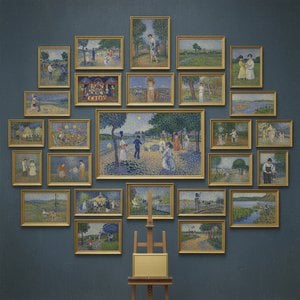
The Provençal Painter of Monteux
In the quiet landscapes of Provence, a talent began to take shape within the walls of the Séminaire de Sainte-Garde in Saint-didier, Vaucluse. It was here, under the watchful eye of Pierre Laplanche, that the young artist first learned the discipline of drawing. This early training provided the foundation for a life spent translating the essence of his surroundings onto canvas. His path led him from the local classrooms of the École des Beaux-Arts d'Avignon, where he studied under Pierre Grivolas, toward the grander stages of the French capital.
His ambition eventually brought him to the prestigious Beaux-Arts de Paris. Around 1881, with the guidance of Jules Laurens, he entered the atelier of Alexandre Cabanel. This period of intense study refined his ability to capture the human form and the subtle nuances of light. By 1888, his technical skill had reached a level where he joined the atelier of Jean-Baptiste Lavastre, contributing to the monumental task of creating murals for the central dome of the Exposition Universelle in 1889.
A Life of Portraiture and Devotion
The work of Benoni-Auran was deeply rooted in the people and the faith of his region. While he possessed the technical rigor required for large-scale commissions, his heart often resided in the intimate study of the individual. He became a master of portraiture, capturing the likenesses of families who sought to preserve their heritage through his brush. These portraits often found their way into private collections, becoming family treasures passed down through generations.
Beyond the studio, his art touched the spiritual life of the community. He was known for his ability to handle religious imagery on a monumental scale, creating works that commanded attention in sacred spaces. His output included several specific types of works:
- Portraiture of local families and individuals.
- Large-scale religious imagery.
- Ex-voto paintings created for pilgrimages.
- Murals for public exhibitions and domes.
The Legacy of a Regional Master
The legacy of Benoni-Auran is tied closely to the identity of Monteux. His presence in the art of the Vaucluse region was marked by a versatility that allowed him to move between the academic precision of the Paris ateliers and the more spontaneous, regional character of his ex-voto paintings. These later works, often less formal than his academic training, revealed a sensitivity to the specific customs and spiritual needs of his home province.
Today, his presence is still felt in the public spaces of his birthplace, with some of his works held in the Town Hall of Monteux. He remains a figure of significance for those studying the intersection of academic tradition and regional expression in late nineteenth-century French art.
Otázky a odpovědi
Mohu navštívit virtuální muzeum děl umělce Benoit Benoni-Auran?
3D galerie umělce Benoit Benoni-Auran je stránka, která v rámci virtuální trojrozměrné galerie prezentuje umělecká díla tohoto tvůrce.
Existuje kompletní seznam děl umělce Benoit Benoni-Auran?
Veškerá díla umělce Benoit Benoni-Auran na tato webová stránka si můžete prohlédnout na jeho stránce Všechná umělecká díla.
Existuje chronologický přehled tvorby umělce Benoit Benoni-Auran?
Kronika umělce umělce Benoit Benoni-Auran je interaktivní časová osa ovládaná skrolováním, která představuje díla umělce v chronologickém pořadí, rozdělená do kapitol podle jednotlivých období jeho kariéry.
Kde najdu díla umělce Benoit Benoni-Auran seskupená podle uměleckých směrů?
Díla umělce Benoit Benoni-Auran si můžete prohlédnout rozdělená podle uměleckých směrů na jeho stránce Všechna umělecká hnutí.