Early Life, Family and Artistic Training
Augusto Mussini was born in Reggio Emilia on January 9, 1870. He grew up in a household shaped by the quiet rhythms of local life; his father, Angelo, worked as a cook in the bishop's house, while his mother, Beatrice Cobianchi, raised him with a deep, steady faith. His path toward art began with a brief period in a seminary in 1881, though his interests soon shifted toward the secular world. By 1885, he left the public gymnasium to pursue a more practical vocation, enrolling in the Regia Scuola di disegno per operai.
It was within these school walls that Mussini began to refine his technical skill. He studied under the guidance of Gaetano Chierici and Cirillo Manicardi, learning to observe the world with a precise, attentive eye. By 1888, he had graduated, marking the beginning of his emergence as a skilled draftsman. His early output from that year reveals a talent for capturing the likeness of those close to him, seen in two charcoal drawings: a portrait of Desideria Mussini and a portrait of Giuseppe Mussini.
Artistic Career and Movement Through Italy
After completing his initial studies, Mussini’s professional life began to take shape in Reggio Emilia. In 1890, he helped found the Cooperativa pittori di Reggio Emilia, an association that would later rely on his leadership when he took over as its artistic director. His ambitions, however, soon drew him away from his hometown toward the major artistic centers of Italy.
The search for deeper training led him to Rome in 1892. During his time there, he studied at the Academy of France and attended the Scuola Libera del Nudo at the Accademia di Belle Arti. Seeking further refinement, he moved to Florence in 1893 to enroll at the Accademia di Belle Arti di Firenze. This period of movement through Italy’s most significant academies helped shape his technical foundation before his life took a sudden, unexpected turn.
By 1896, his work began to find its way into the public eye through major exhibitions, including the Venice Biennale. He was also active in the intellectual circles of the time; in 1903, he contributed to the journal Leonardo, writing under the pseudonym Augustus. This period of his life was marked by a growing presence in the Italian art scene, just before the personal crisis that would lead him toward a religious life.
Religious Vocation and Life as a Friar
The trajectory of Mussini's life took a sudden and profound turn on 26 October 1903. Following a duel with his friend and rival, the painter Giovanni Costetti, he disappeared from Florence. Rather than facing the consequences of the conflict, he sought refuge in a Capuchin monastery in Gorizia. This period of transition saw him moving through different spiritual spaces, including a Franciscan monastery in Trieste, as he sought a life away from his previous struggles.
By January 1905, his search for peace led him to a Franciscan monastery in Ascoli Piceno. It was here that he entered the religious life, taking the name Fra Paolo. This transition did not mean the end of his creative impulses; instead, his vocation and his art began to move in parallel. He resumed his artistic activities within the sacred spaces he now called home, dedicating his hands to the service of the church.
As a friar, he spent much of his time decorating various churches throughout the Marches. His work became deeply integrated with the religious environments he inhabited, often working in isolation and contemplation. One of his significant contributions during this period was the creation of a large mural in the Church of Cappuccini, which illustrated the life of Seraphin of Montegranaro.
Artistic Style and Technical Approach
Mussini’s brushwork reflected a complex intersection of traditions. His early training led him toward a veristic-social style, deeply rooted in the Lombard tradition, yet his work often drifted into the realms of Symbolism and Pre-Raphaelite influences. He had a particular way of handling light; by employing the Divisionist technique, he was able to use color to spiritualize his landscapes, making the light itself feel like a presence within the scene. This approach allowed him to move beyond mere representation, seeking instead to capture a sense of the divine through the careful separation of tones.
In his portraiture, he displayed a meticulous realism. He possessed a talent for the lenticular description of objects, capturing the physical weight and texture of the world with intense precision. His palette was often somber, relying on dark tones and superimposed browns to create depth and shadow. Even within these darker compositions, he utilized pure color through thin, delicate brushstrokes. This technical control allowed him to balance a heavy, grounded realism with a more ethereal, decorative sensibility, such as the Liberty-style floral decorations that appeared in his work.
Key Works and Religious Commissions
After entering the religious life, Mussini’s hands were often occupied with the walls of the churches and convents he served. In 1905, he produced two significant works centered on the life of Saint Seraphin of Montegranaro. These included a tempera on wall piece titled La vocazione di s. Serafino and an oil on wall work titled La morte di s. Serafino. His devotion to these subjects reflected a deep connection to the spiritual spaces he inhabited during his years as a friar.
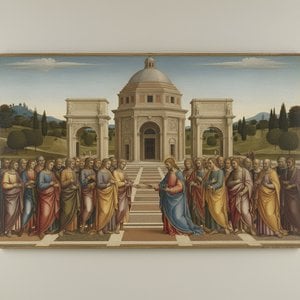
His commitment to sacred art continued through various large-scale decorations. Between 1906 and 1907, he worked on the Allegorie delle Virtù cardinali, a fresco and wall decoration. He also applied his skills to the L'Annunciazione, another fresco and wall decoration that occupied the sacred spaces of his order. These works demonstrate how his artistic practice became inseparable from his religious vocation, moving from the private study of portraits to the public service of liturgical art.
Mussini also worked on more intimate religious objects, such as the triptych L'Assunzione della Vergine tra s. Luigi Gonzaga e s. Antonio da Padova. Whether working on expansive murals or structured triptychs, his output remained focused on the intersection of his technical training and his life as a member of the Franciscan order.
Otázky a odpovědi
Kde mohu najít statistiky o dílech umělce Augusto Mussini?
Statistiky o dílech umělce Augusto Mussini naleznete na jeho profilové stránce Statistiky.
Kolik děl umělce Augusto Mussini je možné si prohlédnout?
Na stránce Všechná umělecká díla si můžete prohlédnout 1 uměleckých děl děl autora Augusto Mussini.
Mohu navštívit virtuální muzeum děl umělce Augusto Mussini?
Díla umělce Augusto Mussini si můžete prohlédnout v 3D galerii na jeho stránce 3D galerie.
Jak mohu si prohlédnout všechna umělecká díla umělce Augusto Mussini?
Veškerá díla umělce Augusto Mussini na tato webová stránka si můžete prohlédnout na jeho stránce Všechná umělecká díla.