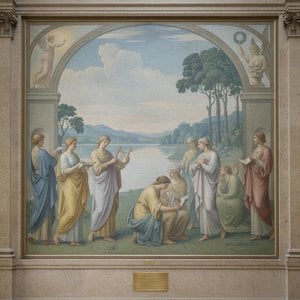
A Life of Shadows and Symbolism
Paris, 1857. The birth of Cornelius Ary Renan brings him into a lineage of intellect and art. He is the son of the scholar Ernest Renan and carries the names of his painter ancestors, Hendrik Scheffer and Ary Scheffer. His path is set early in the studios of Elie Delaunay and Pierre Puvis de Chavannes. By 1880, he begins to exhibit his vision to the public.
The canvas becomes a space for the Symbolist movement. He does not merely paint; he translates poetry into oil. His works are shaped by the rhythms of Symbolist verse and the sights gathered during travels through Asia and Algeria. Even with a physical disability, he moves through these distant landscapes, bringing their far-off textures back to his studio in Paris.
His circle includes the influential Gustave Moreau. In this atmosphere of myth and dream, Renan develops a style that leans into the ethereal. He explores themes of transformation and mythic struggle, often drawing from classical legends like those found in Ovid.
The Diver and the Dream
In 1882, a specific vision emerges: The Diver – The Coral Fisherman. This work captures the essence of his Symbolist leanings. It is a piece that later finds a home in the Columbus Museum of Art in Ohio. His brushwork handles subjects like the metamorphosis of Daphne and the tension of Charybdis and Scylla, turning mythological tales into tangible, painted realities.
His output includes several notable explorations:
- La Douleur d'Orphée
- La phalène
- Ischia, Ancient Scene
- Sappho
The Musée de la Vie Romantique in Paris holds a significant portion of his legacy. His paintings often carry the weight of his personal reflections, much like his posthumously published book of poetry, Rêves d'artiste.
Politics and the Breton Spirit
Beyond the studio, Renan is a figure of social friction. He adopts the secularist mantle of his father, leading movements in Brittany. He co-founds the organization Bretons de Paris alongside Armand Dayot. This group eventually evolves into the Ligue des bleus de Bretagne, born from a specific dissatisfaction with the conservative and clerical leanings of the Breton Regionalist Union.
His political life is as active as his artistic one, though it is cut short. He dies in Paris on 4 August 1900, shortly after the foundation of the movement he helped build. He leaves behind a body of work that remains anchored in the tension between the physical world and the symbolic realm.
Otázky a odpovědi
Jaké barvy používal/a Ary Renan nejčastěji?
Barevný profil děl umělce Ary Renan naleznete na jeho stránce Genom palety.
Kde najdu díla umělce Ary Renan uspořádaná podle barvy?
Stránka Sestavení podle barev umělce Ary Renan umožňuje prohlížet jeho díla uspořádaná podle barev.
Kde najdu díla umělce Ary Renan seskupená podle techniky?
Díla umělce Ary Renan si můžete prohlédnout podle použité techniky na jeho stránce Podle techniky.
Existuje kompletní seznam děl umělce Ary Renan?
Veškerá díla umělce Ary Renan na tato webová stránka si můžete prohlédnout na jeho stránce Všechná umělecká díla.