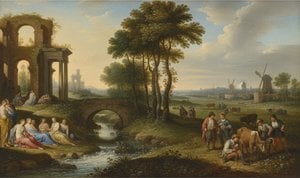
The Wanderer of the Roman Campagna
Born in the historic Dutch city of Dordrecht on November 5, 1776, Abraham Teerlink was a painter whose life and soul were inextricably linked to the light and landscapes of Southern Europe. Though his roots were firmly planted in the Netherlands, his artistic destiny unfolded far from the lowlands. Raised in a middle-class family, Teerlink’s early years were marked by a burgeoning passion for the arts, nurtured under the guidance of tutors such as Michiel Versteegh, J. Kelderman, and Arie Lamme. His initial training followed the traditional path of many young masters, beginning with the meticulous copying of established works, yet even in these early exercises, a unique sensibility began to emerge—one that would eventually move away from rigid imitation toward a profound, naturalistic observation of the world.
The trajectory of Teerlink’s career was irrevocably altered in 1807 when he was awarded the prestigious Prix de Rome. This scholarship, granted by King Louis Napoleon, provided him with the golden opportunity to travel to Paris and Rome, a journey that would redefine his aesthetic language. In Paris, he immersed himself in the epicenter of Neoclassicism, studying within the legendary studio of Jacques-Louis David. Alongside his compatriot Leendert de Koningh, Teerlink absorbed the disciplined techniques of the French Academy, yet he did not remain a mere disciple of the classical ideal. Instead, he began to weave together the structural rigor learned in Paris with a burgeoning interest in the atmospheric textures of the Italian landscape.
A Synthesis of Light and Nature
Upon arriving in Rome in 1809, Teerlink found more than just a subject for his canvases; he found a permanent home. Settling definitively in the Eternal City by 1810, he became a fixture of the international artistic community, serving as a bridge between Northern European sensibilities and the sun-drenched vistas of Italy. His mature style represents a captivating synthesis of influences. While his early mentors sought to instill the virtues of seventeenth-century Dutch landscape painting, Teerlink’s later works reveal the profound impact of David and the subtle naturalism of Valenciennes. He moved away from the formal, often stiff compositions of the older generation, opting instead for a more fluid and organic approach to the landscape.
Teerlink’s compositions are frequently characterized by their serene yet evocative depictions of the Roman countryside, often featuring cattle grazing amidst the ruins or lush greenery. His ability to capture the specific luminosity of the Campagna allowed him to create works that felt both timeless and deeply grounded in a particular moment of light. Notable works such as "Grot van Neptunus te Tivoli" and his various views of the coasts of Bajae and Miseno demonstrate his mastery over atmosphere and depth. Through his brush, the rugged terrain of the Abruzzi or the tranquil river landscapes became stages for a quiet, natural drama, where the interplay of shadow and sun evokes a sense of peaceful solitude.
Legacy and Recognition
Throughout his long life, which concluded in Rome in 1857, Teerlink achieved significant professional distinction. His talents were recognized far beyond the borders of Italy; he was awarded a knighthood in the Order of the Dutch Lion by King William I in 1839 and became an honorary member of the Royal Academy of Fine Arts in Amsterdam. As a professor of fine arts in Rome, he also played a vital role in mentoring the next generation of Dutch painters who traveled south to experience the wonders of Italy, acting as a host and guide to many young artists seeking their own artistic truths.
Though some contemporary critics later labeled his work as rétardataire—suggesting it lagged behind the rapidly evolving movements of the mid-19th century—modern appreciation celebrates Teerlink for his enduring ability to capture the soul of the landscape. His legacy resides in the quiet strength of his compositions and his successful marriage of Northern precision with Mediterranean warmth. Today, his works remain a testament to a life spent chasing the light, leaving behind a visual record of a vanished era of Roman splendor and the timeless beauty of the natural world.
Otázky a odpovědi
Kde najdu díla umělce Abraham Teerlink uspořádaná podle barvy?
Stránka Sestavení podle barev umožňuje prohlížet díla umělce Abraham Teerlink rozdělená podle barvy.
Kde a v jakém roce se narodil/a Abraham Teerlink?
Abraham Teerlink se narodil(a) v roce 1776 ve městě Dordrecht.
Která umělecká díla umělce Abraham Teerlink mají nejvyšší počet zhlédnutí?
Statistiky o dílech umělce Abraham Teerlink naleznete na jeho profilové stránce Statistiky.
Pod jakými dalšími jmény je Abraham Teerlink známý/á?
Abraham Teerlink je známý/á také pod jmény Abraham Alexander Teerlink, Alexander Teerlink, Alexandre Teerlink, Abram Teerlink, Abraham Theerlinck.